

Description
Symptoms
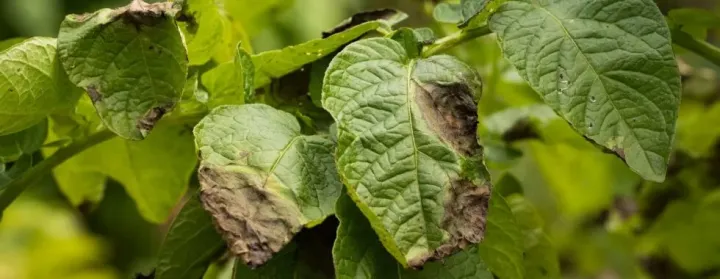
The first signs of late blight appear as small brown or dark gray spots on leaves, which rapidly expand in size. In high humidity, a characteristic whitish, fuzzy growth consisting of the pathogen's sporangiophores forms on the underside of the leaf blade.
Elongated dark lesions develop on stems and petioles, which can girdle the stem, causing wilting and collapse. The infection quickly spreads to fruits, causing firm, irregular brown lesions that rot rapidly when secondary microorganisms invade the compromised tissue.
In tubers (such as potatoes), firm, depressed, lead-gray spots form on the surface. Cutting into such a tuber reveals a rusty-brown rot that penetrates deep into the tissues, making the harvest unsuitable for long-term storage.
A specific feature is the rapid spread of the disease across the field, resembling a burn. Under favorable conditions, an entire crop can be destroyed in just a few days, requiring immediate diagnostic action at the first sign of spotting.
While most famous as a pest of Solanaceous crops, the pathogen affects a wide range of hosts, including onions, garlic, celery, asparagus, fodder beet, winter rapeseed, and even ornamental Calceolaria, where symptoms vary from tissue necrosis to general plant decline.
Pathogen
The disease is caused by the oomycete Phytophthora infestans, which is biologically closer to algae than to true fungi. It is an obligate parasite with a complex life cycle involving both asexual and sexual reproduction.
The pathogen persists in soil via oospores that can survive for several years, and spreads through infected tubers, bulbs, and plant debris. During the growing season, the infection spreads via zoospores that move through water films.
The mycelium develops inside plant tissues, breaking down cell walls and absorbing nutrients. Damage to the vascular system disrupts the plant's metabolism, ultimately leading to the death of the infected organs.
The genetic variability of the pathogen allows it to constantly adapt to new environments and overcome crop resistance, creating significant challenges for breeding programs aiming to develop immune varieties.
The pathogen's ability to reproduce actively under favorable temperatures makes it one of the most aggressive agricultural pests. Continuous monitoring of pathogen populations is essential for effective phytosanitary control.
Conditions for development
The primary factor triggering late blight is high air humidity (above 80-90%) combined with the presence of liquid water on plant surfaces from dew, fog, or frequent rainfall.
The optimal temperature range for infection and disease development is 15°C to 22°C. At temperatures above 25°C, pathogen development slows significantly, and at 30°C and above, it effectively ceases.
Dense planting, poor ventilation, and moisture retention in rows create a microclimate ideal for the rapid spread of zoospores. This is particularly critical in greenhouses and high-density field environments.
Sharp fluctuations between night and day temperatures promote heavy dew, which acts as the main transport mechanism for zoospores, allowing them to penetrate through stomata or directly through the leaf epidermis.
Imbalanced plant nutrition, especially excessive nitrogen fertilization, lowers crop immunity and makes tissues more susceptible to infection, accelerating the progression of the disease.
Why it matters
Late blight is considered the most destructive disease of potatoes and tomatoes worldwide, capable of destroying 70-80% of the crop in a short period during epidemic years.
Damage to the foliage leads to the cessation of photosynthesis, preventing tubers from reaching optimal mass, while significantly reducing their culinary quality and storage life.
In vegetable crops like onions, garlic, or celery, the disease triggers rot, rendering the produce unmarketable and unsafe for consumption due to potential toxin accumulation.
The economic loss stems from direct harvest reductions, the cost of expensive fungicide applications, and the need to dispose of contaminated produce, which otherwise serves as a source of secondary infection.
Ornamental plants like Anemone coronaria lose their aesthetic value when infected, causing financial losses for floricultural businesses and home gardens alike.
Protection
The primary protection strategy involves an integrated pest management (IPM) approach, combining agronomic, biological, and chemical methods aimed at suppressing pathogen spread.
Agronomic measures include: adhering to crop rotation, selecting resistant varieties, maintaining spatial isolation between potato and tomato plantings, timely removal and destruction of plant residues, and optimal irrigation practices.
Chemical protection involves the regular use of contact and systemic fungicides. It is crucial to rotate products with different modes of action to prevent the development of resistant pathogen strains.
Preventive treatment of crops during periods predisposed to disease (cool, humid weather) is a key practice. Systemic products are justified early in the season, while contact fungicides are better suited near harvest time.
Biological products based on Bacillus subtilis strains and other beneficial microorganisms provide good results under low infection pressure, preventing primary infections and strengthening the plant's natural immunity.
In brief
60
Affects crops
Biology
Pathogens and affected parts
Pathogens
Phytophthora cactorum· oomycete
Phytophthora cryptogea· oomycete
Phytophthora parasitica· oomycete
Phytophthora nicotianae· oomycete
Phytophthora medicaginis· oomycete
Phytophthora· oomycete
Phytophthora cambivora· oomycete
Phytophthora cinnamomi· oomycete
Phytophthora citricola· oomycete
Phytophthora citrophthora· oomycete
Phytophthora drechsleri· oomycete
Phytophthora megasperma· oomycete
Affected plant parts
rootfruitwhole plantstemseedleafflower
Content graph
Affects crops · 60
African violetAlfalfaAlmondAppleApricotAsparagusAuriculaAvocadoAzaleaBalsamBarberton daisyBlack walnutCarnationCassavaCattleyaCeleryChickpeaCitrusCoconut palmCommon hopCommon pearCottonDate palmDouglas FirDuracina cherryFairy primroseFodder beetFuchsiaGarlicGeraniumIvy-leaved pelargoniumJerusalem artichokeLettuceOnionPapayaPassiflora L.PeachPersian violetPersian walnutPistachioPlanePoinsettiaPoppy anemonePrimrosePrimula obconicaRadishRed raspberrySafflowerScented GeraniumSlipper FlowerSour cherrySoybeanStrawberrySugar CaneSunflowerSweet GumSweet PepperTobaccoWatermelonWinter rapeseed
Content graph
Connections · Late blight
Most often together:
Marketplace
Products · 1770
All 1770
Potato 658
Tomato 523
Fungicides 315
Soybean 55
Tulips 50
Plant Growth Regulator 33
Biological Products 18
Raspberry, Strawberry 14
Pepper 12
Eggplant 10
Sunflower 6
Blueberry 5




NORTHERN GLARE
Federal Research Center of Potato named after A.G. Lorch
Potato
0
0
·
94
No offers
—
Details


Community
Discussion
No discussions yet — be the first.