
Cassava
Manihot esculenta Crantz
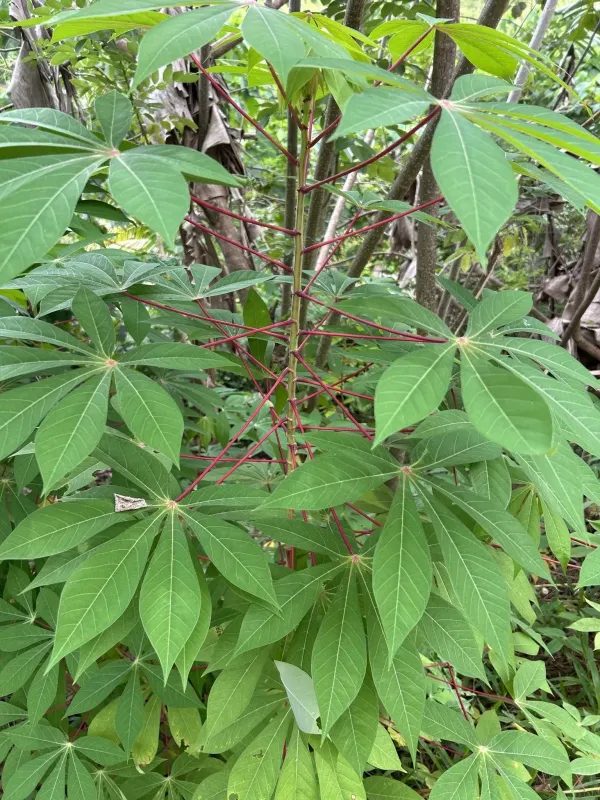
Description
Sowing dates
Cassava (Manihot esculenta Crantz) is a member of the Euphorbiaceae family. It is a perennial tropical shrub primarily propagated through stem cuttings measuring 20–30 cm in length.
Planting typically aligns with the onset of the rainy season to ensure sufficient moisture for successful establishment and root development of the cuttings.
Cuttings are placed in prepared soil either vertically, horizontally, or at an angle depending on regional agronomic practices and soil structure.
Weed management is critical during the first few months of growth, as cassava develops its canopy slowly and is sensitive to competition in its early stages.
The plant demonstrates significant biological resilience, though it performs best when provided with adequate spacing to minimize resource competition and ensure uniform root growth.
Growing requirements
Cassava is a heat-loving crop that thrives in tropical climates, requiring consistent temperatures between 25 °C and 30 °C for optimal physiological activity.
It is remarkably drought-tolerant due to its ability to store starch and water in its tubers, allowing the plant to survive during prolonged dry intervals.
High light intensity is essential for maximizing tuber yield, as shading significantly restricts the rate of photosynthesis and subsequent energy storage.
Well-drained soils are mandatory for cassava cultivation; the crop is highly susceptible to root rot in waterlogged or heavy, poorly aerated conditions.
Nutrient requirements include phosphorus for root development and potassium for starch accumulation, while excessive nitrogen application should be avoided to prevent over-abundant foliage growth.
Yield
Typical yields for cassava range from 10 to 25 tonnes per hectare, though improved cultivars and modern agronomic practices can push yields well beyond 40 tonnes.
The growth cycle spans from 8 to 18 months, depending on the variety and local climatic factors, determining the timing of crop maturity.
Cassava serves as a fundamental staple food for millions, providing a reliable source of energy in the form of dietary carbohydrates and starch.
Industrial applications are diverse, ranging from the production of high-quality tapioca starch and flour to raw materials for the bioethanol industry.
The crop remains a vital component of food security in tropical regions, thanks to its ability to yield successfully even in nutrient-poor and marginal soil environments.
Main diseases and pests
The crop is vulnerable to various fungal diseases, including anthracnose, leaf rust, and phyllosticta leaf spot, which reduce overall photosynthetic area.
Root system integrity is often threatened by pathogens causing fusarium root rot, pythium root rot, and rhizomorphous root rot, which can lead to total crop failure.
Verticillium wilt remains a serious concern, attacking the plant's vascular system and leading to rapid wilting and necrosis of the foliage and tubers.
Effective management requires the use of clean, disease-free planting material and the implementation of robust crop rotation strategies to minimize soil-borne pathogens.
Pests such as spider mites and whiteflies not only cause direct physical damage to the leaves but also frequently act as vectors for debilitating viral diseases.
Harvesting
Harvesting is performed by pulling the plant or digging out the tubers, requiring care to avoid mechanical damage that could lead to rapid spoilage.
Post-harvest deterioration is a major issue, as fresh cassava roots have a very short shelf life and begin to decay within days due to enzymatic browning.
Immediate processing into dried chips, flour, or starch is the standard strategy for preserving the harvested produce and adding value to the crop.
Harvest time is typically determined by the yellowing and shedding of leaves, which marks the peak accumulation of starch in the storage roots.
Strategic timing of the harvest is essential, as leaving the tubers in the ground for too long can lead to fiber development, reducing the quality and starch content.