
Phytophthora root rot of alfalfa
Phytophthora medicaginis
Description
How to identify
The causative agent of the disease is Phytophthora medicaginis, a soil-borne oomycete belonging to the kingdom Stramenopila. This pathogen is highly specialized and thrives in saturated soil conditions.
Taxonomically, it is placed within the Peronosporaceae family. Unlike true fungi, this organism requires free water in the soil profile to release zoospores that swim toward the root hairs of the host plant.
The life cycle includes the production of sporangia and motile zoospores, which facilitate infection. When conditions become unfavorable, the pathogen forms thick-walled oospores, which can persist in the soil for many years.
This pathogen is primarily spread through infested soil moved by farm equipment, as well as by surface runoff during heavy rainfall. Once established in a field, it is very difficult to eradicate.
Identification is often based on the observation of specific environmental conditions, such as poorly drained spots in the field where plants show signs of sudden wilting and decline.
What it damages
The primary host is alfalfa (Medicago sativa). The pathogen attacks the root system, causing significant damage that leads to stand thinning and reduced forage production throughout the growing season.
Infection results in the destruction of the taproot and secondary root hairs, which impairs the plant's ability to absorb water and essential nutrients. This often leads to the death of the plants.
The economic impact is substantial, as farmers face reduced yields and the necessity to replant fields sooner than planned. This creates a cycle of increased costs and lost income for agricultural producers.
Young stands are particularly vulnerable, especially if the soil remains saturated for extended periods following seedling emergence. Severe infections can destroy entire sections of a field.
Beyond yield loss, the disease degrades the quality of the forage, as unhealthy plants are more susceptible to secondary invaders and exhibit poor regrowth after cuttings.
Signs of infestation
Early symptoms include yellowing and wilting of the leaves. Plants may appear stunted and exhibit chlorosis, often mimicking symptoms of nitrogen or moisture deficiency.
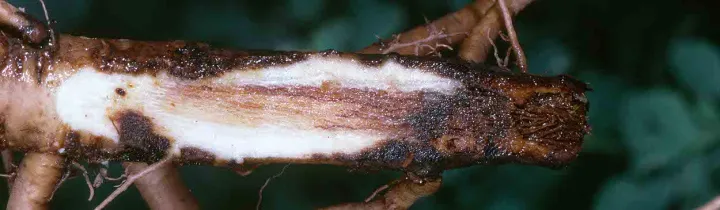
The most diagnostic sign is found on the roots. Infected roots show distinct, water-soaked, yellowish-brown lesions that eventually turn dark brown or black as the tissue decays.
When the taproot is affected, the plant can be easily pulled from the ground because the lateral root system has been destroyed. The roots appear soft and rotted upon inspection.
A cross-section of the root will reveal a sharp boundary between the necrotic, discolored tissue and the remaining healthy, white tissue, which is typical for Phytophthora infections.
Infected plants typically die in circular patches or along low-lying areas of the field where water tends to collect after irrigation or rainfall events.
Control measures
The most effective management strategy is to plant alfalfa in well-drained soils. Improving drainage through tiling or land leveling is essential for preventing the buildup of water-saturated conditions.
Selecting resistant alfalfa cultivars is a critical practice. Modern breeding programs have developed varieties with high levels of resistance to Phytophthora medicaginis.
Avoid excessive irrigation. Managing water application to ensure that the soil is not kept constantly saturated is vital for suppressing the activity and motility of the zoospores.
Rotation with non-host crops can help reduce the population of oospores in the soil over time. Proper field hygiene and equipment cleaning help prevent the spread of the pathogen to new fields.
- Ensure proper field drainage and land leveling.
- Plant resistant or tolerant alfalfa varieties.
- Avoid over-irrigation of fields.
- Clean machinery to prevent soil movement between fields.
Causes diseases · 1
Discussion
No discussions yet — be the first.