
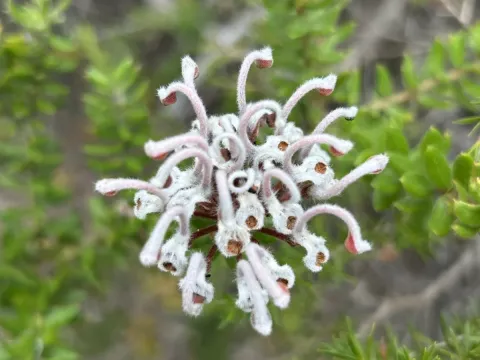
Grevillea
Grevillea R. Br. corr. R. Br.
Grevillea is a large genus of evergreen trees and shrubs belonging to the Proteaceae family. Native primarily to Australia and New Guinea, these plants have evolved in diverse ecosystems, ranging from coastal scrub to temperate rainforests, which dictates their specific agronomic needs.
What the section contains
 Fern-leaved grevillea
Grevillea pteridifolia Knight
Fern-leaved grevillea
Grevillea pteridifolia Knight
 Grevillea
 formosa x Grevillea banksii
Grevillea
Grevillea formosa x Grevillea banksii
 Grevillea
 juniperina x grevillea victoriae
Grevillea
Grevillea juniperina x grevillea victoriae
 Grevillea
 leiophylla x humilis ssp maritima
Grevillea
Grevillea leiophylla x humilis ssp maritima
 Grevillea
 pteridifolia x Grevillea banksii
Grevillea
Grevillea pteridifolia x Grevillea banksii
 Grevillea
 x variegata
Grevillea
Grevillea x variegata
 Grevillea alpina
 Lindl.
Grevillea alpina x Grevillea lavandulacea
Grevillea alpina x Grevillea lavandulacea
Grevillea alpina
Grevillea alpina Lindl.
Grevillea alpina x Grevillea lavandulacea
Grevillea alpina x Grevillea lavandulacea
 Grevillea banksii
 R. Br.
Grevillea banksii
Grevillea banksii R. Br.
 Grevillea bipinnatifida
 R. Br.
Grevillea bipinnatifida hybrid
Grevillea bipinnatifida x Grevillea thyrsoides subsp. pustulata
Grevillea bipinnatifida
Grevillea bipinnatifida R. Br.
Grevillea bipinnatifida hybrid
Grevillea bipinnatifida x Grevillea thyrsoides subsp. pustulata
 Grevillea crithmifolia
 R. Br.
Grevillea crithmifolia
Grevillea crithmifolia R. Br.
 Grevillea fililoba
Grevillea fililoba
Grevillea fililoba
 Grevillea formosa
 McGill.
Grevillea formosa
Grevillea formosa McGill.
 Grevillea humilis
Grevillea hybrid
Grevillea bipinnatifida x Grevillea banksii var. forsteri
Grevillea hybrid
Grevillea bipinnatifida x G. pteridifolia
Grevillea humilis
Grevillea humilis
Grevillea hybrid
Grevillea bipinnatifida x Grevillea banksii var. forsteri
Grevillea hybrid
Grevillea bipinnatifida x G. pteridifolia
 Grevillea johnsonii
 McGill.
Grevillea johnsonii
Grevillea johnsonii McGill.
 Grevillea juniperina
 x Grevillea rhyolitica
Grevillea juniperina
Grevillea juniperina x Grevillea rhyolitica
 Grevillea lanigera
 A. Cunn. ex R. Br.
Grevillea lanigera
Grevillea lanigera A. Cunn. ex R. Br.
 Grevillea lanigera x lavandulacea
Grevillea lanigera x lavandulacea
Grevillea lanigera x lavandulacea
 Grevillea laurifolia
 Sieber ex Spreng.
Grevillea leiophylla
Grevillea leiophylla
Grevillea laurifolia
Grevillea laurifolia Sieber ex Spreng.
Grevillea leiophylla
Grevillea leiophylla
 Grevillea longistyla
Grevillea longistyla
Grevillea longistyla
 Grevillea longistyla x johnsonii
Hybrids between Grevillea longistyla and Grevillea johnsonii
Grevillea longistyla x johnsonii
Hybrids between Grevillea longistyla and Grevillea johnsonii
 Grevillea longistyla x venusta
Grevillea longistyla x venusta
Grevillea longistyla x venusta
 Grevillea obtusifolia
 Meisn.
Grevillea obtusifolia
Grevillea obtusifolia Meisn.
 Grevillea preissii
Grevillea preissii hybrid
Grevillea preissii x Grevillea fililoba
Grevillea preissii
Grevillea preissii
Grevillea preissii hybrid
Grevillea preissii x Grevillea fililoba
 Grevillea rhyolitica
 Makinson
Grevillea rhyolitica
Grevillea rhyolitica Makinson
 Grevillea rosmarinifolia x grevillea lanigera
Grevillea rosmarinifolia x grevillea lanigera
Grevillea rosmarinifolia x grevillea lanigera
 Grevillea stenomera
Grevillea stenomera
Grevillea stenomera
 Grevillea thelemanniana
 Hügel ex Endl.
Grevillea thelemanniana
Grevillea thelemanniana Hügel ex Endl.
 Grevillea thyrsoides
 Meisn.
Grevillea thyrsoides
Grevillea thyrsoides Meisn.
 Grevillea thyrsoides pustulata
Grevillea thyrsoides Meisn. subsp. pustulata Olde & Marriott
Grevillea thyrsoides pustulata
Grevillea thyrsoides Meisn. subsp. pustulata Olde & Marriott
 Grevillea venusta
Grevillea venusta
Grevillea venusta
 Hybrid Grevillea victoriae and Grevillea rhyolitica
Hybrids between Grevillea victoriae and Grevillea rhyolitica
Hybrid Grevillea victoriae and Grevillea rhyolitica
Hybrids between Grevillea victoriae and Grevillea rhyolitica
 Hybrids of Grevillea rosmarinifolia and Grevillea alpina
Hybrids between Grevillea rosmarinifolia and Grevillea alpina
Juniper-leaf grevillea
Grevillea juniperina R. Br. x Grevillea lanigera A. Cunn. ex R. Br.
Juniper-leaf grevillea
Grevillea juniperina R. Br.
Hybrids of Grevillea rosmarinifolia and Grevillea alpina
Hybrids between Grevillea rosmarinifolia and Grevillea alpina
Juniper-leaf grevillea
Grevillea juniperina R. Br. x Grevillea lanigera A. Cunn. ex R. Br.
Juniper-leaf grevillea
Grevillea juniperina R. Br.
 Lavender grevillea
Grevillea lavandulacea Schltdl.
Rosemary grevillea
Grevillea rosmarinifolia A. Cunn.
Lavender grevillea
Grevillea lavandulacea Schltdl.
Rosemary grevillea
Grevillea rosmarinifolia A. Cunn.
 Royal Grevillea
Grevillea victoriae
Royal Grevillea
Grevillea victoriae
 Silky grevillea
Grevillea sericea (Sm.) R. Br.
Silky grevillea
Grevillea sericea (Sm.) R. Br.
 Silky oak
Grevillea robusta A. Cunn. ex R. Br.
Silky oak
Grevillea robusta A. Cunn. ex R. Br.
Grevillea
Successful cultivation requires soil that is acidic, well-drained, and low in phosphorus. Because they are highly sensitive to phosphorus toxicity, standardized agricultural fertilizers must be avoided in favor of formulas specifically designed for Proteaceae members.
The culture thrives in full sun exposure and requires warm temperatures to maintain active growth. In cooler climates, they are typically cultivated as greenhouse specimens or container plants, as they are generally not frost-tolerant and suffer significantly under freezing conditions.
Water management is critical for Grevillea, as they are susceptible to root rot in waterlogged substrates. Regular but sparse watering with soft, low-salinity water is essential to simulate their natural habitat conditions and ensure optimal nutrient uptake.
Economically, Grevillea is prized for its high ornamental value in landscape architecture and the cut flower industry. Some larger timber species are also cultivated for their high-quality wood, which is valued for its durability and aesthetic pattern in furniture manufacturing.
Root rot, primarily caused by the oomycete Phytophthora, is the most destructive threat to Grevillea. It thrives in poorly drained soils and can quickly kill mature plants if the environment remains excessively damp.
Chlorosis is a common physiological disorder, often appearing as yellowing foliage. This is frequently triggered by an improper pH balance in the soil, which prevents the plant from absorbing iron and manganese efficiently.
Pest pressure often includes scale insects, which feed on sap and secrete honeydew. This substance attracts sooty mold, which further interferes with photosynthesis and diminishes the aesthetic quality of the shrub.
Mealybugs are another prevalent concern, particularly in greenhouse environments. These pests gather in clusters in protected areas, making manual control difficult and often requiring systemic pesticide interventions.
To maintain plant health, it is vital to avoid over-fertilizing and to maintain adequate airflow around the foliage. Integrated pest management strategies are recommended to mitigate the impact of insects without stressing the plant's delicate root system.