
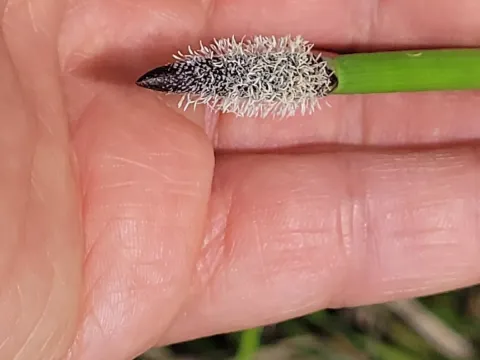
Eleocharis
Eleocharis
Eleocharis, commonly known as spikerush, belongs to the Cyperaceae family and is a versatile perennial plant adapted to aquatic or semi-aquatic habitats. Planting is best initiated in the spring once water and soil temperatures reach approximately 15 to 20 degrees Celsius.
What the section contains
 Baldwin's Spikerush
Eleocharis baldwinii
Baldwin's Spikerush
Eleocharis baldwinii
 Beaked spikerush
Eleocharis rostellata
Beaked spikerush
Eleocharis rostellata
 Blunt spikerush
Eleocharis obtusa
Blunt spikerush
Eleocharis obtusa
 Bonariensis spikerush
Eleocharis bonariensis
Bristle-leaf spikerush
Eleocharis setifolia
Bonariensis spikerush
Eleocharis bonariensis
Bristle-leaf spikerush
Eleocharis setifolia
 Carniolan spike-rush
Eleocharis carniolica
Carniolan spike-rush
Eleocharis carniolica
 Chinese water chestnut
Eleocharis dulcis
Chinese water chestnut
Eleocharis dulcis
 Common spikerush
Eleocharis palustris
Common spikerush
Eleocharis palustris
 Creeping spike-rush
Eleocharis macrostachya
Creeping spike-rush
Eleocharis macrostachya
 Dwarf hairgrass
Eleocharis parvula
Eleocharis caduca
Eleocharis caduca
Dwarf hairgrass
Eleocharis parvula
Eleocharis caduca
Eleocharis caduca
 Eleocharis confervoides
Eleocharis confervoides
Eleocharis confervoides
 Eleocharis congesta
Eleocharis decoriglumis
Eleocharis decoriglumis
Eleocharis congesta
Eleocharis congesta
Eleocharis decoriglumis
Eleocharis decoriglumis
 Eleocharis dombeyana
Eleocharis dombeyana
Eleocharis dombeyana
 Eleocharis elegans
Eleocharis erecta
Eleocharis erecta
Eleocharis elegans
Eleocharis elegans
Eleocharis erecta
Eleocharis erecta
 Eleocharis fistulosa
Eleocharis fistulosa
Eleocharis fistulosa
 Eleocharis mamillata
Eleocharis mamillata
Eleocharis mamillata
 Eleocharis mammillata
Eleocharis mammillata
Eleocharis mammillata
 Eleocharis minuta
Eleocharis minuta
Eleocharis minuta
 Eleocharis mitrocarpa
Eleocharis mutata
Eleocharis mutata
Eleocharis naumaniana
Eleocharis naumaniana
Eleocharis mitrocarpa
Eleocharis mitrocarpa
Eleocharis mutata
Eleocharis mutata
Eleocharis naumaniana
Eleocharis naumaniana
 Eleocharis nigrescens
Eleocharis nigrescens
Eleocharis nigrescens
 Eleocharis ochreata
Eleocharis ochrostachys
Eleocharis ochrostachys
Eleocharis ochreata
Eleocharis ochreata
Eleocharis ochrostachys
Eleocharis ochrostachys
 Eleocharis parvinux
Eleocharis parvinux
Eleocharis parvinux
 Eleocharis pellucida
Eleocharis pellucida
Eleocharis pellucida
 Eleocharis retroflexa
Eleocharis retroflexa
Eleocharis retroflexa
 Eleocharis sphacelata
Eleocharis spiralis
Eleocharis spiralis
Eleocharis sphacelata
Eleocharis sphacelata
Eleocharis spiralis
Eleocharis spiralis
 Eleocharis tetraquetra
Eleocharis trilophus
Eleocharis trilophus
Eleocharis valleculosa
Eleocharis valleculosa
Eleocharis tetraquetra
Eleocharis tetraquetra
Eleocharis trilophus
Eleocharis trilophus
Eleocharis valleculosa
Eleocharis valleculosa
 Eleocharis wichurae
Eleocharis wichurae
Eleocharis wichurae
 Eleocharis yokoscensis
Eleocharis yokoscensis
Eleocharis yokoscensis
 Few-flowered spike-rush
Eleocharis quinqueflora
Flatstem spikerush
Eleocharis complanata
Few-flowered spike-rush
Eleocharis quinqueflora
Flatstem spikerush
Eleocharis complanata
 Gulf Coast spikerush
Eleocharis cellulosa
Gulf Coast spikerush
Eleocharis cellulosa
 Knotted spikerush
Eleocharis interstincta
Knotted spikerush
Eleocharis interstincta
 Knotted spikerush
Eleocharis nodulosa
Knotted spikerush
Eleocharis nodulosa
 Kuroguwai
Eleocharis kuroguwai
Kuroguwai
Eleocharis kuroguwai
 Little spikerush
Eleocharis exigua
Little spikerush
Eleocharis exigua
 Little spikerush
Eleocharis minima
Little spikerush
Eleocharis minima
 Many-stemmed spikerush
Eleocharis multicaulis
Many-stemmed spikerush
Eleocharis multicaulis
 Needle spikerush
Eleocharis acicularis
Needle spikerush
Eleocharis acicularis
 Ovate spikerush
Eleocharis ovata
Philippine spikerush
Eleocharis philippensis
Ovate spikerush
Eleocharis ovata
Philippine spikerush
Eleocharis philippensis
 Purple spikerush
Eleocharis atropurpurea
Purple spikerush
Eleocharis atropurpurea
 Sand spikerush
Eleocharis montevidensis
Sand spikerush
Eleocharis montevidensis
 Sellow's spikerush
Eleocharis sellowiana
Sellow's spikerush
Eleocharis sellowiana
 Sharp spikerush
Eleocharis acuta
Slender spikerush
Eleocharis attenuata
Sharp spikerush
Eleocharis acuta
Slender spikerush
Eleocharis attenuata
 Slender spikerush
Eleocharis filiculmis
Slender spikerush
Eleocharis filiculmis
 Slender spikerush
Eleocharis limosa
Slender spikerush
Eleocharis limosa
 Small spike-rush
Eleocharis pusilla
Small spike-rush
Eleocharis pusilla
 Spike rush
Eleocharis geniculata
Spike rush
Eleocharis geniculata
 Uniglumed spikerush
Eleocharis uniglumis
Uniglumed spikerush
Eleocharis uniglumis
 Ussuri spikerush
Eleocharis ussuriensis
Ussuri spikerush
Eleocharis ussuriensis
Eleocharis
May is considered the optimal window for establishing new crops, allowing the root systems to adapt before the intense growth of the summer season. In a controlled cultivation environment, precise spacing is critical to ensure uniform nutrient uptake and plant health.
Seed propagation requires constant high moisture and specific soil conditions, usually involving shallow planting in organic-rich mud. As the seeds are extremely small, they require light exposure to trigger germination, making deep burial counterproductive.
For commercial production, vegetative propagation using rhizome division is generally preferred as it yields faster results and ensures genetic consistency. This method allows growers to rapidly fill plantation zones and maintain the uniformity of the crop.
Agrotechnical planning must include containment strategies, as Eleocharis is highly prolific and can become invasive if not managed within designated boundaries, potentially encroaching on surrounding agricultural zones.
Eleocharis is strictly dependent on high moisture levels, thriving in waterlogged soils or standing water. It favors silty, nutrient-rich substrates with a neutral to slightly acidic pH, which support vigorous rhizome and shoot development.
As a light-demanding plant, it requires full sun exposure to maximize biomass production. Shading from trees or taller vegetation significantly hampers growth, leading to weak, etiolated shoots and a decline in overall plantation density.
Stable, moderate temperatures are ideal; while the plant can tolerate short periods of frost, consistent warmth is necessary for optimal development. Extreme temperature fluctuations can inhibit root growth and metabolic processes.
Mineral nutrition must focus on the availability of nitrogen and potassium, which are essential for leaf and shoot synthesis. It is vital to monitor water salinity and mineral content to avoid environmental stress on the plant.
Maintenance of water clarity is essential, as the proliferation of algae or invasive weeds can compete for space and nutrients, significantly reducing the vigor of the Eleocharis crop.
Yield potential in Eleocharis is determined by effective water level management and the fertility of the underlying substrate. When managed correctly, it can provide significant quantities of green biomass for use as fertilizer or fodder.
Certain species, particularly Eleocharis dulcis, are cultivated for their edible corms, which are highly valued in culinary applications. Under optimal conditions, yields for these tubers can range between 5 to 15 tons per hectare.
Productivity is typically measured by dry matter accumulation, which correlates directly with shoot density. Rigorous weed management during the establishment phase is essential for maximizing final harvest yields.
The accumulation of starch in the corms is triggered by the reduction of water levels towards the end of the growth cycle. Failure to manage this transition accurately can result in poor tuber quality and increased susceptibility to post-harvest decay.
Mechanized harvesting on dedicated plantations is increasingly common, though it requires equipment designed for low ground pressure to avoid compacting the delicate wetland soil and damaging the root systems.
Fungal diseases, such as rust and various forms of rot, are the primary threats, especially in environments with poor circulation and excessive moisture. Prevention relies on maintaining proper plant density and water flow.
Insects and mollusks that graze on young shoots pose significant risks to crop development. Chemical control is often restricted due to the aquatic nature of the habitat, necessitating the use of biological control methods.
Abiotic stresses, including spikes in water salinity or sudden changes in pH, can quickly lead to widespread plantation die-off. Routine monitoring of water quality is a standard requirement for professional agronomists.
Invasive species like reeds or cattails can easily outcompete Eleocharis if left unchecked. A systematic approach to weeding and site maintenance is vital to protecting the integrity of the crop area.
Quarantine measures during the introduction of new plant material are critical to prevent the spread of diseases, as aquatic ecosystems can rapidly transmit pathogens across a site once they are established.
Harvesting the aerial biomass involves mechanical mowing during the early flowering phase when nutrient levels in the tissues are at their peak. For corm production, fields must be drained before harvesting begins.
After excavation, the corms require immediate cleaning to remove mud and outer husks. Proper post-harvest storage at cool temperatures is essential to maintain freshness and prevent rapid quality loss.
When harvested as fodder, the material is typically dried or processed into silage. Ensuring the harvested product is free from impurities and debris is necessary for maintaining the market value of the forage.
Mechanical harvesting equipment must be precisely calibrated to avoid bruising the corms, as even minor physical damage can lead to rapid decay during storage and transportation processes.
Logistics must be streamlined, as the plant is highly perishable once removed from the water. Rapid handling is required to minimize exposure to sunlight and heat, which accelerate degradation and loss of value.