
Creeping spike-rush
Eleocharis macrostachya
Description
Sowing dates
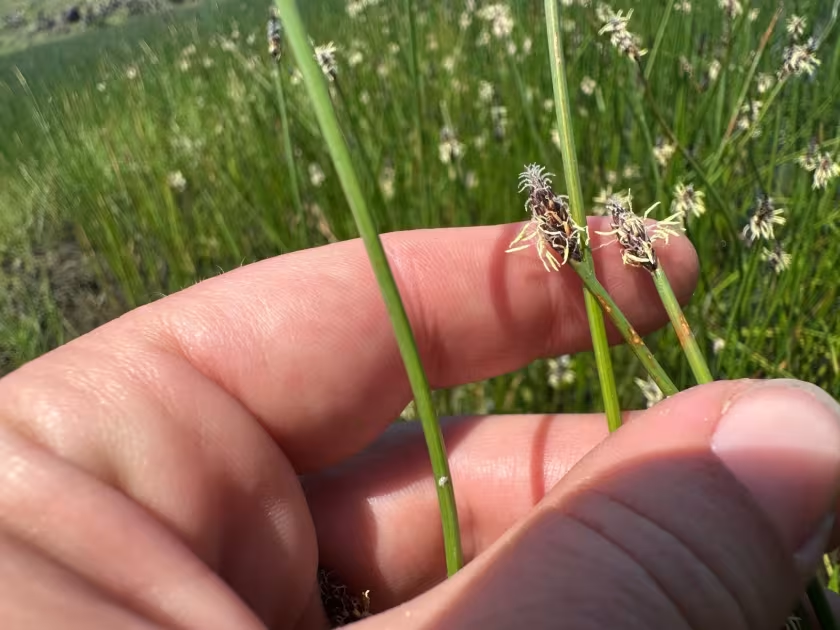
Eleocharis macrostachya, commonly known as creeping spike-rush, is a perennial aquatic plant belonging to the Cyperaceae family. It is primarily managed through the propagation of its extensive underground rhizome network.
The optimal time for planting is early spring. Rhizomes should be planted into saturated soil at a depth of about 5–8 cm to ensure immediate contact with water and allow the root system to establish quickly in the moist environment.
When seeding is chosen, the seeds require specific conditions for germination, including high moisture levels and potential cold stratification to break dormancy. Sowing should be timed for late fall or early spring to mimic natural cycles.
Plant spacing should be adjusted based on the objective, such as erosion control or forage production. Closer spacing is generally recommended for site stabilization, allowing the plants to form a cohesive mat more rapidly.
Maintenance during the establishment phase is critical. The site must remain consistently wet, as the plant lacks the drought tolerance of typical upland crops and relies on constant moisture for photosynthesis and structural integrity.
Growing requirements
This species requires high light exposure to thrive and maximize its biomass production. Shady environments significantly inhibit its growth rate and decrease the density of the plant colonies.
The soil should ideally be saturated, consisting of mucky, peaty, or clay-heavy soils. The plant is highly effective at growing in nutrient-rich sediments, which makes it an excellent candidate for constructed wetlands and phytoremediation.
Environmental adaptability is a key trait, as the species tolerates periodic flooding and varying water depths. It is well-suited to temperate climates where it can experience distinct seasonal growth cycles and cold-hardy winter dormancy.
Optimum growth occurs at temperatures ranging between 15°C and 28°C. During the peak of the growing season, adequate water supply is more important than ambient temperature for the continued expansion of the rhizome mats.
Creeping spike-rush is a hardy plant that shows resilience against environmental stressors common in aquatic habitats, including low oxygen levels in the substrate and fluctuations in water pH.
Harvesting
Harvesting strategies depend on the end-use of the biomass. When grown as forage, the crop should be harvested before the plants produce seed heads to ensure the highest protein content and digestibility for livestock.
Mechanical harvesting in wetland environments requires specialized machinery equipped with wide tracks or flotation devices to prevent damage to the delicate root mats and the surrounding wet soil structure.
In cases of ecological restoration or water quality management, harvesting is often done once per year at the end of the growth cycle to remove sequestered nutrients from the wetland system effectively.
After collection, the biomass can be used for hay production if dried properly or incorporated into silage. Due to its high fiber content, it acts as a valuable roughage component in animal diets.
If the biomass is used for composting, it provides a stable carbon-rich material that decomposes well and helps in soil amendment when applied to marginal lands for improvement purposes.