
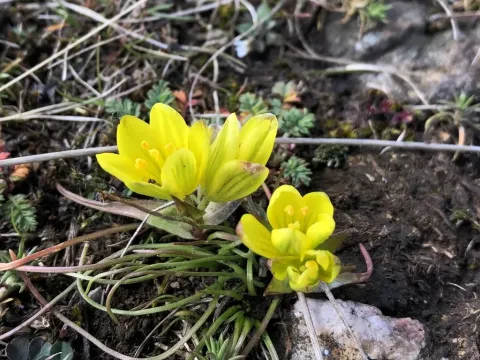
Gagea
Gagea
Gagea is a genus of perennial bulbous plants belonging to the Liliaceae family. These plants are recognized as classic spring ephemerals, completing their life cycle shortly after the spring thaw.
What the section contains
 Crimean Star of Bethlehem
Gagea taurica
Crimean Star of Bethlehem
Gagea taurica
 Field Gagea
Gagea arvensis
Field Gagea
Gagea arvensis
 Gagea
Gagea hybrids
Gagea alexeenkoana
Gagea alexeenkoana
Gagea amblyopetala
Gagea amblyopetala
Gagea
Gagea hybrids
Gagea alexeenkoana
Gagea alexeenkoana
Gagea amblyopetala
Gagea amblyopetala
 Gagea artemczukii
Gagea artemczukii
Gagea artemczukii
 Gagea bohemica
Gagea bohemica
Gagea bohemica
 Gagea bulbifera
Gagea bulbifera
Gagea bulbifera
 Gagea commutata
Gagea commutata
Gagea commutata
 Gagea dayana
Gagea dubia
Gagea dubia
Gagea dayana
Gagea dayana
Gagea dubia
Gagea dubia
 Gagea fibrosa
Gagea fibrosa
Gagea fibrosa
 Gagea foliosa
Gagea germainae
Gagea germainae
Gagea foliosa
Gagea foliosa
Gagea germainae
Gagea germainae
 Gagea granatellii
Gagea granatellii
Gagea granatellii
 Gagea hiensis
Gagea hiensis
Gagea hiensis
 Gagea libanotica
Gagea luteoides
Gagea luteoides
Gagea maeotica
Gagea maeotica
Gagea mauritanica
Gagea mauritanica
Gagea libanotica
Gagea libanotica
Gagea luteoides
Gagea luteoides
Gagea maeotica
Gagea maeotica
Gagea mauritanica
Gagea mauritanica
 Gagea micrantha
Gagea micrantha
Gagea micrantha
 Gagea minima
Gagea minima
Gagea minima
 Gagea nakaiana
Gagea nakaiana
Gagea nakaiana
 Gagea peduncularis
Gagea peduncularis
Gagea peduncularis
 Gagea podolica
Gagea podolica
Gagea podolica
 Gagea polidorii
Gagea polidorii
Gagea polidorii
 Gagea pusilla
Gagea pusilla
Gagea pusilla
 Gagea reverchonii
Gagea reverchonii
Gagea reverchonii
 Gagea serotina
Gagea serotina
Gagea serotina
 Gagea soleirolii
Gagea sulfurea
Gagea sulfurea
Gagea soleirolii
Gagea soleirolii
Gagea sulfurea
Gagea sulfurea
 Gagea transversalis
Gagea transversalis
Gagea transversalis
 Gagea triflora
Gagea ucrainica
Gagea ucrainica
Gagea triflora
Gagea triflora
Gagea ucrainica
Gagea ucrainica
 Gagea wilczekii
Gagea wilczekii
Gagea wilczekii
 Glacier Gagea
Gagea glacialis
Glacier Gagea
Gagea glacialis
 Gold-star lily
Gagea chrysantha
Gold-star lily
Gagea chrysantha
 Grainy star-of-Bethlehem
Gagea granulosa
Grainy star-of-Bethlehem
Gagea granulosa
 Greek gagea
Gagea graeca
Greek gagea
Gagea graeca
 Green-yellow gagea
Gagea chlorantha
Green-yellow gagea
Gagea chlorantha
 Koch's star-of-Bethlehem
Gagea caroli-kochii
Koch's star-of-Bethlehem
Gagea caroli-kochii
 Liotard's star-of-Bethlehem
Gagea liotardii
Liotard's star-of-Bethlehem
Gagea liotardii
 Lusitanian star-of-Bethlehem
Gagea lusitanica
Lusitanian star-of-Bethlehem
Gagea lusitanica
 Meadow star-of-Bethlehem
Gagea pratensis
Meadow star-of-Bethlehem
Gagea pratensis
 Nevada star-of-Bethlehem
Gagea nevadensis
Nevada star-of-Bethlehem
Gagea nevadensis
 Reticulated star-of-Bethlehem
Gagea reticulata
Reticulated star-of-Bethlehem
Gagea reticulata
 Spathulate Star-of-Bethlehem
Gagea spathacea
Spathulate Star-of-Bethlehem
Gagea spathacea
 Three-nerved Gagea
Gagea trinervia
Three-nerved Gagea
Gagea trinervia
 Yellow star-of-Bethlehem
Gagea lutea
Yellow star-of-Bethlehem
Gagea lutea
Gagea
Native to temperate regions of Eurasia and North Africa, Gagea species thrive in diverse habitats, including open grasslands, woodlands, and rocky slopes. They are highly adapted to climates with distinct seasonal temperature changes.
Soil requirements for Gagea include well-drained, nutrient-rich conditions. The plants require high light intensity during their active growth phase in early spring before the canopy of surrounding vegetation closes.
Cultivation practices for Gagea focus on providing stable soil moisture during the spring months. The plant propagates effectively through small bulbils, which allow for rapid expansion in favorable environmental conditions.
Economically, Gagea is valued primarily as a source of early nectar for pollinators and as a botanical component in ornamental landscape designs. Its biological resilience makes it a low-maintenance species for suitable garden environments.
The primary threat to Gagea is the development of fungal rot in the bulb, often caused by waterlogged soil conditions during the dormant summer period. Proper drainage is the most critical factor for success.
Pests such as onion flies and various bulb-eating mites can pose significant problems. These organisms target the underground storage organs, weakening the plant and potentially leading to loss of clusters.
Common diseases include grey mold (Botrytis) and Fusarium wilt, which proliferate in damp and poorly ventilated conditions. Managing humidity around the bulb zone is essential for preventing these issues.
Chemical control should be approached with caution, prioritizing cultural practices like crop rotation and careful site selection. Ensuring that the bulbs are planted in appropriate substrates helps maintain plant health.
Regular monitoring of the site during the early growing season allows for early detection of pest activity. Removing affected plants promptly can help prevent the spread of soil-borne pathogens within the growing area.