
Field Gagea
Gagea arvensis
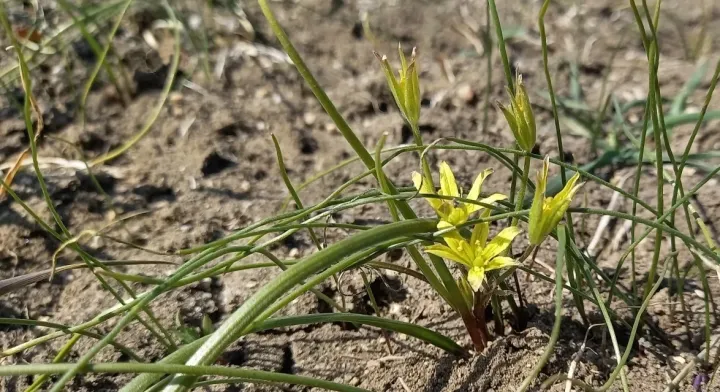
Description
Growing requirements
Field Gagea (Gagea arvensis) is a perennial bulbous plant belonging to the Liliaceae family. It is recognized as a classic spring ephemeral, utilizing the moist conditions of early spring to complete its growth cycle before the canopy of later-developing vegetation closes.
The plant grows from small bulbs enclosed in a common tunic, typically reaching a height of 10 to 20 centimeters. It features slender basal leaves and yellow, star-shaped flowers that appear in early spring, often creating dense colonies in undisturbed patches of soil.
Regarding habitat requirements, this species favors well-lit, open areas with moderate soil fertility. It thrives on sandy or loamy soils that provide adequate drainage, as the bulbs are sensitive to prolonged waterlogging, particularly during the dormant summer phase.
In terms of agricultural significance, Field Gagea acts as an opportunistic weed. Its life cycle is entirely adapted to cold-tolerant growth, allowing it to emerge while soil temperatures are still too low for most summer crops, thereby avoiding direct competition for sunlight.
The plant's strategy is to rapidly accumulate carbohydrate reserves in its bulbs, ensuring survival through the dormant season. Once the seeds have matured, the above-ground biomass senesces rapidly, which allows the plant to evade subsequent agricultural interventions like weeding or mowing.
Main diseases and pests
Due to its specialized timing as a spring ephemeral, Field Gagea exhibits high resistance to most agricultural pests that target conventional crops. It is rarely affected by the insects that damage leaves or stems later in the season.
Plant diseases such as fungal infections are uncommon, though bulbs may succumb to rot if soil conditions become excessively saturated during the summer dormancy period.
Mechanical tillage represents the most significant threat to the population. Deep plowing can displace bulbs, affecting the density of the patches that emerge the following spring.
Chemical control via broad-spectrum herbicides is usually effective during the active growth phase, provided that the application timing aligns with the early developmental stages of the weed.
Overall, Field Gagea is not considered a primary threat to crop yields because its developmental peak occurs significantly earlier than that of most major food crops.