
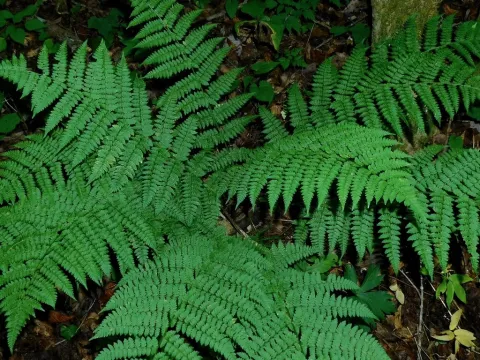
Wood fern
Dryopteris
The Wood fern (Dryopteris), a member of the Dryopteridaceae family, is a diverse genus of ferns found primarily in temperate forests. These plants are characterized by their robust rhizomes and large, pinnate fronds that form elegant rosettes in the landscape.
What the section contains
 Aiton's wood fern
Dryopteris aitoniana
Aiton's wood fern
Dryopteris aitoniana
 Ardeche shield fern
Dryopteris ardechensis
Ardeche shield fern
Dryopteris ardechensis
 Azores wood fern
Dryopteris azorica
Azores wood fern
Dryopteris azorica
 Borrer's Male Fern
Dryopteris borreri
Borrer's Male Fern
Dryopteris borreri
 Broad buckler-fern
Dryopteris dilatata
Broad buckler-fern
Dryopteris dilatata
 Champion's Wood Fern
Dryopteris championii
Champion's Wood Fern
Dryopteris championii
 Chinese wood fern
Dryopteris chinensis
Chinese wood fern
Dryopteris chinensis
 Clinton's wood fern
Dryopteris clintoniana
Clinton's wood fern
Dryopteris clintoniana
 Coastal Wood Fern
Dryopteris arguta
Coastal Wood Fern
Dryopteris arguta
 Copper shield fern
Dryopteris erythrosora
Copper shield fern
Dryopteris erythrosora
 Corley's buckler fern
Dryopteris corleyi
Crested wood fern
Dryopteris cristata
Corley's buckler fern
Dryopteris corleyi
Crested wood fern
Dryopteris cristata
 Crisp-leaved wood fern
Dryopteris crispifolia
Crisp-leaved wood fern
Dryopteris crispifolia
 Dryopteris amurensis
Dryopteris amurensis
Dryopteris amurensis
 Dryopteris crassirhizoma
Dryopteris crassirhizoma
Dryopteris crassirhizoma
 Dryopteris cycadina
Dryopteris cycadina
Dryopteris cycadina
 Dryopteris dickinsii
Dryopteris dickinsii
Dryopteris dickinsii
 Dryopteris fuscipes
Dryopteris fuscipes
Dryopteris fuscipes
 Dryopteris maximowicziana
Dryopteris maximowicziana
Dryopteris maximowicziana
 Dryopteris pseudofilix-mas
Dryopteris pseudofilix-mas
Dryopteris pseudofilix-mas
 Formosan wood fern
Dryopteris formosana
Formosan wood fern
Dryopteris formosana
 Fragrant shield fern
Dryopteris fragrans
Fragrant shield fern
Dryopteris fragrans
 Goering's wood fern
Dryopteris goeringiana
Goering's wood fern
Dryopteris goeringiana
 Goldie's wood fern
Dryopteris goldiana
Goldie's wood fern
Dryopteris goldiana
 Guanche wood fern
Dryopteris guanchica
Guanche wood fern
Dryopteris guanchica
 Hay-scented buckler fern
Dryopteris aemula
Hay-scented buckler fern
Dryopteris aemula
 Hybrid wood fern
Dryopteris hybrids
Hybrid wood fern
Dryopteris hybrids
 Intermediate wood fern
Dryopteris intermedia
Intermediate wood fern
Dryopteris intermedia
 Japanese shield fern
Dryopteris varia
Japanese shield fern
Dryopteris varia
 Koidzumi wood fern
Dryopteris koidzumiana
Koidzumi wood fern
Dryopteris koidzumiana
 Kurata's Wood Fern
Dryopteris kuratae
Leather woodfern
Dryopteris marginalis
Kurata's Wood Fern
Dryopteris kuratae
Leather woodfern
Dryopteris marginalis
 Madeira shield fern
Dryopteris maderensis
Madeira shield fern
Dryopteris maderensis
 Male fern
Dryopteris filix-mas
Male fern
Dryopteris filix-mas
 Mixed woodfern
Dryopteris immixta
Mixed woodfern
Dryopteris immixta
 Mountain wood fern
Dryopteris oreades
Mountain wood fern
Dryopteris oreades
 Narrow buckler fern
Dryopteris carthusiana
Narrow buckler fern
Dryopteris carthusiana
 Northern buckler fern
Dryopteris expansa
Northern buckler fern
Dryopteris expansa
 Pale male fern
Dryopteris pallida
Radde's wood fern
Dryopteris raddeana
Pale male fern
Dryopteris pallida
Radde's wood fern
Dryopteris raddeana
 Rigid buckler-fern
Dryopteris submontana
Rigid buckler-fern
Dryopteris submontana
 Scaly male fern
Dryopteris affinis
Scaly male fern
Dryopteris affinis
 Scaly male fern
Dryopteris remota
Scaly male fern
Dryopteris remota
 Scaly-footed wood fern
Dryopteris lepidopoda
Scaly-footed wood fern
Dryopteris lepidopoda
 Shaggy shield fern
Dryopteris atrata
Shaggy shield fern
Dryopteris atrata
 Shining Shield Fern
Dryopteris splendens
Shining Shield Fern
Dryopteris splendens
 Siebold's wood fern
Dryopteris sieboldii
Siebold's wood fern
Dryopteris sieboldii
 Southern wood fern
Dryopteris ludoviciana
Southern wood fern
Dryopteris ludoviciana
 Stewart's wood fern
Dryopteris stewartii
Stewart's wood fern
Dryopteris stewartii
 Tyrrhenian shield fern
Dryopteris tyrrhena
Tyrrhenian shield fern
Dryopteris tyrrhena
 Villars' Male Fern
Dryopteris villarii
Villars' Male Fern
Dryopteris villarii
 Watts' shield fern
Dryopteris wattsii
Watts' shield fern
Dryopteris wattsii
Wood fern
Successful cultivation of Dryopteris requires an environment that mimics its natural forest habitat. The ideal site should provide partial to full shade, protecting the foliage from intense sunlight that causes desiccation and bleaching of the fronds.
Soil conditions are critical for this crop. The plants thrive in rich, moisture-retentive, yet well-drained soil with a slightly acidic pH. Incorporating organic matter, such as leaf mold or peat, significantly improves the establishment and growth rate of the ferns.
Consistent moisture is necessary, especially during the active growth period. While the plants require regular watering, it is essential to ensure that the soil does not become waterlogged, as poor drainage is a leading cause of root-related failures.
Maintenance tasks include the annual removal of dead or damaged fronds during early spring before new growth appears. This practice improves the health of the crown and encourages the development of new, healthy foliage throughout the season.
Dryopteris species are generally robust, but they can be susceptible to root rot if grown in poorly drained, compacted soils. This fungal disease is often exacerbated by over-irrigation during cooler months when evaporation is minimal.
Slugs and snails are the most common pests, particularly affecting young, emerging croziers in the spring. Implementing mechanical barriers or using eco-friendly bait is often sufficient to manage these populations and protect the foliage.
Foliar pathogens, such as fungal leaf spots, can occur when the plants are overcrowded or if the canopy lacks sufficient airflow. Maintaining proper spacing between plants helps to reduce humidity levels and limits the spread of spores.
Scale insects and spider mites may occasionally infest ferns, especially in lower humidity environments. Regular misting and monitoring the underside of the fronds can help identify infestations early, allowing for localized treatment.
To maintain a healthy crop, growers should focus on cultural practices: providing correct soil structure, ensuring adequate spacing, and removing infected tissue immediately to keep the remaining plants disease-free.