
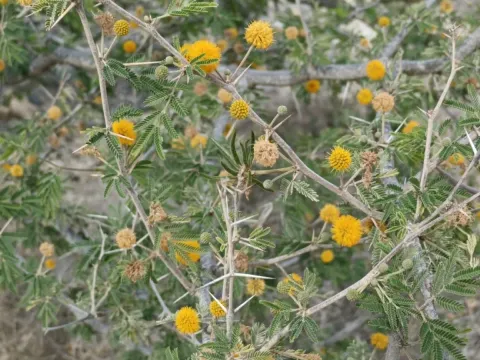
Vachellia
Vachellia
Vachellia is a genus of trees and shrubs belonging to the Fabaceae family, which was taxonomically separated from the broader Acacia genus. These plants are well-adapted to arid and semi-arid environments worldwide.
What the section contains
 Gerrard's wattle
Vachellia gerrardii
Gerrard's wattle
Vachellia gerrardii
 Karroo thorn
Vachellia karroo
Karroo thorn
Vachellia karroo
 Sweet Acacia
Vachellia farnesiana
Sweet Acacia
Vachellia farnesiana
 Vachellia abyssinica
Vachellia abyssinica
Vachellia abyssinica
 Vachellia acuifera
Vachellia acuifera
Vachellia acuifera
 Vachellia albicorticata
Vachellia albicorticata
Vachellia albicorticata
 Vachellia amythethophylla
Vachellia amythethophylla
Vachellia amythethophylla
 Vachellia arenaria
Vachellia arenaria
Vachellia arenaria
 Vachellia astringens
Vachellia belairioides
Vachellia belairioides
Vachellia astringens
Vachellia astringens
Vachellia belairioides
Vachellia belairioides
 Vachellia bidwillii
Vachellia bidwillii
Vachellia bidwillii
 Vachellia borleae
Vachellia borleae
Vachellia borleae
 Vachellia bucheri
Vachellia bucheri
Vachellia bucheri
 Vachellia bussei
Vachellia bussei
Vachellia bussei
 Vachellia campeachiana
Vachellia chiapensis
Vachellia chiapensis
Vachellia campeachiana
Vachellia campeachiana
Vachellia chiapensis
Vachellia chiapensis
 Vachellia collinsii
Vachellia collinsii
Vachellia collinsii
 Vachellia cornigera
Vachellia daemon
Vachellia daemon
Vachellia cornigera
Vachellia cornigera
Vachellia daemon
Vachellia daemon
 Vachellia davyi
Vachellia davyi
Vachellia davyi
 Vachellia drepanolobium
Vachellia drepanolobium
Vachellia drepanolobium
 Vachellia eburnea
Vachellia eburnea
Vachellia eburnea
 Vachellia erioloba
Vachellia erioloba
Vachellia erioloba
 Vachellia etbaica
Vachellia etbaica
Vachellia etbaica
 Vachellia exuvialis
Vachellia exuvialis
Vachellia exuvialis
 Vachellia flava
Vachellia flava
Vachellia flava
 Vachellia grandicornuta
Vachellia grandicornuta
Vachellia grandicornuta
 Vachellia gummifera
Vachellia gummifera
Vachellia gummifera
 Vachellia haematoxylon
Vachellia haematoxylon
Vachellia haematoxylon
 Vachellia hebeclada
Vachellia hebeclada
Vachellia hebeclada
 Vachellia hindsii
Vachellia hindsii
Vachellia hindsii
 Vachellia hockii
Vachellia hockii
Vachellia hockii
 Vachellia horrida
Vachellia horrida
Vachellia horrida
 Vachellia kirkii
Vachellia kirkii
Vachellia kirkii
 Vachellia lahai
Vachellia lahai
Vachellia lahai
 Vachellia leucophloea
Vachellia leucophloea
Vachellia leucophloea
 Vachellia luederitzii
Vachellia luederitzii
Vachellia luederitzii
 Vachellia nebrownii
Vachellia nubica
Vachellia nubica
Vachellia nebrownii
Vachellia nebrownii
Vachellia nubica
Vachellia nubica
 Vachellia planifrons
Vachellia planifrons
Vachellia planifrons
 Vachellia rehmanniana
Vachellia rehmanniana
Vachellia rehmanniana
 Vachellia robusta
Vachellia roigii
Vachellia roigii
Vachellia robusta
Vachellia robusta
Vachellia roigii
Vachellia roigii
 Vachellia seyal
Vachellia seyal
Vachellia seyal
 Vachellia tomentosa
Vachellia tomentosa
Vachellia tomentosa
 Vachellia tortilis
Vachellia tortilis
Vachellia tortilis
 Vachellia tortuosa
Vachellia tortuosa
Vachellia tortuosa
 Vachellia vernicosa
Vachellia vernicosa
Vachellia vernicosa
 Vachellia xanthophloea
Vachellia xanthophloea
Vachellia xanthophloea
 Whitethorn acacia
Vachellia constricta
Whitethorn acacia
Vachellia constricta
Vachellia
The culture requires well-drained soils to thrive, as it is highly susceptible to root decay in waterlogged conditions. Sandy or sandy-loam soils are ideal for long-term growth and development.
Vachellia species are known for their extreme heat tolerance and ability to survive prolonged droughts. They require significant solar radiation to maintain active photosynthesis and healthy growth cycles.
As a legume, Vachellia plays a crucial role in nitrogen fixation. By forming symbiotic relationships with soil bacteria, the plants enrich the local ecosystem, making them valuable for sustainable agriculture.
Economically, these trees are utilized for timber production, the extraction of gum arabic, and as a vital source of fodder for livestock in regions where other forage crops cannot survive.
Bruchid beetles represent the primary threat to Vachellia, as they infest the pods and consume the seeds, which significantly compromises reproduction and seed storage quality.
Aphids and various leaf-eating caterpillars can cause severe defoliation in young specimens, potentially stunting their growth and reducing their resistance to climatic stress.
Fungal diseases such as powdery mildew can affect the canopy when humidity levels become excessively high or when the airflow between trees is restricted by dense planting.
Root rot caused by pathogens such as Phytophthora remains a critical issue in poorly drained agricultural zones, leading to the rapid decline and death of mature trees.
To mitigate these risks, farmers must practice proper spacing to ensure ventilation, monitor for early pest emergence, and strictly avoid planting in compacted soils prone to water accumulation.