
Karroo thorn
Vachellia karroo
Description
Growing requirements
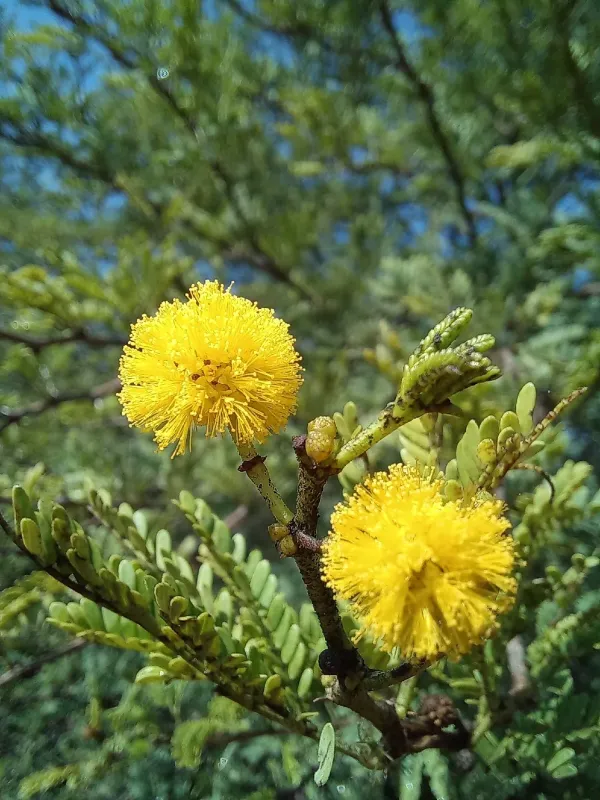
Karroo thorn (Vachellia karroo) is a prominent member of the Fabaceae family, native to southern Africa, characterized by its extreme resilience and distinct physiological traits.
The tree thrives in a wide range of climatic conditions, ranging from semi-arid to humid regions, showing a remarkable ability to survive extended droughts due to its deep taproot system.
It prefers well-drained soils and is highly valued for its ability to grow in saline or nutrient-poor substrates, where it helps in nitrogen fixation and soil improvement.
Cultivation practices require ensuring sufficient sunlight, as the species is intolerant to dense shade, which can lead to stunted growth and poor branching development.
The plant demonstrates significant versatility in land management, often utilized for land reclamation and as a pioneer species in restoring degraded ecosystems.
Yield
The economic value of Vachellia karroo is vast, with its timber being a primary product, recognized for its hardness, durability, and resistance to environmental decay.
It serves as a vital forage source for livestock, particularly during the dry season when green vegetation is scarce, providing essential minerals and proteins for cattle and goats.
Apiculture is a major sector reliant on Karroo thorn, as its long flowering season allows bees to produce a light-colored, high-quality honey that is commercially desirable.
The bark of the tree is traditionally used for tanning leather due to its high tannin content, while the exudate gum is harvested for various industrial and food applications.
Furthermore, the tree acts as a natural barrier when planted as living fences, providing security for livestock against predators and mitigating the impact of strong winds.
Main diseases and pests
Like many species in its habitat, Karroo thorn is susceptible to infestations by various insect pests, including wood-boring beetles that can damage the internal structure of the tree.
Fungal pathogens represent another significant threat, particularly in regions where humidity levels remain consistently high, leading to leaf spots and potential defoliation.
- Defoliating moth larvae.
- Root rot caused by stagnant water.
- Bacterial cankers on stems.
Maintaining proper spacing between individual trees is crucial for ensuring adequate airflow and reducing the risk of disease spread within a plantation or agroforestry site.
Integrated pest management strategies focusing on biological control are recommended to protect the integrity of the ecosystem while maintaining the quality of the forage.