

Reference · Crops
Plum
Prunus L.
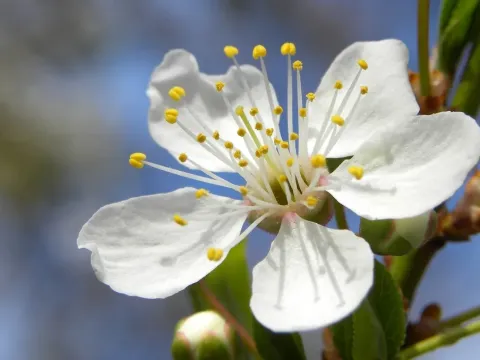
Planting plum trees, which belong to the Prunus genus and Rosaceae family, is typically done using saplings. The ideal time for planting is early spring before bud break or during early autumn, allowing the root system to establish before harsh winter frosts occur.
114
items
What the section contains
 Sweet cherry
Prunus avium (L.) L.
377 products
Sweet cherry
Prunus avium (L.) L.
377 products
 European plum
Prunus domestica L.
242 products
European plum
Prunus domestica L.
242 products
 Peach
Prunus persica (L.) Batsch
182 products
Peach
Prunus persica (L.) Batsch
182 products
 Apricot
Prunus armeniaca L.
106 products
Apricot
Prunus armeniaca L.
106 products
 Cherry plum
Prunus cerasifera Ehrh.
34 products
Cherry plum
Prunus cerasifera Ehrh.
34 products
 Bird cherry
Prunus padus L.
8 products
Bird cherry
Prunus padus L.
8 products
 Almond
Prunus amygdalus x Prunus blireiana
Almond
Prunus amygdalus x Prunus blireiana
 Almond
Prunus dulcis (Mill.) D. A. Webb
Almond
Prunus amygdalus x Prunus persica
Almond
Prunus dulcis (Mill.) D. A. Webb
Almond
Prunus amygdalus x Prunus persica
 Almond-leaved peach
Prunus x persicoides (Ser.) M. Vilm. & Bois
Almond-leaved peach
Prunus x persicoides (Ser.) M. Vilm. & Bois
 American plum
Prunus americana Marsh.
American plum
Prunus americana Marsh.
 Amur chokecherry
Prunus maackii Rupr.
Amur chokecherry
Prunus maackii Rupr.
 Beach plum
Prunus maritima Marshall
Beach plum
Prunus maritima Marshall
 Bell-flowered cherry
Prunus cerasoides D. Don var. campanulata (Maxim.) Koidz.
Bell-flowered cherry
Prunus cerasoides D. Don var. campanulata (Maxim.) Koidz.
 Bessey cherry
Prunus pumila L. var. besseyi (L. H. Bailey) Gleason
Bessey cherry
Prunus pumila L. var. besseyi (L. H. Bailey) Gleason
 Bessey cherry-myrobalan hybrid
Prunus besseyi x Prunus cerasifera Ehrh
Black apricot
Prunus x dasycarpa Ehrh.
Bessey cherry-myrobalan hybrid
Prunus besseyi x Prunus cerasifera Ehrh
Black apricot
Prunus x dasycarpa Ehrh.
 Black cherry
Prunus serotina Ehrh.
Black cherry
Prunus serotina Ehrh.
 Blackthorn
Prunus spinosa L.
Blackthorn
Prunus spinosa L.
 Blireiana plum
Prunus blireiana
Blireiana plum
Prunus blireiana
 Carolina laurelcherry
Prunus caroliniana (Mill.) Aiton
Carolina laurelcherry
Prunus caroliniana (Mill.) Aiton
 Cerapadus
hybrids between Prunus cerasus and Prunus maackii
Cerapadus
hybrids between Prunus cerasus and Prunus maackii
 Cherry laurel
Prunus laurocerasus L.
Cherry laurel
Prunus laurocerasus L.
 Cherry plum
Prunus cerasifera Ehrh. x P. persica (L.) Batsch
Cherry plum
Prunus cerasifera Ehrh. var. divaricata (Ledeb.) L. H. Bailey
Cherry plum
Prunus cerasifera Ehrh. x P. persica (L.) Batsch
Cherry plum
Prunus cerasifera Ehrh. var. divaricata (Ledeb.) L. H. Bailey
 Cherry plum hybrid
(Prunus salicina x P. americana) x P. pumila L. var. besseyi
Cherry plum hybrid
(Prunus salicina x P. americana) x P. pumila L. var. besseyi
 Chinese cherry
Prunus pseudocerasus Lindl.
Chinese cherry
Prunus pseudocerasus Lindl.
 Chinese dwarf cherry
Prunus humilis Bunge
Chinese dwarf cherry
Prunus humilis Bunge
 Chokecherry
Prunus virginiana L.
Common plum
Prunus domestica x (Prunus cerasifera x Prunus persica)
Damson plum
Prunus domestica L. subsp. insititia (L.) C. K. Schneid.
Damson plum
Prunus x fruticans Weihe
Chokecherry
Prunus virginiana L.
Common plum
Prunus domestica x (Prunus cerasifera x Prunus persica)
Damson plum
Prunus domestica L. subsp. insititia (L.) C. K. Schneid.
Damson plum
Prunus x fruticans Weihe
 David's apricot
Prunus davidiana (Carrière) Franch.
David's apricot
Prunus davidiana (Carrière) Franch.
 Dawyck cherry
Prunus dawyckensis
Dawyck cherry
Prunus dawyckensis
 Duke cherry
Prunus avium x Prunus fruticosa Pallas
Duke cherry
Prunus x gondouinii (Poit. & Turpin) Rehder
Duracina cherry
Prunus avium x Prunus campanulata
Duke cherry
Prunus avium x Prunus fruticosa Pallas
Duke cherry
Prunus x gondouinii (Poit. & Turpin) Rehder
Duracina cherry
Prunus avium x Prunus campanulata
 Dwarf cherry
Prunus fruticosa x Prunus serrulata
Dwarf cherry
Prunus fruticosa x Prunus serrulata
 Dwarf Russian almond
Prunus tenella Batsch
Elegant cherry
Prunus concinna Koehne
Dwarf Russian almond
Prunus tenella Batsch
Elegant cherry
Prunus concinna Koehne
 European dwarf cherry
Hybrids between Prunus fruticosa Pall. and Prunus cerasus L.
European dwarf cherry
Prunus fruticosa Pall.
European plum
Prunus domestica L. subsp. domestica
European plum
Prunus domestica L. subsp. italica (Borkh.) Gams ex Hegi
European dwarf cherry
Hybrids between Prunus fruticosa Pall. and Prunus cerasus L.
European dwarf cherry
Prunus fruticosa Pall.
European plum
Prunus domestica L. subsp. domestica
European plum
Prunus domestica L. subsp. italica (Borkh.) Gams ex Hegi
 Felted grey cherry
Prunus incana x Prunus tomentosa
Felted grey cherry
Prunus incana x Prunus tomentosa
 Flowering almond
Prunus glandulosa Thunb.
Flowering almond
Prunus glandulosa Thunb.
 Flowering almond
Prunus triloba Lindl.
Fontanes' plum
Prunus x fontanesiana (Spach) C. K. Schneid.
Flowering almond
Prunus triloba Lindl.
Fontanes' plum
Prunus x fontanesiana (Spach) C. K. Schneid.
 Fuji cherry
Prunus incisa Thunb.
Fuji cherry
Prunus incisa Thunb.
 GF 677 hybrid rootstock
Prunus dulces x P. persica x P. mira
Grey cherry
Prunus incana (Pall.) Batsch
GF 677 hybrid rootstock
Prunus dulces x P. persica x P. mira
Grey cherry
Prunus incana (Pall.) Batsch
 Grey felted cherry
Prunus canescens L. x Prunus tomentosa L.
Grey felted cherry
Prunus canescens L. x Prunus tomentosa L.
 Higan cherry
Prunus subhirtella Miq.
Higan cherry
Prunus subhirtella Miq.
 Hybrid cherry
Prunus cerasus L. x Prunus maackii Rupr. x Prunus serrulata Lindl. var. lannesiana (Carrière) Makino
Hybrid of Cherry Plum and Maximowicz Cherry
hybrids between Prunus cerasifera Ehrh. and Prunus maximowiczii Rupr.
Hybrid cherry
Prunus cerasus L. x Prunus maackii Rupr. x Prunus serrulata Lindl. var. lannesiana (Carrière) Makino
Hybrid of Cherry Plum and Maximowicz Cherry
hybrids between Prunus cerasifera Ehrh. and Prunus maximowiczii Rupr.
 Hybrids between Prunus cerasus and Prunus canescens
Hybrids between Prunus cerasus and Prunus canescens
Hybrids between Prunus cerasus and Prunus canescens
 Hybrids of apricot, cherry plum and Bessey cherry
Hybrids between Prunus armeniaca, Prunus cerasifera and Prunus pumila var. besseyi
Hybrids of peach, almond and David's peach
hybrids between Prunus davidiana, Prunus dulcis and Prunus persica
Hybrids of Prunus davidiana and Prunus persica
hybrids between Prunus davidiana and Prunus persica
Hybrids of Prunus domestica and Prunus davidiana
hybrids between Prunus domestica L. and Prunus davidiana (Carrière) Franch.
Hybrids of apricot, cherry plum and Bessey cherry
Hybrids between Prunus armeniaca, Prunus cerasifera and Prunus pumila var. besseyi
Hybrids of peach, almond and David's peach
hybrids between Prunus davidiana, Prunus dulcis and Prunus persica
Hybrids of Prunus davidiana and Prunus persica
hybrids between Prunus davidiana and Prunus persica
Hybrids of Prunus domestica and Prunus davidiana
hybrids between Prunus domestica L. and Prunus davidiana (Carrière) Franch.
Marketplace
Products in this section · 12


Plum
Select healthy one-year or two-year-old saplings with a well-developed root structure. Depending on the rootstock vigor, trees should be spaced 3 to 5 meters apart to ensure proper light penetration and airflow throughout the canopy.
Prepare planting holes in advance, incorporating organic matter and fertilizers. It is crucial to ensure the graft union remains above the soil surface after the earth settles to prevent bark rot and other physiological issues.
In commercial orchards, propagation is commonly achieved through grafting (budding) onto clonal or seedling rootstocks to preserve specific cultivar characteristics and ensure vigor.
Immediately after planting, water the trees thoroughly and apply mulch around the base. This practice helps conserve soil moisture and suppresses weed growth, which is essential for young trees.
Plums thrive in fertile, well-drained loamy soils with a neutral pH. They are sensitive to waterlogging, so orchards located in areas with high water tables must have adequate drainage systems installed.
These trees require a sunny location protected from strong prevailing winds. While plums have moderate cold tolerance, selecting cultivars suited to the specific climatic zone is vital for consistent production.
Regular irrigation is critical during the fruit development stage and active vegetative growth. Water stress can lead to premature fruit drop and poor fruit quality at harvest time.
Pruning is a mandatory practice for plum trees. Regular thinning of the canopy and removal of diseased or crossing branches improve structural integrity and expose the interior to sunlight.
A balanced fertilization program is essential: nitrogen-based fertilizers in spring promote vegetative growth, while potassium and phosphorus applied in late summer support winter hardening.
Yield potential depends on the specific cultivar, tree age, and site management. Generally, plum trees begin to produce a significant harvest between 3 and 5 years after planting.
An average mature tree can yield between 30 and 100 kg of fruit, depending on the rootstock and cultivation intensity. High-density orchards can achieve higher outputs per hectare.
Plums have diverse culinary applications, ranging from fresh consumption to processing into prunes, jams, jellies, juices, and various distilled beverages or fermented products.
To avoid alternate bearing, fruit thinning is recommended for high-yielding years. This helps maintain tree health and improves the overall size and quality of the remaining fruit.
Harvesting is typically done in multiple passes, as plums do not always ripen uniformly. Timing the harvest based on the intended use—fresh market or processing—is key to economic success.
Key fungal threats include brown rot (Monilinia), shot-hole disease (Stigmina carpophila), and plum leaf scald. These diseases can devastate orchard productivity if not managed effectively.
Pest pressure is primarily dominated by the plum fruit moth, which infests the fruit, and various species of aphids that curl leaves and stunt growth, potentially transmitting viruses.
Disease management relies on a combination of copper-based fungicides, strict orchard hygiene—such as removing mummified fruits—and the selection of resistant or tolerant cultivars.
Integrated Pest Management (IPM) techniques, including pheromone monitoring traps and targeted insecticide applications, help reduce pest populations while minimizing environmental impact.
Maintaining tree vigor through proper pruning and nutrition naturally improves the plant's ability to withstand minor pest and disease pressures throughout the growing season.
Plums should be harvested during dry weather to minimize the risk of post-harvest rot. For commercial supply chains, fruit is picked with the pedicel attached to prevent juice leakage.
Handling fruit with care is essential, as the skin is delicate and susceptible to bruising. Mechanical damage is the leading cause of secondary infections during storage and transit.
Post-harvest sorting is necessary to separate fruit by size and maturity level. Premium fruits are packed for fresh consumption, while those with minor imperfections are sent for processing.
Rapid cooling to 0°C–2°C immediately after harvest significantly extends the shelf life of fresh plums. This allows growers to distribute produce over a longer period.
For home use, plums are highly versatile and can be dried, frozen, or canned, ensuring that the nutritional benefits of the fruit remain accessible throughout the year.