
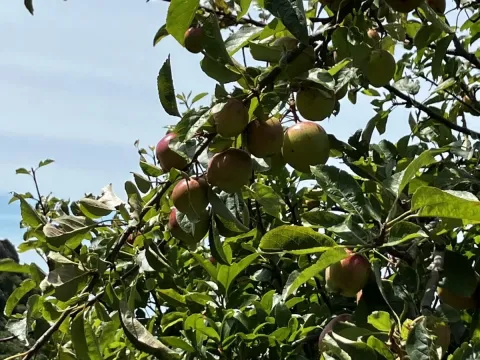
Apple tree
Malus
Planting of apple trees (Malus), belonging to the Rosaceae family, is recommended during the biological dormancy of the plant. Early spring, before active sap flow, or autumn, at least 3–4 weeks before steady frost, are considered the most favorable windows.
What the section contains
 Arnold crabapple
Malus arnoldiana
Arnold crabapple
Malus arnoldiana
 Asiatic apple
Malus asiatica
Asiatic apple
Malus asiatica
 Astringent apple
Malus adstringens
Astringent apple
Malus adstringens
 Bracted apple
Malus bracteata
Bracted apple
Malus bracteata
 Chinese flowering apple
Malus spectabilis
Chinese flowering apple
Malus spectabilis
 Dawson apple
Malus dawsoniana
Dawson apple
Malus dawsoniana
 Denboer apple
Malus denboerii
Denboer apple
Malus denboerii
 Diverse-leaved crabapple
Malus heterophylla
Flat-fruited apple
Malus platycarpa
Diverse-leaved crabapple
Malus heterophylla
Flat-fruited apple
Malus platycarpa
 Florentine crabapple
Malus florentina
Florentine crabapple
Malus florentina
 Gansu crabapple
Malus kansuensis
Gansu crabapple
Malus kansuensis
 Glabrous crabapple
Malus glabrata
Glaucous crabapple
Malus glaucescens
Glabrous crabapple
Malus glabrata
Glaucous crabapple
Malus glaucescens
 Hall crabapple
Malus halliana
Hall crabapple
Malus halliana
 Hartwig crabapple
Malus hartwigii
Hartwig crabapple
Malus hartwigii
 Honan crabapple
Malus honanensis
Honan crabapple
Malus honanensis
 Hybrid apple varieties
Malus hybrids
Hybrid apple varieties
Malus hybrids
 Iowa crabapple
Malus ioensis
Iowa crabapple
Malus ioensis
 Komarov's crabapple
Malus komarovii
Komarov's crabapple
Malus komarovii
 Lanceleaf crabapple
Malus lancifolia
Lanceleaf crabapple
Malus lancifolia
 Lebanese wild apple
Malus trilobata
Lebanese wild apple
Malus trilobata
 Magdeburg Apple
Malus magdeburgensis
Magdeburg Apple
Malus magdeburgensis
 Malus brevipes
Malus brevipes
Malus brevipes
 Malus dasyphylla
Malus dasyphylla
Malus dasyphylla
 Manchurian crabapple
Malus mandshurica
Manchurian crabapple
Malus mandshurica
 Midget crabapple
Malus micromalus
Midget crabapple
Malus micromalus
 Moerlands apple
Malus moerlandsii
Moerlands apple
Malus moerlandsii
 Oriental apple
Malus orientalis
Oriental apple
Malus orientalis
 Pacific crabapple
Malus fusca
Pacific crabapple
Malus fusca
 Pratt's crabapple
Malus prattii
Pratt's crabapple
Malus prattii
 Rock crabapple
Malus rockii
Rock crabapple
Malus rockii
 Scheidecker Crabapple
Malus scheideckeri
Scheidecker Crabapple
Malus scheideckeri
 Sikkim crabapple
Malus sikkimensis
Soulard crabapple
Malus soulardii
Sikkim crabapple
Malus sikkimensis
Soulard crabapple
Malus soulardii
 Southern crabapple
Malus angustifolia
Southern crabapple
Malus angustifolia
 Spontaneous apple tree
Malus spontanea
Spontaneous apple tree
Malus spontanea
 Sublobate crabapple
Malus sublobata
Sweet crabapple
Malus coronaria
Sublobate crabapple
Malus sublobata
Sweet crabapple
Malus coronaria
 Taiwan crabapple
Malus formosana
Taiwan crabapple
Malus formosana
 Toringo crabapple
Malus toringoides
Toringo crabapple
Malus toringoides
 Tschonoski crabapple
Malus tschonoskii
Tschonoski crabapple
Malus tschonoskii
Apple tree
For spring planting, it is essential to prepare the pit in advance to ensure soil compaction. Autumn planting allows the root system to establish itself before the ground freezes, which promotes vigorous growth in the following season.
The choice of timing depends on the climatic zone: in regions with severe winters, spring planting is preferred to avoid the risk of freezing young trees.
In commercial orchards, clonal rootstocks are often used, requiring precise control of planting depth. The root collar must be positioned 3–5 cm above the soil surface level.
Adherence to planting schedules directly impacts the survival rate of the saplings and their resilience against environmental stressors during the early years.
Apple trees thrive in well-lit areas with fertile, well-drained soils, such as loams or chernozems with a neutral pH of 6.0–7.0. The plant is highly sensitive to high water tables, which should not exceed 1.5–2 meters from the surface.
The culture is moderately demanding in terms of water, requiring regular irrigation during dry periods, especially during the fruit development and bud-setting stages. Waterlogging in the root zone is detrimental.
Nutrition management requires balanced NPK fertilization. Nitrogen is essential for vegetative growth in spring, while phosphorus and potassium are critical in late summer for proper wood maturation and winter preparation.
Climate requirements vary by cultivar: most Malus domestica varieties are well-adapted to temperate climates but require sufficient sunshine hours to accumulate sugars and develop proper fruit flavor.
Good orchard management involves regular pruning to ensure light penetration, prevent disease, and maintain a strong tree scaffold.
Yield depends on the cultivar, rootstock type, tree age, and orchard density. Dwarf and semi-dwarf rootstocks allow for higher yields per unit of area and earlier entry into production, often starting by the second or third year.
The average yield of a mature tree in an intensive orchard can range from 30 to 50 kg, while high-density commercial production can reach 30–60 tons per hectare.
Biennial bearing is a common biological trait in many apple varieties. To stabilize yields, growers use crop load management techniques such as thinning, which prevents limb breakage and ensures fruit size quality.
Peak productivity is generally achieved between 10 and 15 years of age, with many orchards remaining economically viable for several decades under proper care.
Effective management of canopy structure and nutrition is crucial to prevent tree exhaustion and maximize annual fruit quality.
The most common fungal disease affecting apple trees is apple scab (Venturia inaequalis), which damages leaves and fruit under humid conditions. Powdery mildew, fruit rot, and black rot also pose significant risks.
Regarding pests, the codling moth (Cydia pomonella) causes the greatest economic damage by burrowing into the fruit. Aphids, spider mites, and apple suckers are also frequent threats to orchard health.
Integrated Pest Management (IPM) includes preventive fungicide applications, biological controls, and pheromone traps to monitor pest populations and time insecticide treatments effectively.
Orchard hygiene, including the removal of fallen leaves and mummified fruit, is the foundation for reducing the pathogen load in the orchard for subsequent seasons.
Regular monitoring and selective spraying allow for the reduction of chemical usage, ensuring higher product safety and environmental sustainability.
Harvesting takes place during the stage of harvest maturity, when fruits reach their target color and size, and seeds begin to turn dark brown.
Fruits should be harvested manually, carefully gripping them at the stem to prevent mechanical damage, as any bruises can become entry points for rot during storage.
For long-term storage, only clean, healthy, and undamaged fruits are selected. Optimal storage conditions require temperatures of 0 to +2°C with high relative humidity.
Varieties are categorized into early-season, mid-season, and late-season (winter) types. Winter apples have the highest storage potential, maintaining freshness for 4–6 months in temperature-controlled facilities.
Timely harvest is critical to prevent pre-harvest drop and ensure the best organoleptic properties for the market.