
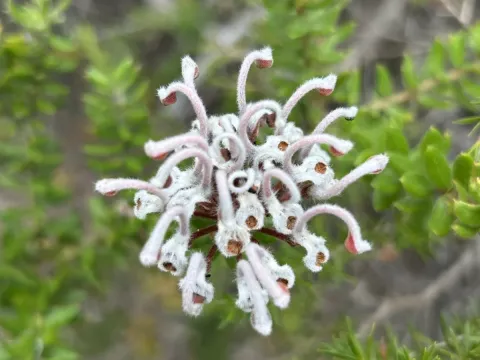
Grevillea
Grevillea
Grevillea is a diverse genus of evergreen trees and shrubs within the Proteaceae family, native to Australia and parts of the Indo-Pacific. These plants are highly adapted to diverse ecological niches, ranging from rainforests to arid inland regions.
What the section contains
 Grampians Grevillea
Grevillea confertifolia
Grampians Grevillea
Grevillea confertifolia
 Grevillea acanthifolia
Grevillea acanthifolia
Grevillea acanthifolia
 Grevillea arenaria
Grevillea arenaria
Grevillea arenaria
 Grevillea aspleniifolia
Grevillea aspleniifolia
Grevillea aspleniifolia
 Grevillea baileyana
Grevillea baileyana
Grevillea baileyana
 Grevillea baueri
Grevillea baueri
Grevillea baueri
 Grevillea diminuta
Grevillea diminuta
Grevillea diminuta
 Grevillea dimorpha
Grevillea dimorpha
Grevillea dimorpha
 Grevillea dryandroides
Grevillea dryandroides
Grevillea dryandroides
 Grevillea glabrata
Grevillea glabrata
Grevillea glabrata
 Grevillea glauca
Grevillea glauca
Grevillea glauca
 Grevillea guthrieana
Grevillea guthrieana
Grevillea guthrieana
 Grevillea heliosperma
Grevillea heliosperma
Grevillea heliosperma
 Grevillea hilliana
Grevillea hilliana
Grevillea hilliana
 Grevillea hybrids
Grevillea hybrids
Grevillea hybrids
 Grevillea iaspicula
Grevillea iaspicula
Grevillea iaspicula
 Grevillea jephcottii
Grevillea jephcottii
Grevillea jephcottii
 Grevillea leptobotrys
Grevillea leptobotrys
Grevillea leptobotrys
 Grevillea longifolia
Grevillea longifolia
Grevillea longifolia
 Grevillea macleayana
Grevillea macleayana
Grevillea macleayana
 Grevillea mollis
Grevillea mollis
Grevillea mollis
 Grevillea ornithopoda
Grevillea ornithopoda
Grevillea ornithopoda
 Grevillea semperflorens
Grevillea semperflorens
Grevillea semperflorens
 Grevillea striata
Grevillea striata
Grevillea striata
 Grevillea willisii
Grevillea willisii
Grevillea willisii
 Holly-leaf grevillea
Grevillea aquifolium
Holly-leaf grevillea
Grevillea aquifolium
 Olive grevillea
Grevillea olivacea
Olive grevillea
Grevillea olivacea
Grevillea
Agronomic success depends on well-draining, slightly acidic soil with low phosphorus availability. Proteaceae are evolved to thrive in nutrient-poor soils, making standard high-phosphorus fertilizers potentially lethal to the root system.
The climate requirements for Grevillea include high levels of solar exposure and protection from freezing temperatures. In many temperate regions, cultivation is restricted to greenhouses or containers, as the plant cannot tolerate frost or prolonged damp cold.
Botanically, the plant is characterized by its distinct, often nectar-rich flowers arranged in complex inflorescences. The foliage varies from fine and needle-like to broad and leathery, displaying significant morphological adaptation to local environments.
Economically, Grevillea is primarily utilized in ornamental horticulture and as a source of nectar for pollinators. Some species provide durable timber, while others are used in landscaping to prevent soil erosion in warm, arid climates.
Pest management for Grevillea in controlled environments focuses on spider mites and scale insects. These pests often thrive in environments where ventilation is poor, leading to stunted growth and damaged foliage if not treated promptly.
Root-borne pathogens, particularly Phytophthora species, represent a major threat to cultivation. These fungi thrive in waterlogged, poorly aerated soils, necessitating the use of specialized, airy substrates and precise irrigation schedules.
Nutrient deficiency, specifically magnesium and iron, causes characteristic chlorosis. Providing balanced, phosphorus-free nutrients is essential to maintain the structural integrity and aesthetic quality of the plants.
Mechanical damage to roots during transplanting or weeding often triggers a decline in plant vigor. Professional agricultural practices emphasize minimal root disturbance to maintain the health of the plant's sensitive root hairs.
Effective disease control involves a combination of environmental management and chemical intervention. Ensuring consistent airflow and monitoring soil moisture are the most effective preventative measures against fungal outbreaks.