
Grampians Grevillea
Grevillea confertifolia
Description
Growing requirements
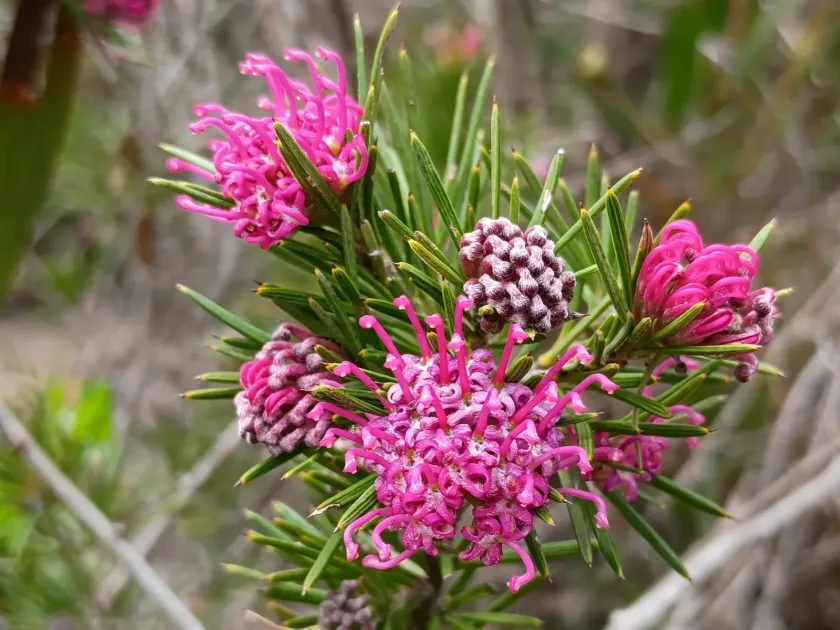
Grevillea confertifolia, commonly known as the Grampians Grevillea, is a compact evergreen shrub belonging to the Proteaceae family. It is native to the Grampians region in Victoria, Australia, where it thrives in rocky, well-drained environments.
This species requires exceptionally well-drained soil. In cultivation, it performs best in sandy or gravelly loam with low phosphorus levels, mimicking its natural habitat. Heavy clays should be avoided or heavily amended with grit.
The plant is highly adaptable to full sun exposure, which is necessary for vigorous growth and abundant flowering. While it is hardy in many climates, it prefers Mediterranean-style conditions with mild winters.
Watering should be managed carefully, ensuring the substrate dries out sufficiently between waterings to prevent root system collapse. Once established, the shrub exhibits excellent drought tolerance.
Cultivation practices involve minimal fertilization, specifically using fertilizers formulated for Proteaceae, and light pruning after the flowering season to maintain a dense, attractive foliage habit.
Main diseases and pests
The most significant threat to the Grampians Grevillea is Phytophthora cinnamomi, a water mould that thrives in damp, poorly drained soils and causes root rot.
Pests such as mealybugs and scale insects may infest the dense foliage, particularly in confined greenhouse environments or sheltered garden spots with poor air circulation.
Lime-induced chlorosis is a common physiological issue if the soil pH is too high, leading to interveinal yellowing of the leaves and stunted growth.
Environmental stress from extreme humidity combined with cold temperatures can invite fungal diseases like Botrytis, which can damage the stems and flowers.
To maintain plant health, it is essential to promote good airflow, avoid over-watering, and monitor for early signs of infestations or nutrient deficiencies.