

Reference · Crops
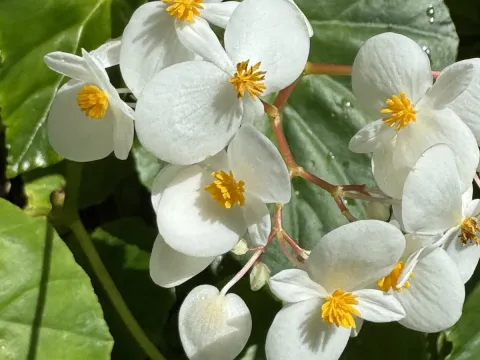
Begonia
Begonia L.
Propagation of Begonia is typically performed through seeds or vegetative cuttings, depending on the specific cultivar and the intended scale of production within the nursery.
46
items
What the section contains
 Angel Wing Begonia
Begonia coccinea Hook.
Angel Wing Begonia
Begonia coccinea Hook.
 Beefsteak begonia
Begonia x erythrophylla Neumann
Beefsteak begonia
Begonia x erythrophylla Neumann
 Begonia boliviensis
 A. DC.
Begonia boliviensis
Begonia boliviensis A. DC.
 Begonia boliviensis hybrid
Hybrids between Begonia boliviensis and Begonia pendula
Begonia boliviensis hybrid
Hybrids between Begonia boliviensis and Begonia pendula
 Begonia deliciosa
 Linden ex Fotsch
Begonia deliciosa
Begonia deliciosa Linden ex Fotsch
 Begonia foliosa
 Kunth
Begonia foliosa
Begonia foliosa Kunth
 Begonia hatacoa
 Buch.-Ham. ex D. Don
Begonia hatacoa
Begonia hatacoa Buch.-Ham. ex D. Don
 Begonia hydrocotylifolia
 Otto ex Hook.
Begonia hydrocotylifolia
Begonia hydrocotylifolia Otto ex Hook.
 Begonia kingiana
 Irmsch.
Begonia kingiana
Begonia kingiana Irmsch.
 Begonia Lorraine
Begonia x cheimantha Everett ex C. Weber
Begonia Lorraine
Begonia x cheimantha Everett ex C. Weber
 Begonia manicata
 Brongn. ex Cels
Begonia manicata
Begonia manicata Brongn. ex Cels
 Begonia obliqua
 L.
Begonia obliqua
Begonia obliqua L.
 Begonia parviflora
 Poepp. & Endl.
Begonia parviflora
Begonia parviflora Poepp. & Endl.
 Begonia pedatifida taliensis
Begonia pedatifida x Begonia taliensis
Begonia pedatifida taliensis
Begonia pedatifida x Begonia taliensis
 Begonia per-dusenii
 Brade
Begonia per-dusenii
Begonia per-dusenii Brade
 Begonia pseudolubbersii
 Brade
Begonia pseudolubbersii
Begonia pseudolubbersii Brade
 Begonia Rex
Begonia-Rex-Hybridae
Begonia Rex
Begonia-Rex-Hybridae
 Begonia soli-mutata
 L. B. Sm. & Wassh.
Begonia soli-mutata
Begonia soli-mutata L. B. Sm. & Wassh.
 Begonia venosa
 Skan ex Hook. f.
Begonia venosa
Begonia venosa Skan ex Hook. f.
 Conch-leaf begonia
Begonia conchifolia A. Dietr.
Conch-leaf begonia
Begonia conchifolia A. Dietr.
 Coral Begonia
Begonia-Corallina-Hybridae
Coral Begonia
Begonia-Corallina-Hybridae
 Elatior Begonia
Begonia x hiemalis Fotsch
Elatior Begonia
Begonia x hiemalis Fotsch
 Eyelash begonia
Begonia bowerae Ziesenh.
Hybrid Begonia
Begonia per-dusenii Brade x B. x semperflorens-cultorum hort.
Eyelash begonia
Begonia bowerae Ziesenh.
Hybrid Begonia
Begonia per-dusenii Brade x B. x semperflorens-cultorum hort.
 Hybrid Begonia
Begonia hatacoa x Begonia deliciosa
Hybrid Begonia
Begonia hatacoa x Begonia deliciosa
 Hybrid begonia
Begonia x hybrida P. N. Don ex Burb.
Hybrid begonia
Begonia x hybrida P. N. Don ex Burb.
 Hybrid Begonia
Begonia picta Sm. x B. rex Putz.
Hybrid Wax Begonia
Begonia Semperflorens-Cultorum Group x Begonia venosa
Hybrid Begonia
Begonia picta Sm. x B. rex Putz.
Hybrid Wax Begonia
Begonia Semperflorens-Cultorum Group x Begonia venosa
 Imperial begonia
Begonia imperialis Lem.
Imperial begonia
Begonia imperialis Lem.
 Iron Cross Begonia
Begonia masoniana Irmsch.
Iron Cross Begonia
Begonia masoniana Irmsch.
 King begonia
Begonia rex-cultorum L. H. Bailey
King begonia
Begonia rex-cultorum L. H. Bailey
 Pedatifid begonia
Begonia pedatifida Lév.
Pedatifid begonia
Begonia pedatifida Lév.
 Pendulous begonia
Begonia pendula Ridl.
Pendulous begonia
Begonia pendula Ridl.
 Polka dot begonia
Begonia maculata Raddi
Polka dot begonia
Begonia maculata Raddi
 Rex Begonia
Begonia-Rex-Hybridae x Begonia hatacoa
Rex Begonia
Begonia-Rex-Hybridae x Begonia hatacoa
 Rex Begonia
Begonia-Rex-Hybridae x Begonia hatacoa x Begonia deliciosa
Rex Begonia
Begonia-Rex-Hybridae x Begonia hatacoa x Begonia deliciosa
 Rex begonia
Begonia rex Putz. x B. sikkimensis A. DC.
Rex begonia
Begonia rex Putz. x B. sikkimensis A. DC.
 Sikkim begonia
Begonia sikkimensis A. DC.
Sikkim begonia
Begonia sikkimensis A. DC.
 Tali begonia
Begonia taliensis Gagnep.
Tali begonia
Begonia taliensis Gagnep.
 Tuberous begonia
Begonia x tuberhybrida Voss
Tuberous begonia
Begonia x tuberhybrida Voss
 Wax begonia
Begonia cucullata Willd.
Wax begonia
Begonia cucullata Willd. var. cucullata
Wax begonia
Begonia cucullata Willd.
Wax begonia
Begonia cucullata Willd. var. cucullata
 Wax begonia
Begonia parviflora x Begonia Semperflorens-Cultorum Group
Wax Begonia
Begonia Semperflorens-Cultorum Group
Wax begonia
Begonia Semperflorens-Cultorum Group x Begonia foliosa
Wax begonia
Begonia Semperflorens-Cultorum Group x Begonia obliqua
Wax begonia
Begonia parviflora x Begonia Semperflorens-Cultorum Group
Wax Begonia
Begonia Semperflorens-Cultorum Group
Wax begonia
Begonia Semperflorens-Cultorum Group x Begonia foliosa
Wax begonia
Begonia Semperflorens-Cultorum Group x Begonia obliqua
Marketplace
Products in this section · 3


Begonia
Seeds are exceptionally small and require surface sowing in a fine, moist, and well-draining substrate without covering them, as they need light to initiate the germination process.
Sowing in a controlled greenhouse environment is usually scheduled for early winter to ensure the plants reach the flowering stage by the peak spring market demand.
Vegetative propagation via stem or leaf cuttings is the preferred method for maintaining genetic uniformity in commercial hybrids, ensuring high-quality plant batches.
Consistent substrate moisture and a temperature range of 22–24 degrees Celsius are essential during the initial germination phase to ensure high success rates in seedling emergence.
The Begonia genus belongs to the Begoniaceae family and originates from tropical and subtropical regions, dictating its preference for warm and humid growing conditions.
The crop requires a well-aerated, nutrient-rich, and slightly acidic substrate. Effective drainage is non-negotiable to prevent root asphyxiation and the development of waterborne pathogens.
Light management is crucial; while Begonias thrive in bright areas, they require diffused light to prevent leaf scorching, which is especially important for foliage-intensive varieties.
Temperatures should be kept consistently between 18 and 22 degrees Celsius. Deviations below 12 degrees or above 28 degrees significantly impede physiological development and floral initiation.
High relative humidity is necessary for vigorous growth, but proper air circulation must be maintained to prevent stagnant air conditions that encourage the growth of pathogenic fungi.
Powdery mildew represents a major threat to commercial Begonia production, characterized by a white fungal mat on leaves that spreads rapidly under high-humidity conditions.
Botrytis cinerea, or gray mold, is a common issue affecting flowers and stems, particularly in crowded greenhouse environments where ventilation is inadequate or inconsistent.
Insects such as thrips, aphids, and spider mites are frequent pests that cause direct damage to plant tissues, potentially serving as vectors for viral and bacterial diseases.
Root and stem rots caused by Pythium species are devastating and often result from overwatering or utilizing unsterilized growing media during the transplanting phase.
A successful integrated pest management (IPM) program for Begonia involves regular crop scouting, maintaining hygiene, and the targeted application of certified chemical or biological control agents.