
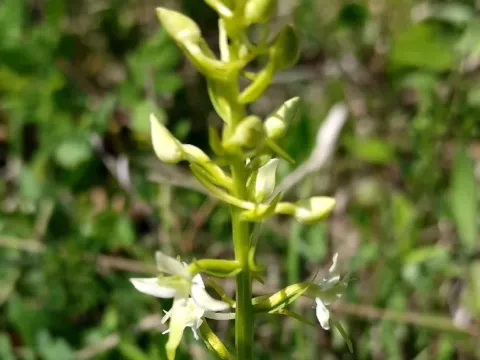
Butterfly orchid
Platanthera
The genus Platanthera belongs to the Orchidaceae family. These are perennial herbaceous plants distributed across the Northern Hemisphere in temperate and subarctic zones.
What the section contains
 Algerian butterfly orchid
Platanthera algeriensis
Algerian butterfly orchid
Platanthera algeriensis
 Blunt-leaved bog orchid
Platanthera obtusata
Blunt-leaved bog orchid
Platanthera obtusata
 Chapman's fringed orchid
Platanthera chapmanii
Chapman's fringed orchid
Platanthera chapmanii
 Choris's rein orchid
Platanthera chorisiana
Choris's rein orchid
Platanthera chorisiana
 Coleman's bog orchid
Platanthera colemanii
Coleman's bog orchid
Platanthera colemanii
 Crested fringed orchid
Platanthera cristata
Crested fringed orchid
Platanthera cristata
 Elegant rein orchid
Platanthera elegans
Elegant rein orchid
Platanthera elegans
 Greater butterfly-orchid
Platanthera chlorantha
Greater butterfly-orchid
Platanthera chlorantha
 Greater Purple Fringed Orchid
Platanthera grandiflora
Greater Purple Fringed Orchid
Platanthera grandiflora
 Green wood orchid
Platanthera clavellata
Green wood orchid
Platanthera clavellata
 Green-flowered bog orchid
Platanthera sparsiflora
Green-flowered bog orchid
Platanthera sparsiflora
 Hooker's Orchid
Platanthera hookeri
Hooker's Orchid
Platanthera hookeri
 Huron Green Orchid
Platanthera huronensis
Huron Green Orchid
Platanthera huronensis
 Lesser butterfly-orchid
Platanthera bifolia
Lesser butterfly-orchid
Platanthera bifolia
 Northern bog orchid
Platanthera aquilonis
Northern bog orchid
Platanthera aquilonis
 Northern green orchid
Platanthera hyperborea
Northern green orchid
Platanthera hyperborea
 Pale green orchid
Platanthera flava
Pale green orchid
Platanthera flava
 Platanthera cooperi
Platanthera cooperi
Platanthera cooperi
 Platanthera elongata
Platanthera ephemeranthera
Platanthera ephemeranthera
Platanthera hohnboei
Platanthera hohnboei
Platanthera elongata
Platanthera elongata
Platanthera ephemeranthera
Platanthera ephemeranthera
Platanthera hohnboei
Platanthera hohnboei
 Platanthera hologlottis
Platanthera hologlottis
Platanthera hologlottis
 Platanthera leptopetala
Platanthera leptopetala
Platanthera leptopetala
 Platanthera michaelii
Platanthera michaelii
Platanthera michaelii
 Platanthera micrantha
Platanthera micrantha
Platanthera micrantha
 Platanthera minor
Platanthera minor
Platanthera minor
 Platanthera oligantha
Platanthera oligantha
Platanthera oligantha
 Platanthera ophrydioides
Platanthera ophrydioides
Platanthera ophrydioides
 Platanthera pachycaulon
Platanthera pachycaulon
Platanthera pachycaulon
 Platanthera tipuloides
Platanthera tipuloides
Platanthera tipuloides
 Platanthera transversa
Platanthera transversa
Platanthera transversa
 Platanthera unalascensis
Platanthera unalascensis
Platanthera unalascensis
 Platanthera zothecina
Platanthera zothecina
Platanthera zothecina
 Scented Bog Orchid
Platanthera dilatata
Scented Bog Orchid
Platanthera dilatata
 Slender bog orchid
Platanthera stricta
Slender bog orchid
Platanthera stricta
 White fringed orchid
Platanthera blephariglottis
White fringed orchid
Platanthera blephariglottis
 Yadon's rein orchid
Platanthera yadonii
Yadon's rein orchid
Platanthera yadonii
 Yellow Fringed Orchid
Platanthera ciliaris
Yellow Fringed Orchid
Platanthera ciliaris
 Yellow fringeless orchid
Platanthera integra
Yellow fringeless orchid
Platanthera integra
Butterfly orchid
It is important to note that Platanthera is not a commercial agricultural crop. These plants are wild orchids that strictly depend on natural habitats such as damp meadows and shaded woodlands.
The plant possesses a unique biology characterized by a pair of root tubers. Its growth is highly specialized, requiring specific fungal symbionts (mycorrhiza) in the soil for seed germination.
Environmental requirements are rigid: they need consistent soil moisture, specific soil acidity, and protection from direct sunlight in forest understories, making mass cultivation impossible.
Due to these biological constraints, Platanthera species are categorized as strictly protected or threatened plants. Their propagation requires highly technical in vitro laboratory environments.
The primary threats to Platanthera are habitat destruction, including land drainage, deforestation, and urbanization which disrupt the delicate mycorrhizal balance in the soil.
Pollution and the use of agricultural chemicals in surrounding areas represent significant dangers, as the orchid is highly sensitive to soil chemistry changes.
Pathological threats include various fungal root rots which can become prevalent if the soil hydro-regime is destabilized by human intervention or extreme climate events.
In the wild, herbivores and certain insects may feed on floral stalks, but the main driver of population decline remains illegal foraging and the degradation of natural ecosystems.
Because these plants are not cultivated, there is no established system for integrated pest management (IPM) or chemical protection, further emphasizing the need for habitat conservation over active management.