
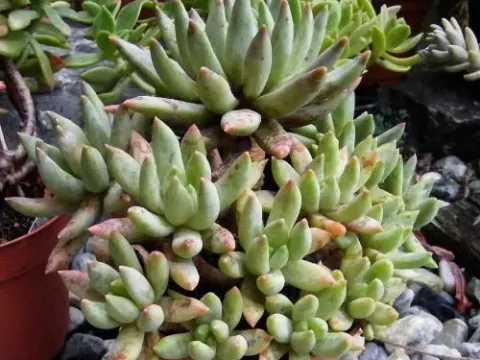
Pachyveria
Pachyveria Haage & Schmidt
Pachyveria is a hybrid genus derived from the cross-breeding of Pachyphytum and Echeveria. As a member of the Crassulaceae family, it inherits the succulent characteristics of its parent plants, making it a highly resilient indoor and ornamental crop.
What the section contains


Pachyveria
The ancestral origins of these succulents trace back to the arid mountainous regions of Mexico. Since its creation, it has become a staple in the ornamental plant trade, prized for its sculptural geometry and low water requirements.
Optimal growth requires intense but indirect light to maintain the compact shape of the rosettes. Insufficient light leads to etiolation, a condition where the stem stretches and the plant loses its aesthetic and market value.
The substrate must be highly porous and inorganic-heavy to prevent water retention. A professional growing mix usually consists of 50 percent grit or perlite and 50 percent organic peat-based components to ensure perfect drainage.
Pachyveria is primarily produced for the commercial horticultural market. It serves as an essential component in dish gardens, terrariums, and xeriscaping projects where water conservation is prioritized.
Overwatering remains the leading cause of plant mortality in Pachyveria cultivation. Excess moisture in the root zone invites pathogens like Pythium and Phytophthora, which cause rapid decay of the vascular system.
Common pests include mealybugs and scale insects, which prefer the sheltered spots between the succulent leaves. Integrated pest management using systemic pesticides is the most effective approach for large-scale production facilities.