
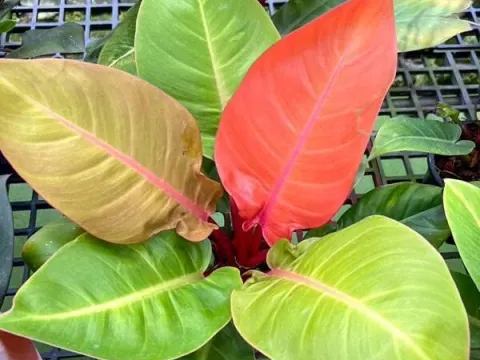
Philodendron
Philodendron
Philodendron is a prominent member of the Araceae family, native to the tropical regions of the Americas. These plants exhibit a diverse growth habit, ranging from vining climbers to self-heading types, and are well-adapted to the understory of dense forest ecosystems.
What the section contains
 Fiddle-leaf Philodendron
Philodendron bipennifolium
Fiddle-leaf Philodendron
Philodendron bipennifolium
 Hairy-stemmed philodendron
Philodendron squamiferum
Hairy-stemmed philodendron
Philodendron squamiferum
 Heartleaf philodendron
Philodendron cordatum
Heartleaf philodendron
Philodendron cordatum
 Mexican philodendron
Philodendron mexicanum
Mexican philodendron
Philodendron mexicanum
 Philodendron alatum
Philodendron alatum
Philodendron alatum
 Philodendron appendiculatum
Philodendron appendiculatum
Philodendron appendiculatum
 Philodendron brandtianum
Philodendron brandtianum
Philodendron brandtianum
 Philodendron elegans
Philodendron elegans
Philodendron elegans
 Philodendron giganteum
Philodendron giganteum
Philodendron giganteum
 Philodendron gloriosum
Philodendron gloriosum
Philodendron gloriosum
 Philodendron grazielae
Philodendron grazielae
Philodendron grazielae
 Philodendron hastatum
Philodendron hastatum
Philodendron hastatum
 Philodendron hybrid
s
Philodendron hybrid
Philodendron hybrids
 Philodendron imbe
Philodendron imbe
Philodendron imbe
 Philodendron lacerum
Philodendron lacerum
Philodendron lacerum
 Philodendron laciniatum
Philodendron laciniatum
Philodendron laciniatum
 Philodendron lingulatum
Philodendron lingulatum
Philodendron lingulatum
 Philodendron lupinum
Philodendron lupinum
Philodendron lupinum
 Philodendron mamei
Philodendron mamei
Philodendron mamei
 Philodendron Manda
Philodendron mandaianum
Philodendron Manda
Philodendron mandaianum
 Philodendron melanochrysum
Philodendron melanochrysum
Philodendron melanochrysum
 Philodendron melinonii
Philodendron melinonii
Philodendron melinonii
 Philodendron minarum
Philodendron minarum
Philodendron minarum
 Philodendron nangaritense
Philodendron nangaritense
Philodendron nangaritense
 Philodendron ornatum
Philodendron ornatum
Philodendron ornatum
 Philodendron panduriforme
Philodendron panduriforme
Philodendron panduriforme
 Philodendron selloum
Philodendron selloum
Philodendron selloum
 Philodendron tortum
Philodendron tortum
Philodendron tortum
 Philodendron tripartitum
Philodendron tripartitum
Philodendron tripartitum
 Philodendron xanadu
Philodendron xanadu
Philodendron xanadu
Philodendron
Environmental conditions for optimal growth include high ambient humidity and temperatures between 18 and 28 degrees Celsius. The culture thrives when protected from extreme fluctuations, as stable conditions are critical for maintaining healthy transpiration and nutrient uptake.
Soil structure should favor rapid drainage while retaining sufficient moisture to prevent desiccation. A mixture containing composted bark, perlite, and high-quality peat provides the necessary aeration for root development, which is vital for preventing oxygen starvation in the rhizosphere.
Light management requires a balance between sufficient photosynthesis and protection from photo-inhibition. While Philodendrons are shade-tolerant, they demonstrate more robust growth and larger foliage when provided with bright, indirect light conditions.
Irrigation practices must be calibrated to the growth cycle, with increased watering during the active vegetative phase. Conversely, in the dormancy period, moisture levels should be reduced to prevent saturation and the subsequent development of anaerobic soil environments.
Common pathological issues in Philodendron production include leaf spot diseases caused by bacteria such as Xanthomonas. These pathogens thrive in high humidity and often spread through splashing water during routine irrigation cycles.
Insects such as spider mites and mealybugs represent significant economic threats to commercial nurseries. These pests colonize the undersides of leaves and leaf axils, causing chlorosis, wilting, and in severe cases, the death of individual plant tissues.
Root system pathogens, particularly Rhizoctonia and Pythium, are prevalent in substrates that lack proper drainage. Once established, these fungi can rapidly destroy the vascular system of the plant, necessitating strict quarantine and sanitation procedures.
Management of pest and disease outbreaks requires a multifaceted Integrated Pest Management (IPM) approach. This includes the use of biological controls, strategic insecticide application, and the maintenance of high standards of greenhouse sanitation to break the lifecycle of threats.
Frequent scouting for abnormal discolorations or stunted growth is necessary to ensure the health of the crop. Rapid identification of stress factors, whether abiotic or biotic, allows for prompt corrective actions, thereby ensuring consistent quality and yield of the plant material.