
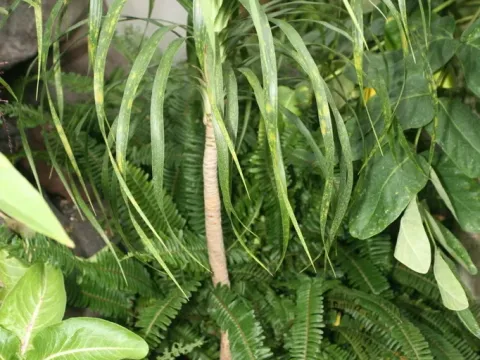
Dracaena
Dracaena
Dracaena (Dracaena) is a genus of trees and shrubs belonging to the Asparagaceae family, encompassing approximately 150 species. Naturally, these plants originate from the tropical and subtropical regions of Africa, as well as parts of South and Southeast Asia.
What the section contains
 Afromontane dracaena
Dracaena afromontana
American dragon tree
Dracaena americana
Afromontane dracaena
Dracaena afromontana
American dragon tree
Dracaena americana
 Ceylon Dracaena
Dracaena zeylanica
Dracaena acaulis
Dracaena acaulis
Ceylon Dracaena
Dracaena zeylanica
Dracaena acaulis
Dracaena acaulis
 Dracaena aletriformis
Dracaena aletriformis
Dracaena aletriformis
 Dracaena angustifolia
Dracaena angustifolia
Dracaena angustifolia
 Dracaena arborea
Dracaena arborea
Dracaena arborea
 Dracaena aubryana
Dracaena aubryana
Dracaena aubryana
 Dracaena bicolor
Dracaena bicolor
Dracaena bicolor
 Dracaena canaliculata
Dracaena canaliculata
Dracaena canaliculata
 Dracaena cantleyi
Dracaena cantleyi
Dracaena cantleyi
 Dracaena cochinchinensis
Dracaena densifolia
Dracaena densifolia
Dracaena cochinchinensis
Dracaena cochinchinensis
Dracaena densifolia
Dracaena densifolia
 Dracaena goldieana
Dracaena goldieana
Dracaena goldieana
 Dracaena hanningtonii
Dracaena hanningtonii
Dracaena hanningtonii
 Dracaena hybrid
s
Dracaena hybrid
Dracaena hybrids
 Dracaena kaweesakii
Dracaena kaweesakii
Dracaena kaweesakii
 Dracaena maingayi
Dracaena maingayi
Dracaena maingayi
 Dracaena mannii
Dracaena mannii
Dracaena mannii
 Dracaena masoniana
Dracaena mokoko
Dracaena mokoko
Dracaena masoniana
Dracaena masoniana
Dracaena mokoko
Dracaena mokoko
 Dracaena pinguicula
Dracaena portieri
Dracaena portieri
Dracaena pinguicula
Dracaena pinguicula
Dracaena portieri
Dracaena portieri
 Dracaena trifasciata
Dracaena trifasciata
Dracaena trifasciata
 Dracaena umbraculifera
Dracaena umbraculifera
Dracaena umbraculifera
 Dracaena umbratica
Dracaena Zebra
Dracaena zebra
Dracaena umbratica
Dracaena umbratica
Dracaena Zebra
Dracaena zebra
 Dragon blood tree
Dracaena cinnabari
Golden Dracaena
Dracaena aurea
Dragon blood tree
Dracaena cinnabari
Golden Dracaena
Dracaena aurea
 Hyacinth-leaved dracaena
Dracaena hyacinthoides
Hyacinth-leaved dracaena
Dracaena hyacinthoides
 Kona Dragon Tree
Dracaena konaensis
Kona Dragon Tree
Dracaena konaensis
 Sander's dracaena
Dracaena sanderiana
Sander's dracaena
Dracaena sanderiana
 Serrulated Dragon Tree
Dracaena serrulata
Serrulated Dragon Tree
Dracaena serrulata
 Usambara Dracaena
Dracaena usambarensis
Usambara Dracaena
Dracaena usambarensis
Dracaena
The culture thrives under bright, filtered light, although many varieties exhibit high adaptability to partial shade. The optimal temperature for healthy vegetation ranges from +18 to +25 degrees Celsius, while temperatures falling below +12 degrees Celsius can cause significant physiological damage.
Requirements for the growing medium include high aeration and a neutral pH (6.0–6.5). An ideal substrate consists of a mixture of turf soil, leaf compost, and coarse sand in a 2:1:1 ratio, often supplemented with charcoal to improve drainage and prevent stagnation.
Agronomic irrigation practices are based on moderate watering, allowing the soil to dry out to a depth of 2–3 cm between waterings. During summer, the plants require regular misting or increased ambient humidity to prevent leaf tip necrosis caused by dry indoor air.
In commercial agriculture, Dracaena is cultivated primarily as a potted ornamental crop or as foliage for the floral industry. Beyond its aesthetic value, it is widely recognized for its air-purifying properties, specifically the removal of indoor pollutants like formaldehyde.
The main pests affecting the crop include scale insects, mealybugs, and spider mites, which typically proliferate under improper humidity conditions. Management involves the application of systemic insecticides upon the detection of initial infestations.
Diseases in Dracaena are often fungal in nature, such as Alternaria and Phyllosticta leaf spot, manifesting as dark, necrotic lesions on the leaves. Effective prophylaxis requires strict moisture control and the maintenance of adequate ventilation in greenhouse environments.
Root rot, triggered by over-irrigation, represents the most severe threat to the crop, leading to rapid systemic failure. Management of infected plants requires immediate repotting, removal of necrotic tissue, and the application of specialized fungicides.
Bacteriosis is another critical threat that flourishes in warm, humid conditions, manifesting as water-soaked lesions on stems. Since this condition is difficult to cure, affected specimens are typically discarded to prevent further spread within the facility.
Maintaining crop health requires rigorous quarantine procedures for new planting stock. Implementing a consistent program of sanitary pruning significantly minimizes the risk of pathogen spread within professional cultivation facilities.