
Dracaena goldieana
Dracaena goldieana
Description
Growing requirements
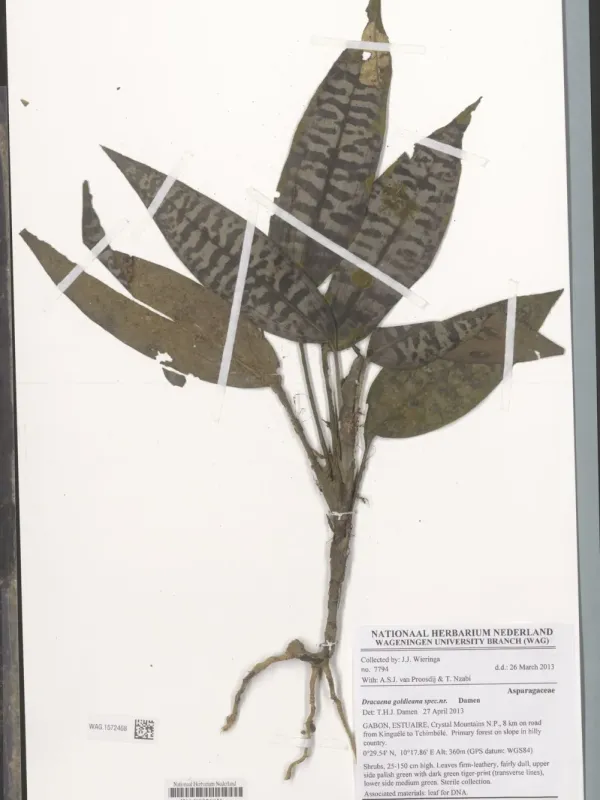
Dracaena goldieana is a highly valued ornamental plant belonging to the Asparagaceae family, native to the tropical rainforests of West Africa. This species is distinguished by its broad, leathery leaves featuring striking dark green and silvery-white transverse bands.
For optimal growth, this crop requires bright, indirect light conditions. Direct sunlight is strictly avoided as it causes foliar damage and fading of the unique leaf pattern. The ideal temperature range for cultivation is between 20°C and 25°C, ensuring stability throughout the growth cycle.
High relative humidity is essential for the healthy development of Dracaena goldieana. In controlled environments, providing supplementary humidity through misting or automated systems is necessary to prevent leaf tip necrosis and maintain the plant's aesthetic quality.
The planting substrate must be well-draining, nutrient-rich, and slightly acidic. A mix consisting of peat moss, pine bark, and perlite provides the necessary aeration and moisture-holding capacity for a robust root system development.
Agronomic management includes moderate irrigation, ensuring the growing medium remains consistently moist without becoming waterlogged. Regular nutrient supplementation with a balanced NPK fertilizer during the active growing season promotes vibrant foliage color and structural integrity.
Main diseases and pests
Pest pressure is primarily driven by spider mites and scale insects, especially in environments where humidity levels fluctuate. Integrated pest management strategies, including regular inspections and the application of horticultural soaps or systemic insecticides, are required.
Root rot, often caused by over-irrigation and poor drainage, remains the most critical pathological threat to the crop. Preventive measures include utilizing sterile pots with adequate drainage holes and ensuring proper spacing between plants to facilitate air circulation.