

Description
Symptoms
Initial symptoms of Aphanomyces root rot include yellowing and wilting of the lower foliage, which progresses rapidly throughout the entire plant.
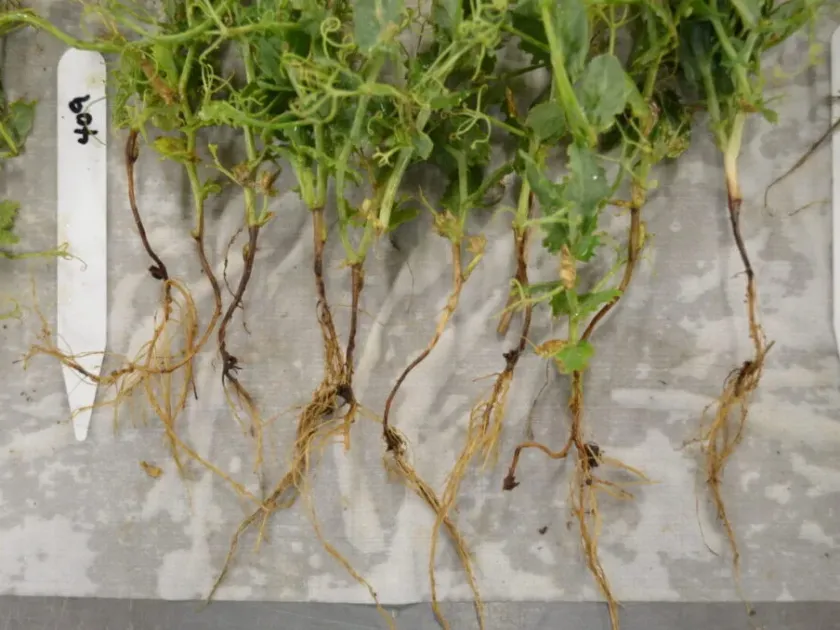
Upon inspection, the root system shows significant tissue softening, discoloration ranging from light brown to black, and a water-soaked appearance.
Fine feeder roots are typically destroyed first, leaving a stunted, decaying taproot that often fails to support the developing plant.
In later stages, dark lesions or constrictions appear on the stem base near the soil line, causing the plant to lodge and eventually collapse.
Infected fields often exhibit patchy growth patterns where plants appear significantly smaller and less vigorous compared to healthy sections.
Pathogen
The causative agent is the oomycete Aphanomyces euteiches, a persistent soil-borne pathogen known to infect various legume and vegetable crops.
The pathogen produces highly resilient resting spores called oospores, which allow it to survive in the soil for several years without a host plant.
When soil moisture conditions are optimal, oospores germinate to release motile zoospores, which swim through water films to find and infect plant roots.
The pathogen's life cycle is strictly dependent on the availability of free moisture in the soil, making it particularly aggressive during wet growing seasons.
It remains one of the most challenging soil-borne pathogens due to its ability to persist in diverse soil types and survive under extreme climatic variations.
Conditions for development
The disease thrives in saturated or poorly drained soil conditions, where high moisture levels facilitate the movement of zoospores toward host roots.
Heavy clay soils that are prone to compaction and poor aeration are major hotspots for the development of Aphanomyces outbreaks.
Optimal temperatures for infection typically range between 15°C and 25°C, matching the peak growth periods of susceptible crops like peas and alfalfa.
High soil acidity levels can exacerbate the susceptibility of the crop, creating a more favorable environment for the pathogen to colonize root tissues.
Continuous cropping of susceptible species without adequate rotations leads to an accumulation of inoculum in the soil to potentially devastating levels.
Why it matters
This root rot is highly destructive, capable of causing widespread stand failure in crops such as peas, lentils, alfalfa, and spinach.
Early-season infections often result in seedling death, forcing farmers to perform costly reseeding of the affected acreage.
Survivors of early infection exhibit significantly reduced yields due to a crippled vascular system that fails to transport water and nutrients efficiently.
The disease also affects the overall health and stress tolerance of the plant, leaving it vulnerable to secondary infections by other fungi and bacteria.
Once a field is heavily infested with Aphanomyces, its economic viability for growing susceptible legumes is compromised for many years.
Protection
Implementing a long-term crop rotation strategy is the most effective management tool, typically requiring 6 to 8 years between susceptible crops.
Improving soil drainage and physical structure is critical to reducing the water saturation that drives pathogen propagation.
Using high-quality, fungicide-treated seed helps protect seedlings during the critical early stages of germination and establishment.
Selecting tolerant or resistant cultivars, where available, remains the cornerstone of modern integrated pest management for this disease.
- Avoid cultivating in areas with known history of poor drainage and compaction.
- Use lime to adjust soil pH to levels less favorable for the pathogen.
- Practice thorough sanitation of machinery to prevent the spread of soil across fields.
In brief
5
Affects crops
Biology
Pathogens and affected parts
Pathogens
Affected plant parts
root
Content graph
Affects crops · 5
Content graph
Connections · Aphanomyces root rot
Most often together:
Marketplace
Products · 66








Community
Discussion
No discussions yet — be the first.