

Description
How to identify
The beet cyst nematode (Heterodera schachtii) is a sedentary endoparasite belonging to the order Tylenchida and the family Heteroderidae.
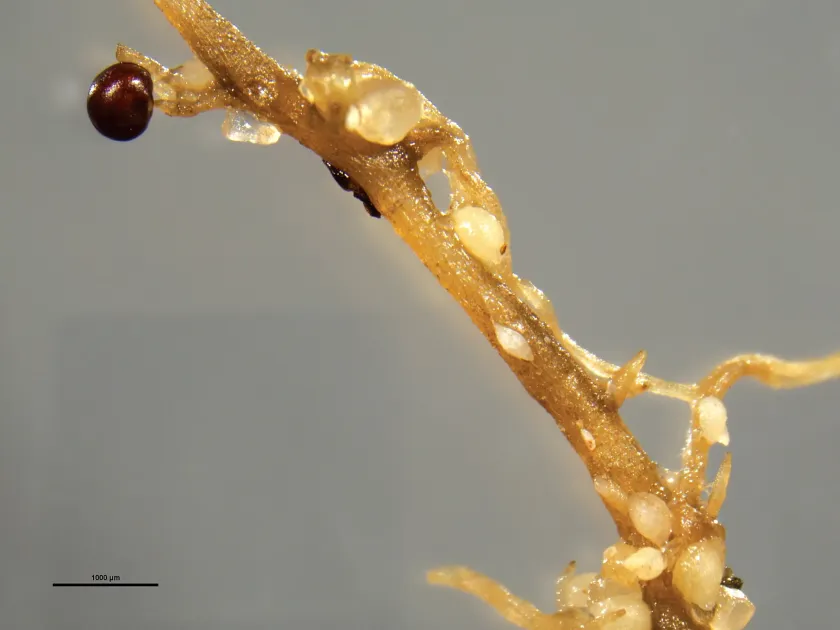
The adult female is lemon-shaped and white, eventually turning into a tough, brown, flask-shaped cyst that protects eggs and larvae for years.
The males are vermiform and are responsible for fertilization, which is required for the production of the next generation of offspring.
Infective second-stage juveniles emerge from the cysts in response to root exudates from host plants and migrate through the soil to locate a suitable root.
Diagnosis usually requires professional soil sampling and analysis to identify the density of cysts, as visual identification in the field is rarely sufficient.
What it damages
The pest primarily targets crops in the Amaranthaceae family, with sugar beet, fodder beet, and red beet being the most economically significant hosts.
It also parasitizes various Brassicaceae species, such as oilseed rape, mustard, and cabbage, often allowing the population to persist in rotation.
Invasion of the root system causes the formation of syncytia, which disrupt the vascular tissue and hinder the plant's ability to transport nutrients and water.
This results in stunted growth, chlorosis, and, in severe cases, the complete collapse of the plant due to lack of vigor and nutrient uptake.
The economic impact is high, resulting in decreased root yield and significantly lower sugar content, making the beets less valuable for processing.
When it appears
The life cycle is temperature-dependent, with activity typically starting in late spring when soil temperatures reach approximately 10°C to 12°C.
As the growing season progresses, the nematode can complete several generations, significantly increasing the population density within the root zone.
Late spring and summer are the critical periods for infestation, as larvae actively seek out roots to establish their feeding sites.
During dry conditions, the impact of the nematode is magnified as the impaired root system cannot compensate for the lack of available moisture in the soil.
Once the host plants are harvested or die, the nematode population remains in the soil in the cyst stage, waiting for the next favourable host crop.
Signs of infestation
The most recognizable sign is the presence of patches in the field where plants are small, yellowed, and wilt during the hottest parts of the day.
Examination of the roots often reveals excessive lateral branching, a condition known as "hairy root," caused by the plant's attempt to repair the damaged root system.
Tiny, white, lemon-shaped female nematodes may be visible on the surface of the roots during the peak growing season if carefully excavated.
Infected areas often show poor stand uniformity, and crop yields within these spots are significantly reduced compared to the rest of the field.
The premature yellowing and death of older leaves are common symptoms that worsen as the infestation level increases over time.
Control measures
Long-term crop rotation is the primary management strategy, with non-host crops preventing the nematode population from reaching damaging levels.
The use of trap crops, such as specific resistant varieties of oil radish or white mustard, can stimulate cyst hatching without allowing the nematode to reproduce.
Strict sanitation protocols for farm equipment are essential to prevent the mechanical transfer of contaminated soil between fields.
Maintaining optimal soil fertility and organic matter levels can help plants withstand nematode pressure and mitigate yield losses.
- Implement wide crop rotations
- Utilize resistant cultivars
- Control host weeds
- Practice thorough soil testing
- Ensure equipment sanitation
Reference
Connections · Beet cyst nematode
Most often together:
Marketplace
Products · 20





Biology
Taxonomy
- Latin name
- Heterodera schachtii
- Order
- Nematodes
- Family
- Heteroderidae
- EPPO code
- HETDSC
Community
Discussion
No discussions yet — be the first.