
Aphanomyces root rot
Aphanomyces euteiches
Description
How to identify
The pathogen Aphanomyces euteiches belongs to the Oomycota group, order Saprolegniales, family Leptolegniaceae. Despite being historically categorized as a fungus, it is technically an oomycete, also known as a water mold, which requires moisture to propagate.
The survival structure of this pathogen, known as oospores, is exceptionally resilient. These spores can remain viable in the soil for over a decade, waiting for environmental conditions, such as high moisture, and chemical signals from host plants to trigger germination.
Once conditions are favorable, oospores germinate into motile zoospores. These zoospores use flagella to swim through the film of water in the soil towards the roots of susceptible hosts, where they encyst and penetrate the host tissue to initiate the infection cycle.
Identification often requires professional diagnostic laboratory assistance. Standard plating on selective media or molecular techniques like PCR are essential to confirm the presence of Aphanomyces euteiches, as visual symptoms are easily confused with other pathogens.
The pathogen is highly specialized and its presence in the soil represents a long-term management challenge. Soil sampling and laboratory testing for inoculum density are standard practices in regions where legume cultivation is a major economic activity.
What it damages
The disease primarily targets leguminous crops, with peas, alfalfa, and lentils being the most economically impacted. The pathogen causes extensive damage to the root system, destroying the cortical tissue and compromising the plant's ability to uptake water and nutrients.
Severe infections lead to significant yield losses, often causing total stand failure in infested fields. Even in cases of moderate infection, the reduced root capacity prevents the plant from reaching its full physiological potential, leading to lower quality and yield.
When it appears
Infection thrives during periods of high soil moisture and warm temperatures, typically in late spring. Waterlogged soils are the primary driver of disease outbreaks, as the motile zoospores require liquid water to travel from the soil reservoir to the root surface.
Symptoms usually appear early in the season, during seedling establishment. However, if conditions remain wet throughout the growing season, the pathogen continues to spread, affecting lateral roots and severely inhibiting the plant's growth throughout its life cycle.
Signs of infestation
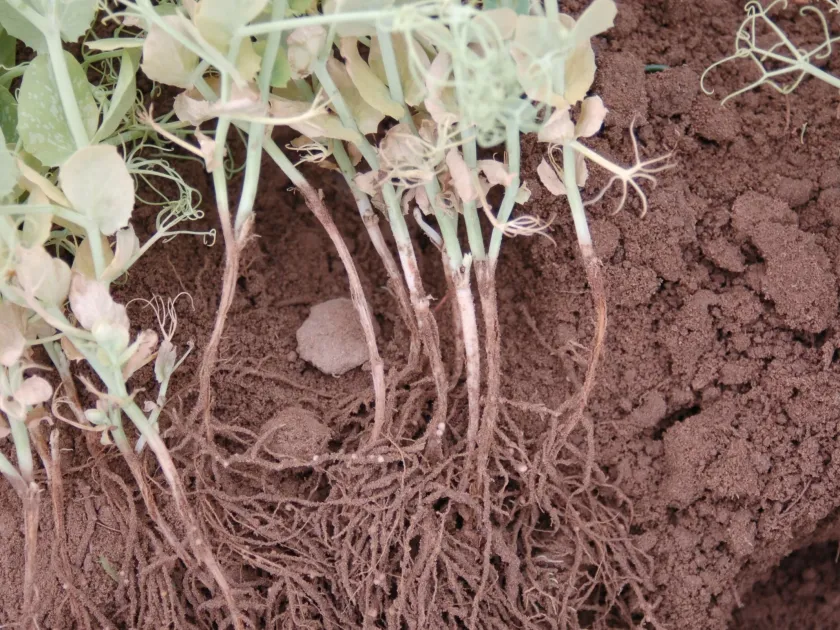
Plants affected by the disease exhibit symptoms such as yellowing, stunted growth, and a significant loss of vigor. The roots often appear water-soaked and discolored, shifting from light brown to a dark, blackened appearance as the rot advances further.
The root cortex often sloughs off, leaving behind a thin, fibrous central vascular cylinder. This destruction of the cortical tissue is a hallmark of the infection, effectively starving the plant and causing it to wilt prematurely despite adequate soil moisture levels.
Control measures
Management focuses on prevention and environmental manipulation. Long-term crop rotation is the most critical strategy, with recommended intervals of 6 to 8 years between susceptible legume crops to reduce the survival capacity of oospores in the soil.
- Improve soil drainage to prevent stagnant water in the root zone.
- Select cultivars with partial resistance or tolerance to Aphanomyces.
- Avoid planting in low-lying, poorly drained sections of the field.
- Apply seed treatments specifically labeled for protection against oomycetes.
- Practice stringent hygiene to avoid moving infested soil between fields via equipment.
Causes diseases · 2
Discussion
No discussions yet — be the first.