

Reference · Crops
Veronica
Veronica L.
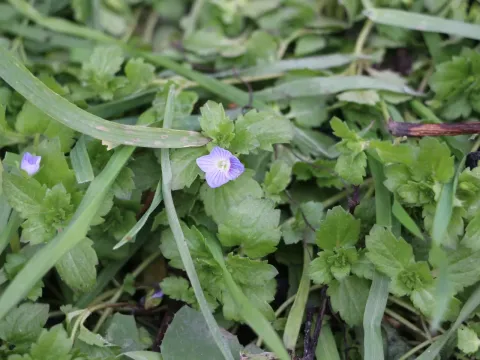
Veronica L. is a diverse genus of flowering plants belonging to the Plantaginaceae family. Historically placed in Scrophulariaceae, taxonomic updates have firmly reclassified these plants, which are now widely distributed across temperate regions of the Northern Hemisphere.
34
items
What the section contains
 Ivy-leaved speedwell
Veronica hederifolia L.
8 products
Ivy-leaved speedwell
Veronica hederifolia L.
8 products
 Corn speedwell
Veronica arvensis L.
1 product
Corn speedwell
Veronica arvensis L.
1 product
 Alpine speedwell
Veronica alpina L.
Alpine speedwell
Veronica alpina x Veronica spicata
Alpine speedwell
Veronica alpina L.
Alpine speedwell
Veronica alpina x Veronica spicata
 Anderson's speedwell
Veronica x andersonii Lindl. & Paxton
Anderson's speedwell
Veronica x andersonii Lindl. & Paxton
 Austrian speedwell
Veronica austriaca L.
Austrian speedwell
Veronica austriaca L.
 Blue water speedwell
Veronica anagallis-aquatica L.
Broadleaf speedwell
Veronica austriaca L. x Veronica spicata L.
Blue water speedwell
Veronica anagallis-aquatica L.
Broadleaf speedwell
Veronica austriaca L. x Veronica spicata L.
 Garden speedwell
Veronica longifolia L.
Garden speedwell
Veronica longifolia L.
 Green field-speedwell
Veronica agrestis L.
Green field-speedwell
Veronica agrestis L.
 Heath speedwell
Veronica officinalis L.
Hybrid of Veronica pusanensis and Veronica pyrethrin
Hybrids between Veronica pusanensis and Veronica pyrethrin
Heath speedwell
Veronica officinalis L.
Hybrid of Veronica pusanensis and Veronica pyrethrin
Hybrids between Veronica pusanensis and Veronica pyrethrin
 Hybrid speedwell
Hybrids between Veronica ovata and Veronica spicata
Hybrid speedwell
Hybrids between Veronica ovata and Veronica spicata
 Koromiko
Veronica salicifolia G. Forst.
Koromiko
Veronica salicifolia G. Forst.
 Pedunculate speedwell
Veronica peduncularis M. Bieb.
Pedunculate speedwell
Veronica peduncularis M. Bieb.
 Persian speedwell
Veronica persica Poir.
Persian speedwell
Veronica persica Poir.
 Prostrate speedwell
Veronica prostrata L.
Prostrate speedwell
Veronica prostrata L.
 Spiked speedwell
Veronica spicata L.
Spiked speedwell
Veronica spicata L.
 Spiked speedwell hybrid
Veronica ovata Nakai subsp. kiusiana (Furumi) Albach x V. spicata L.
Spiked speedwell hybrid
Veronica ovata Nakai subsp. kiusiana (Furumi) Albach x V. spicata L.
 Veronica albicans
 Petrie
Veronica albicans
Veronica albicans Petrie
 Veronica diosmifolia
 R. Cunn. ex A. Cunn.
Veronica elliptica
Veronica elliptica G. Forst.
Veronica matthewsii
Veronica matthewsii Cheeseman
Veronica diosmifolia
Veronica diosmifolia R. Cunn. ex A. Cunn.
Veronica elliptica
Veronica elliptica G. Forst.
Veronica matthewsii
Veronica matthewsii Cheeseman
 Veronica media
Veronica x media Schrad.
Veronica media
Veronica x media Schrad.
 Veronica odora
 Hook. f.
Veronica odora
Veronica odora Hook. f.
 Veronica ovata
 Nakai
Veronica ovata subsp. kiusiana
Veronica ovata Nakai subsp. kiusiana (Furumi) Albach
Veronica ovata
Veronica ovata Nakai
Veronica ovata subsp. kiusiana
Veronica ovata Nakai subsp. kiusiana (Furumi) Albach
 Veronica parviflora
 Vahl
Veronica parviflora
Veronica parviflora Vahl
 Veronica pimeleoides
 Hook. f.
Veronica pimeleoides
Veronica pimeleoides Hook. f.
 Veronica pinguifolia
 Hook. f.
Veronica pinguifolia
Veronica pinguifolia Hook. f.
 Veronica pusanensis
 Y. N. Lee
Veronica pusanensis
Veronica pusanensis Y. N. Lee
 Veronica pyrethrina
 Nakai
Veronica pyrethrina
Veronica pyrethrina Nakai
 Veronica speciosa
 R. Cunn. ex A. Cunn.
Veronica speciosa
Veronica speciosa R. Cunn. ex A. Cunn.
 Veronica x franciscana
 Eastw.
Veronica x franciscana
Veronica x franciscana Eastw.
Marketplace
Products in this section · 12


Veronica
These plants are highly adaptable to various climatic conditions, ranging from alpine slopes to moist meadows. For optimal cultivation, they require sites with sufficient sunlight, although many species tolerate partial shade depending on the specific cultivar's origin.
Soil requirements for Veronica generally favor well-drained, fertile substrates with a neutral pH. While some species are surprisingly drought-tolerant once established, providing consistent moisture during the early growth phase is essential for root system development.
Botanically, Veronica species are characterized by their simple leaves and distinct inflorescences, often racemes or spikes, which provide significant visual appeal. They demonstrate great potential for both ornamental landscaping and naturalized meadow restoration.
Economically, Veronica is utilized in traditional medicine and the herbal supplement industry. Its chemical profile, rich in iridoid glycosides and tannins, continues to be a subject of interest for pharmacological research regarding anti-inflammatory properties.
Powdery mildew represents the most frequent fungal challenge for Veronica. It thrives in humid conditions with limited airflow, necessitating careful spatial management and, when necessary, targeted fungicidal applications to protect foliage integrity.
Leaf spot diseases are also prevalent, particularly in dense plantings. These infections often result in premature senescence of leaves, which can be mitigated through regular pruning and ensuring that the foliage remains as dry as possible.
Pests such as aphids and leaf-eating caterpillars can cause significant damage to young succulent shoots. Integrated pest management strategies, including the introduction of natural predators, are preferred to maintain a balanced ecosystem.
Root-knot nematodes can occasionally pose a threat in lighter soil types. Implementing crop rotation cycles and utilizing certified, clean plant material are the best defensive measures against these soil-borne microscopic pests.
Gastropods, including slugs and snails, often feed on the tender foliage of young Veronica specimens. Protective measures, such as creating physical barriers or using baits, are often required during damp spring seasons to prevent widespread damage.