
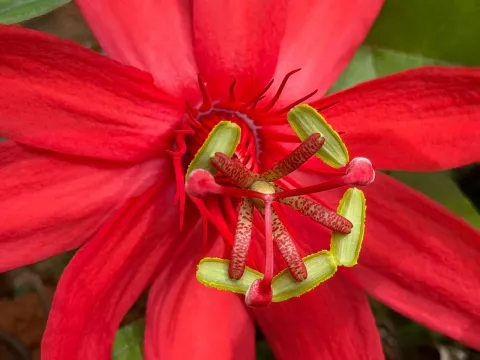
Passion fruit
Passiflora L.
Cultivation of passion fruit (Passiflora) usually begins with seeding, which requires scarification to ensure uniform germination. The optimal time for sowing in greenhouses is late winter or early spring, allowing young plants to establish themselves before the intense summer heat.
What the section contains
 Banana passionfruit
Passiflora mollissima (Kunth) L. H. Bailey
Banana passionfruit
Passiflora mollissima (Kunth) L. H. Bailey
 Banana passionfruit
Passiflora tripartita (Juss.) Poir.
Banana passionfruit
Passiflora tripartita (Juss.) Poir.
 Blue passionflower
Passiflora caerulea L.
Blue passionflower
Passiflora caerulea L.
 Giant granadilla
Passiflora quadrangularis L.
Giant granadilla
Passiflora quadrangularis L.
 Passiflora amethystina
 J. C. Mikan
Passiflora amethystina
Passiflora amethystina J. C. Mikan
 Passiflora amethystina and caerulea hybrid
Hybrids between Passiflora amethystina and Passiflora caerulea
Passiflora amethystina and caerulea hybrid
Hybrids between Passiflora amethystina and Passiflora caerulea
 Passiflora cincinnata
 Mast.
Passiflora cincinnata
Passiflora cincinnata Mast.
 Passiflora cincinnata x Passiflora incarnata hybrid
hybrids between Passiflora cincinnata Mast. and Passiflora incarnata L.
Passiflora cincinnata x Passiflora incarnata hybrid
hybrids between Passiflora cincinnata Mast. and Passiflora incarnata L.
 Passiflora cristalina
 Vanderpl. & Zappi
Passiflora gardneri
Passiflora gardneri Mast.
Passiflora cristalina
Passiflora cristalina Vanderpl. & Zappi
Passiflora gardneri
Passiflora gardneri Mast.
 Passiflora gibertii
 N.E.Br.
Passiflora gibertii
Passiflora gibertii N.E.Br.
 Passiflora insignis
 (Mast.) Hook. f.
Passiflora insignis
Passiflora insignis (Mast.) Hook. f.
 Passiflora Insignis-Mixta
Passiflora insignis x Passiflora mixta
Passiflora Insignis-Mixta
Passiflora insignis x Passiflora mixta
 Passiflora kermesina
 Link & Otto
Passiflora kermesina
Passiflora kermesina Link & Otto
 Passiflora kermesina x miersii hybrid
hybrids between Passiflora kermesina Link & Otto and Passiflora miersii Mart.
Passiflora kermesina x miersii hybrid
hybrids between Passiflora kermesina Link & Otto and Passiflora miersii Mart.
 Passiflora kewensis
Passiflora x kewensis Goldring
Passiflora kewensis
Passiflora x kewensis Goldring
 Passiflora laurifolia
 L.
Passiflora laurifolia
Passiflora laurifolia L.
 Passiflora miersii
 Mart.
Passiflora miersii
Passiflora miersii Mart.
 Passiflora mixta
 L. f.
Passiflora mixta
Passiflora mixta L. f.
 Passiflora nitida
 Kunth
Passiflora nitida
Passiflora nitida Kunth
 Passiflora setacea
 DC.
Passiflora setacea
Passiflora setacea DC.
 Passiflora sublanceolata
 (Killip) J. M. MacDougal
Passiflora sublanceolata
Passiflora sublanceolata (Killip) J. M. MacDougal
 Passiflora tenuifila
 Killip
Passiflora x belotii
Passiflora x belotii hort. ex Pépin
Passiflora tenuifila
Passiflora tenuifila Killip
Passiflora x belotii
Passiflora x belotii hort. ex Pépin
 Passion flower
Passiflora incarnata L.
Passion flower
Passiflora incarnata L.
 Passion flower hybrids
hybrids between Passiflora cincinnata Mast., Passiflora incarnata L., Passiflora edulis Sims f. flavicarpa O. Deg., Passiflora kermesina Link & Otto and Passiflora miersii Mart.
Passion flower hybrids
hybrids between Passiflora cincinnata Mast., Passiflora incarnata L., Passiflora edulis Sims f. flavicarpa O. Deg., Passiflora kermesina Link & Otto and Passiflora miersii Mart.
 Passion fruit
Passiflora edulis Sims
Passion fruit
Passiflora edulis Sims
 Passion fruit hybrid (Passiflora edulis x Passiflora incarnata)
hybrids between Passiflora edulis Sims f. flavicarpa O. Deg. and Passiflora incarnata L.
Purple Passion Flower
Passiflora x violacea Vell.
Passion fruit hybrid (Passiflora edulis x Passiflora incarnata)
hybrids between Passiflora edulis Sims f. flavicarpa O. Deg. and Passiflora incarnata L.
Purple Passion Flower
Passiflora x violacea Vell.
 Scarlet passion flower
Passiflora coccinea Aubl.
Scarlet passion flower
Passiflora coccinea Aubl.
 Scarlet passion flower
Passiflora miniata Vanderpl.
Softleaf passionflower
Passiflora tripartita var. mollissima (Kunth) Holm-Niels
Scarlet passion flower
Passiflora miniata Vanderpl.
Softleaf passionflower
Passiflora tripartita var. mollissima (Kunth) Holm-Niels
 Stinking passionflower
Passiflora foetida L.
Stinking passionflower
Passiflora foetida L.
 Sweet calabash
Passiflora maliformis L.
Sweet calabash
Passiflora maliformis L.
 Sweet granadilla
Passiflora ligularis Juss.
Sweet granadilla
Passiflora ligularis Juss.
 Winged-stem passion flower
Passiflora alata Dryander
Winged-stem passion flower
Passiflora alata Dryander
 Yellow passion fruit
Passiflora edulis Sims f. flavicarpa O. Deg.
Yellow passion fruit
Passiflora edulis Sims f. flavicarpa O. Deg.
Passion fruit
Seeds should be sown at a depth of 1 cm in a lightweight, well-draining substrate enriched with perlite. Maintaining a consistent soil temperature of 22-25 degrees Celsius is critical, as germination is significantly inhibited in cooler conditions.
For vegetative propagation, stem cuttings are taken during the active growth phase in late spring or summer. Using rooting hormones significantly increases the success rate of shoot establishment under controlled humidity.
Transplanting seedlings to their permanent location should only occur after the risk of frost has passed. Plants require significant spacing, typically 2-3 meters apart, to accommodate their vigorous vining nature and facilitate proper air circulation.
In commercial operations, grafting is often used to ensure early fruit production. Grafted seedlings provide enhanced resistance to soil-borne pathogens and contribute to higher uniformity in the orchard.
Passiflora is a genus of evergreen or deciduous vines in the Passifloraceae family, originating from tropical regions of South America. The plant is characterized by rapid vegetative growth and requires sturdy structural support for its climbing habits.
Passion fruit prefers sunny locations sheltered from strong, damaging winds. Sufficient light intensity is essential for flower induction and high fruit quality, making controlled environment agriculture necessary in temperate climates.
Soil requirements demand excellent drainage and a neutral to slightly acidic pH level. Waterlogging is highly detrimental, often causing root asphyxiation; therefore, preparing raised beds or integrating drainage layers is standard practice.
Consistent moisture management is vital, especially during the flowering and fruit-setting stages. However, over-irrigation must be avoided to prevent the proliferation of soil-borne fungi that thrive in saturated conditions.
Balanced fertilization programs using phosphorus and potassium are recommended to support fruit development. Nitrogen applications should be monitored carefully to prevent excessive vegetative growth at the expense of floral production.
Commercial production of passion fruit is centered on high-quality fruit output, widely consumed in the juice, beverage, and confectionery industries globally.
Yield varies significantly based on cultivar and management intensity. Under optimal agricultural practices, passion fruit can produce between 20 and 30 tons of fruit per hectare annually.
Economic yields typically begin in the second year, with peak production occurring between the third and fourth years. Economic longevity of the orchard usually spans 6 to 7 years, after which replanting is necessary to maintain profitability.
Harvesting is performed throughout the ripening period. It is essential to collect fruit promptly, particularly as they approach maturity, to prevent damage or rot caused by contact with moist soil.
Passion fruit is a premium commodity used extensively for processing into concentrates, nectars, and natural flavorings, sustaining a robust market in the tropical agricultural sector.
Passion fruit cultivation is susceptible to various pathogens that can drastically reduce orchard productivity. The primary challenges involve root zone diseases and systemic infections.
Key diseases and pests include:
- Anthracnose;
- Tomato mosaic virus and Tobacco mosaic virus;
- Pythium root rot and Fusarium root rot;
- Gray mold and Sclerotinia.
Root-knot nematodes represent a significant threat to root system integrity, causing stunting and overall plant decline. Pre-planting soil sterilization and nematode-resistant rootstocks are common mitigation strategies.
Integrated pest management (IPM) practices, including proper crop rotation and sanitation, are essential. Pruning infected material and ensuring sufficient plant spacing help maintain low humidity levels around the foliage, reducing fungal pressure.
Biosecurity is critical to prevent the spread of systemic viruses, such as mosaics. Tools and equipment must be disinfected between plants, as these pathogens are easily spread through manual handling and pruning processes.
Harvesting passion fruit is a labor-intensive process that requires careful observation of fruit maturity. Mature fruits are typically picked when the peel displays a full color change and the fruit separates easily from the vine.
Careful handling is required during picking to avoid bruising, which significantly shortens shelf life. Using shears to leave a portion of the peduncle intact helps prevent infection and moisture loss.
Rapid post-harvest cooling is necessary to extend the shelf life of fresh produce. Fruits are stored in high-humidity, temperature-controlled environments to minimize shriveling and weight loss.
During transportation, protective packaging is essential to avoid physical injury to the peel, which acts as the primary barrier against environmental pathogens and mold growth.
Logistics planning is critical to ensure that fruit is delivered to processing facilities or retail markets within the optimal window to maintain maximum aroma and nutritional value.