
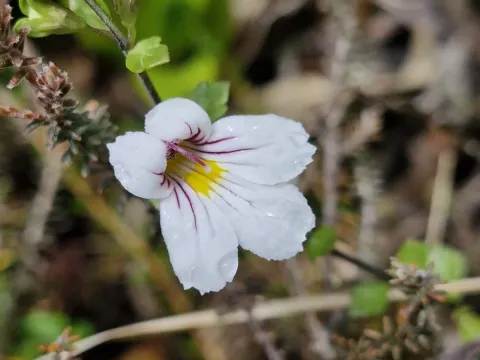
Eyebright
Euphrasia
Eyebright, scientifically known as Euphrasia, is an annual hemi-parasitic plant that germinates in early spring. Due to its unique biological nature, it requires host plants—typically various grass species—to establish its root system and begin growth.
What the section contains
 Alpine Eyebright
Euphrasia cisalpina
Alpine Eyebright
Euphrasia cisalpina
 Alpine eyebright
Euphrasia alpina
Alpine eyebright
Euphrasia alpina
 Arctic eyebright
Euphrasia arctica
Bhutanese eyebright
Euphrasia bhutanica
Arctic eyebright
Euphrasia arctica
Bhutanese eyebright
Euphrasia bhutanica
 Blue eyebright
Euphrasia coerulea
Blue eyebright
Euphrasia coerulea
 Canadian eyebright
Euphrasia canadensis
Canadian eyebright
Euphrasia canadensis
 Cold eyebright
Euphrasia frigida
Dinaric eyebright
Euphrasia dinarica
Cold eyebright
Euphrasia frigida
Dinaric eyebright
Euphrasia dinarica
 Dwarf eyebright
Euphrasia nana
Dwarf eyebright
Euphrasia nana
 English eyebright
Euphrasia anglica
English eyebright
Euphrasia anglica
 Euphrasia azorica
Euphrasia azorica
Euphrasia azorica
 Euphrasia cebennensis
Euphrasia cebennensis
Euphrasia cebennensis
 Euphrasia christii
Euphrasia christii
Euphrasia christii
 Euphrasia grandiflora
Euphrasia grandiflora
Euphrasia grandiflora
 Euphrasia hirtella
Euphrasia hirtella
Euphrasia hirtella
 Euphrasia insignis
Euphrasia insignis
Euphrasia insignis
 Euphrasia liburnica
Euphrasia liburnica
Euphrasia liburnica
 Euphrasia marchesettii
Euphrasia marchesettii
Euphrasia marchesettii
 Euphrasia maximowiczii
Euphrasia maximowiczii
Euphrasia maximowiczii
 Euphrasia minima
Euphrasia minima
Euphrasia minima
 Euphrasia nemorosa
Euphrasia nemorosa
Euphrasia nemorosa
 Euphrasia pectinata
Euphrasia pectinata
Euphrasia pectinata
 Euphrasia picta
Euphrasia picta
Euphrasia picta
 Euphrasia stricta
Euphrasia stricta
Euphrasia stricta
 Euphrasia tetraquetra
Euphrasia tetraquetra
Euphrasia tetraquetra
 Eyebright
Euphrasia rostkoviana
Eyebright
Euphrasia cuspidata
Eyebright
Euphrasia rostkoviana
Eyebright
Euphrasia cuspidata
 Himalayan eyebright
Euphrasia himalayica
Illyrian eyebright
Euphrasia illyrica
Himalayan eyebright
Euphrasia himalayica
Illyrian eyebright
Euphrasia illyrica
 Matsumura eyebright
Euphrasia matsumurae
Matsumura eyebright
Euphrasia matsumurae
 Salzburg eyebright
Euphrasia salisburgensis
Salzburg eyebright
Euphrasia salisburgensis
 Small-flowered eyebright
Euphrasia micrantha
Small-flowered eyebright
Euphrasia micrantha
 Tricuspid eyebright
Euphrasia tricuspidata
Tricuspid eyebright
Euphrasia tricuspidata
Eyebright
Seeds have low germination energy and require a cold stratification period to break dormancy. In nature, the plant self-seeds in late autumn, allowing the seeds to undergo natural winter chilling, which is essential for uniform germination the following year.
For cultivation, seeds should be surface-sown as they require light to trigger germination. Burying the seeds too deep will result in poor emergence, making shallow placement on prepared, grass-covered soil the most effective strategy.
It is vital to sow Eyebright in an environment already established with appropriate grass hosts. Without these hosts, the seedlings may germinate but will fail to reach maturity, as they are incapable of photosynthesis sufficient to support their full life cycle independently.
Timing is crucial, with late autumn or early winter being the best periods for sowing. If spring sowing is necessary, seeds must be artificially stratified in a cold environment for several weeks before being placed into the soil.
Eyebright thrives in temperate climates with consistent moisture and moderate temperatures. It is commonly found in meadows, pastures, and grassy forest clearings where the soil structure allows for good drainage without becoming excessively dry.
Soil requirements include a preference for neutral to slightly acidic pH levels. The plant is highly sensitive to the presence of its host; therefore, the health of the surrounding grass community directly dictates the health of the Eyebright population.
Light intensity is a significant factor, as Eyebright performs best in full sunlight or areas with sparse vegetation. Shady environments inhibit its development, reducing the overall biomass and the accumulation of secondary metabolites used in herbal medicine.
The plant does not require high levels of soil nutrients. In fact, providing external fertilizers is often counterproductive, as it favors the rapid growth of grasses which may outcompete and shade out the Eyebright before it can establish its parasitic connection.
Environmental stability is necessary to ensure the plant reaches the flowering stage. Extreme weather, particularly severe droughts in early summer, can cause premature wilting and death, significantly reducing the yield of harvestable material.
Fungal pathogens such as powdery mildew represent the primary threat to Eyebright crops, especially in areas with poor ventilation or high humidity levels. The development of white mycelium on leaves can severely limit the plant's growth potential.
Pests like aphids can infest the stems during the early stages of growth. While Eyebright possesses natural chemical defenses, large-scale outbreaks can cause significant stress, reducing the quality and quantity of the final harvest.
Competition from aggressive broad-leaved weeds poses a structural risk to the meadow ecosystem. If these weeds displace the required host grasses, the Eyebright loses its nutrient source and will wither, leading to a total loss of the crop on that site.
Root rot can occur if the soil remains waterlogged for extended periods. Even though the plant enjoys moisture, it cannot tolerate stagnant water, which damages the delicate haustoria used to attach to the host's roots.
Environmental disruption, including soil compaction or deep tilling, destroys the subterranean network required for Eyebright's semi-parasitic survival. Maintaining the meadow's integrity is the most effective form of threat prevention.
The harvest period for Eyebright is strictly limited to the peak of its flowering phase. During this time, the concentration of active compounds, including iridoids and tannins, is at its absolute maximum, ensuring high medicinal quality.
Harvesting should be done manually by cutting the aerial parts of the plant. It is essential to leave a portion of the plants in the field to drop their seeds, ensuring the continuity of the population for the next growing season.
Once collected, the material must be dried rapidly to prevent enzymatic breakdown. The best method involves using ventilated drying racks in the shade, protected from direct sunlight, which would otherwise degrade the sensitive chemical components.
Drying temperatures must not exceed 40 degrees Celsius. Excessive heat or improper drying conditions will lead to discoloration and a significant reduction in the efficacy of the dried herb, turning high-value material into waste.
Post-harvest storage requires airtight, light-proof containers kept in a cool, dry place. Proper storage prevents moisture absorption and maintains the botanical integrity of the herb, ensuring it remains suitable for its intended use in herbal preparations.