
Egyptian broomrape
Orobanche aegyptiaca
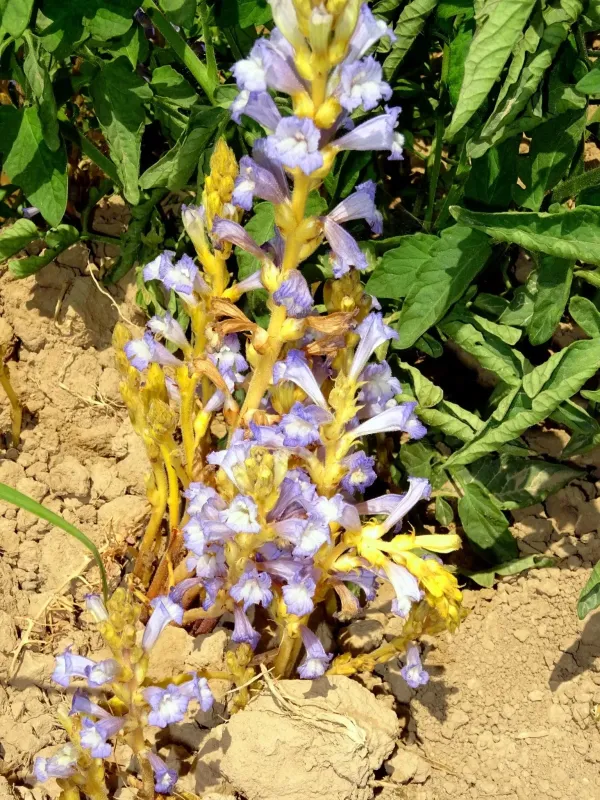
Description
Growing requirements
The Egyptian broomrape (Orobanche aegyptiaca) is a highly destructive holoparasitic plant belonging to the Orobanchaceae family. It lacks chlorophyll and cannot perform photosynthesis, making it entirely dependent on host plants for survival.
This parasitic plant lives underground for most of its life cycle, attaching itself to the roots of various crops such as tomatoes, potatoes, sunflowers, and melons. It utilizes a specialized organ called a haustorium to siphon nutrients and water from the host's vascular system.
Originating from arid regions in the Middle East and Central Asia, the Egyptian broomrape has expanded its range significantly. It is now considered a major threat to agricultural stability in many irrigation-dependent zones globally.
The biological strategy of the species is characterized by the production of hundreds of thousands of microscopic seeds. These seeds can survive in the soil for over a decade, remaining dormant until chemical cues from the roots of a compatible host trigger germination.
Optimal environmental conditions for the parasite include warm soil temperatures and adequate moisture. The presence of suitable host crops facilitates rapid expansion, especially in monocultural farming systems where rotation is rarely practiced.
Main diseases and pests
The Egyptian broomrape is categorized as a devastating agricultural pest due to the massive yield losses it inflicts. Unlike traditional insect pests, it is difficult to spot until the parasitic stalks emerge above ground, by which point the damage to the host is already advanced.
Affected crops exhibit signs of nutrient deficiency, stunting, and reduced biomass, which often leads to total crop failure. The parasite's ability to deplete the host's resources makes it nearly impossible to maintain healthy yields in infested fields.
Management strategies rely heavily on integrated pest management (IPM) practices, including the use of trap crops that stimulate 'suicidal' germination of broomrape seeds. Mechanical weeding and the destruction of broomrape shoots before seed set are essential manual tasks.
Chemical control is notoriously difficult because the parasite and the host are biologically linked. Developing resistant or tolerant crop cultivars remains the most effective research pathway to mitigate the economic impact of this weed.
Strict phytosanitary regulations are required to prevent the movement of contaminated equipment and seeds across borders. Once introduced into a field, the persistence of the seed bank requires long-term commitment to crop rotation and soil management.