
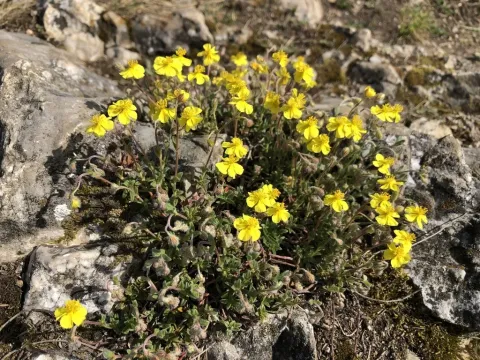
Sunrose
Helianthemum
Sowing Sunrose seeds usually takes place in mid-spring, once the soil has warmed up sufficiently to encourage germination and initial root development.
What the section contains
 Bicknell's hoary rockrose
Helianthemum bicknellii
Bicknell's hoary rockrose
Helianthemum bicknellii
 Bladder sunrose
Helianthemum vesicarium
Bladder sunrose
Helianthemum vesicarium
 Egyptian rockrose
Helianthemum aegyptiacum
Egyptian rockrose
Helianthemum aegyptiacum
 Felty-leaved rockrose
Helianthemum caput-felis
Felty-leaved rockrose
Helianthemum caput-felis
 Georgian Sunrose
Helianthemum georgicum
Georgian Sunrose
Helianthemum georgicum
 Grey rock-rose
Helianthemum cinereum
Grey rock-rose
Helianthemum cinereum
 Hairy rock-rose
Helianthemum hirtum
Hairy rock-rose
Helianthemum hirtum
 Hairy rockrose
Helianthemum ledifolium
Hairy rockrose
Helianthemum ledifolium
 Helianthemum almeriense
Helianthemum almeriense
Helianthemum almeriense
 Helianthemum buschii
Helianthemum buschii
Helianthemum buschii
 Helianthemum cretophilum
Helianthemum cretophilum
Helianthemum cretophilum
 Helianthemum kahiricum
Helianthemum kahiricum
Helianthemum kahiricum
 Helianthemum lippii
Helianthemum lippii
Helianthemum lippii
 Helianthemum marifolium
Helianthemum marifolium
Helianthemum marifolium
 Helianthemum orientale
Helianthemum rupifragum
Helianthemum rupifragum
Helianthemum orientale
Helianthemum orientale
Helianthemum rupifragum
Helianthemum rupifragum
 Helianthemum sanguineum
Helianthemum sanguineum
Helianthemum sanguineum
 Helianthemum stipulatum
Helianthemum stipulatum
Helianthemum stipulatum
 Helianthemum ventosum
Helianthemum ventosum
Helianthemum ventosum
 Helianthemum viscarium
Helianthemum viscarium
Helianthemum viscarium
 Hoary rock-rose
Helianthemum canum
Hoary rock-rose
Helianthemum canum
 Hoary rock-rose
Helianthemum pilosum
Hoary rock-rose
Helianthemum pilosum
 Hymettus rockrose
Helianthemum hymettium
Hymettus rockrose
Helianthemum hymettium
 Moon-leaved rock-rose
Helianthemum lunulatum
Moon-leaved rock-rose
Helianthemum lunulatum
 Narrowleaf rock rose
Helianthemum angustatum
Narrowleaf rock rose
Helianthemum angustatum
 Oeland rock-rose
Helianthemum oelandicum
Oeland rock-rose
Helianthemum oelandicum
 Rough rock-rose
Helianthemum asperum
Rough rock-rose
Helianthemum asperum
 Rush rose
Helianthemum scoparium
Rush rose
Helianthemum scoparium
 Saffron sunrose
Helianthemum croceum
Saint Anthony's Rockrose
Helianthemum sancti-antonii
Saffron sunrose
Helianthemum croceum
Saint Anthony's Rockrose
Helianthemum sancti-antonii
 Scaly rock-rose
Helianthemum squamatum
Scaly rock-rose
Helianthemum squamatum
 Sulphur Sunrose
Helianthemum sulphureum
Sulphur Sunrose
Helianthemum sulphureum
 Sunrose
Helianthemum hybrids
Sunrose
Helianthemum hybrids
 Syrian rock-rose
Helianthemum syriacum
Syrian rock-rose
Helianthemum syriacum
 Violet rockrose
Helianthemum violaceum
Violet rockrose
Helianthemum violaceum
 White rock-rose
Helianthemum apenninum
White rock-rose
Helianthemum apenninum
 Willow-leaved rockrose
Helianthemum salicifolium
Willow-leaved rockrose
Helianthemum salicifolium
Sunrose
Seeds should be sown at a shallow depth of about 0.5 to 1 cm, as they require light to stimulate the biological processes necessary for emergence.
When starting indoors, using seed trays filled with a sandy, well-draining substrate is recommended to prevent waterlogging, which seeds cannot tolerate.
The germination period typically spans between two and three weeks, provided the temperature remains within the optimal range of 18 to 22 degrees Celsius.
Thinning out seedlings is a crucial practice to ensure that each plant has sufficient airflow and space to develop its mature, branching form effectively.
The Helianthemum genus belongs to the Cistaceae family and is recognized for its preference for rocky, well-drained soils and high solar exposure.
Cultivation requires sites with excellent drainage and a neutral to alkaline pH level; calcareous soils are generally preferred for optimal plant health.
As a drought-tolerant species, the plant requires minimal irrigation, focusing primarily on the early growth stages before the root system is established.
The agronomic maintenance involves light pruning immediately after the main blooming period to promote bushier growth and rejuvenate the plant structure.
These plants demonstrate high resilience to harsh environmental conditions, though light winter protection is advisable in climates with severe, snowless frosts.
Root rot is the most significant pathological threat to Sunrose, primarily induced by excess soil moisture and poor drainage in the planting area.
Powdery mildew frequently affects the foliage during humid seasons, especially in areas with poor circulation, leading to aesthetic and physiological damage.
Pests such as aphids may occasionally cluster on the growing tips, causing stunted growth and reducing the plant's overall vigor during the active season.
Implementing integrated pest management includes maintaining adequate spacing and ensuring the soil composition prevents moisture retention around the root crown.
Regular monitoring of the plantation allows for early detection of disease, enabling the use of targeted fungicides to mitigate further spread across the field.