
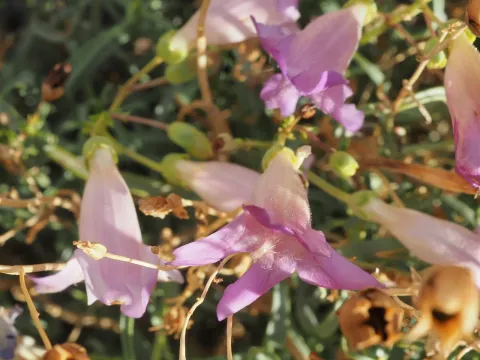
Penstemon
Penstemon
Sowing Penstemon seeds typically begins in late winter or early spring. Seeds are surface-sown on moist substrate, as light is required for germination, meaning they should not be deeply buried.
What the section contains
 Davidson's penstemon
Penstemon davidsonii
Davidson's penstemon
Penstemon davidsonii
 Eaton's penstemon
Penstemon eatonii
Eaton's penstemon
Penstemon eatonii
 Edith's penstemon
Penstemon edithae
Edith's penstemon
Penstemon edithae
 Gentian-leaved penstemon
Penstemon gentianoides
Gentian-leaved penstemon
Penstemon gentianoides
 Gray beardtongue
Penstemon canescens
Gray beardtongue
Penstemon canescens
 Narrowleaf penstemon
Penstemon angustifolius
Narrowleaf penstemon
Penstemon angustifolius
 Penstemon albertinus
Penstemon albertinus
Penstemon albertinus
 Penstemon barettiae
Penstemon barettiae
Penstemon barettiae
 Penstemon caespitosus
Penstemon caespitosus
Penstemon caespitosus
 Penstemon campanulatus
Penstemon campanulatus
Penstemon campanulatus
 Penstemon cardwellii
Penstemon cardwellii
Penstemon cardwellii
 Penstemon cobaea
Penstemon cobaea
Penstemon cobaea
 Penstemon gloxinioides
Penstemon gloxinioides
Penstemon gloxinioides
 Penstemon laetus
Penstemon laetus
Penstemon laetus
 Penstemon menziesii
Penstemon menziesii
Penstemon menziesii
 Penstemon newberryi
Penstemon newberryi
Penstemon newberryi
 Penstemon nitidus
Penstemon nitidus
Penstemon nitidus
 Penstemon ovatus
Penstemon ovatus
Penstemon ovatus
 Penstemon pinifolius
Penstemon pinifolius
Penstemon pinifolius
 Penstemon serrulatus
Penstemon serrulatus
Penstemon serrulatus
 Penstemon venustus
Penstemon venustus
Penstemon venustus
 Richardson's penstemon
Penstemon richardsonii
Richardson's penstemon
Penstemon richardsonii
 Rocky Mountain penstemon
Penstemon strictus
Rocky Mountain penstemon
Penstemon strictus
 Rocky Mountain Penstemon
Penstemon mensarum
Rocky Mountain Penstemon
Penstemon mensarum
 Rydberg's Penstemon
Penstemon rydbergii
Scouler's penstemon
Penstemon scouleri
Rydberg's Penstemon
Penstemon rydbergii
Scouler's penstemon
Penstemon scouleri
 Shrubby Penstemon
Penstemon fruticosus
Shrubby Penstemon
Penstemon fruticosus
 Slender beardtongue
Penstemon gracilis
Slender beardtongue
Penstemon gracilis
 Smooth beardtongue
Penstemon glaber
Smooth beardtongue
Penstemon glaber
Penstemon
A cold stratification period is crucial for many species to break seed dormancy. Containers are placed in a cool environment (2-5°C) for several weeks before being moved to warmer conditions to stimulate sprout development.
Direct sowing into the soil is viable only in regions with mild spring climates. The soil must be well-prepared and free from weeds to ensure that emerging seedlings are not outcompeted for nutrients and sunlight.
Spacing requirements vary by variety, generally requiring 30 to 50 centimeters between plants. Proper spacing is essential to ensure adequate air circulation and to prevent the development of foliage diseases.
Young plants require consistent monitoring during the establishment phase. Proper hardening-off procedures before transplanting into the open field significantly improve the survival rate of the crop.
Penstemon belongs to the Plantaginaceae family and is native to North America. It thrives in sunny locations with well-drained soil, avoiding areas prone to waterlogging or heavy moisture retention.
The ideal soil type for this crop is sandy loam or well-aerated light soil with a neutral to slightly acidic pH. Incorporating organic matter can help improve soil texture and nutrient availability over time.
Water management is critical, as Penstemon is drought-tolerant once established but needs steady moisture during its early growth stages. Excessive irrigation leads to root rot and premature plant death.
Fertilization with balanced NPK formulas during the active growing season supports flower production. Over-fertilization, however, can lead to leggy growth and reduced structural integrity of the stems.
Winter protection is necessary in colder climates, where mulching with straw or leaf cover provides the insulation required to survive freezing temperatures and prevent frost heaving.
Root rot is the most common threat, usually triggered by poor drainage or overwatering. Infected plants exhibit wilting and necrotic lesions at the base of the stem, often requiring plant removal.
Powdery mildew appears as a white, dusty layer on the leaves, favored by high humidity and poor air movement. Fungicidal treatments and thinning out dense foliage are the primary control measures.
Aphids and spider mites are typical pests that feed on plant sap, causing yellowing and deformation of leaves. Integrated pest management strategies are recommended to keep populations below economic damage thresholds.
Leaf spots caused by fungal pathogens can affect plant vigor. Regular monitoring and the sanitation of the garden space by removing infected debris help in breaking the pathogen lifecycle.
Slugs and snails can cause significant damage to young seedlings. Implementing physical barriers such as copper tape or using iron phosphate baits helps protect the crop during its vulnerable stages.