
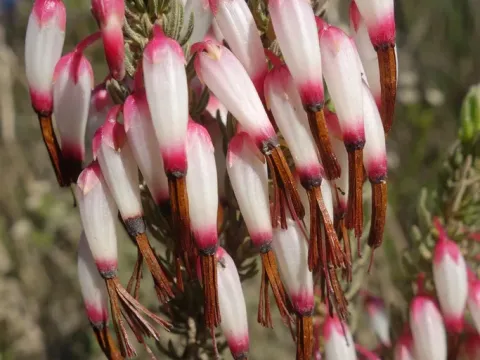
Erica
Erica L.
Erica (Erica L.) is a large genus of evergreen perennial shrubs belonging to the Ericaceae family. With over 800 recognized species, these plants are native primarily to Southern Africa, though some are indigenous to Europe and the Mediterranean.
What the section contains
 Bell heather
Erica cinerea L.
Bell heather
Erica cinerea L.
 Cornish heath
Erica vagans L.
Cornish heath
Erica vagans L.
 Corsican heath
Erica terminalis Salisb.
Corsican heath
Erica terminalis Salisb.
 Cross-leaved heath
Erica tetralix L.
Cross-leaved heath
Erica tetralix L.
 Dorset heath
Erica ciliaris L.
Dorset heath
Erica ciliaris L.
 Erica gracilis
 J. C. Wendl.
Erica gracilis
Erica gracilis J. C. Wendl.
 Erica mammosa
 L.
Erica mammosa
Erica mammosa L.
 Erica manipuliflora
 Salisb.
Erica manipuliflora
Erica manipuliflora Salisb.
 Erica melanthera
 L.
Erica melanthera hybrid
Erica melanthera x Erica sparsa
Erica melanthera
Erica melanthera L.
Erica melanthera hybrid
Erica melanthera x Erica sparsa
 Erica multiflora
 L.
Erica multiflora
Erica multiflora L.
 Erica nana
 Salisb.
Erica nana
Erica nana Salisb.
 Erica patersonia
 Andrews
Erica patersonia
Erica patersonia Andrews
 Erica praegeri
Erica x praegeri Ostenf.
Erica praegeri
Erica x praegeri Ostenf.
 Erica subdivaricata
Erica subdivaricata
Erica subdivaricata
 Erica vestita
 Thunb.
Erica vestita
Erica vestita Thunb.
 Erica vestita x Erica manipuliflora
Erica watsonii
Erica x watsonii Benth.
Erica vestita x Erica manipuliflora
Erica vestita x Erica manipuliflora
Erica watsonii
Erica x watsonii Benth.
 Erica woodii
 Bolus
Erica x darleyensis
Erica x darleyensis Bean
Erica woodii
Erica woodii Bolus
Erica x darleyensis
Erica x darleyensis Bean
 Irish heath
Erica erigena R. Ross
Irish heath
Erica erigena R. Ross
 Mackay's heath
Erica mackaiana Bab.
Mackay's heath
Erica mackaiana Bab.
 Portuguese heath
Erica lusitanica Rudolphi
Portuguese heath
Erica lusitanica Rudolphi
 Spanish heath
Erica australis L.
Spanish heath
Erica australis L.
 Sparse heath
Erica sparsa hort. Lodd., nom. nud.
Stuart's heath
Erica x stuartii E. F. Linton
Sparse heath
Erica sparsa hort. Lodd., nom. nud.
Stuart's heath
Erica x stuartii E. F. Linton
 Tree heath
Erica arborea L.
Tree heath
Erica arborea L.
 Tree heath
Erica scoparia L.
Veitch's Heath
Erica x veitchii Bean
Williams heath
Erica x williamsii Druce
Tree heath
Erica scoparia L.
Veitch's Heath
Erica x veitchii Bean
Williams heath
Erica x williamsii Druce
 Winter heath
Erica carnea L.
Winter heath
Erica x hiemalis hort
Winter heath
Erica carnea L.
Winter heath
Erica x hiemalis hort
Erica
The fundamental requirement for successful cultivation is soil acidity. Erica is a strict acidophile, necessitating a soil pH between 3.5 and 5.5. In alkaline conditions, the plant fails to absorb essential nutrients, leading to chlorosis and eventual death.
Erica requires well-draining, aerated soil rich in organic matter. Sandy or peaty substrates are ideal for promoting healthy root development. It is vital to avoid heavy, clay-rich soils that retain moisture, as the delicate root systems are prone to rot.
Climate needs vary by species, but generally, Erica thrives in regions with temperate, mild winters and cool summers. Most varieties prefer full sun to partial shade, providing that the air circulation around the plants remains constant.
Economically, the plant is highly valued in the nursery industry and ornamental horticulture. It is widely used in rock gardens, borders, and winter-flowering displays, providing essential nectar for pollinators early in the season.
Phytophthora root rot is the most serious threat to Erica, especially in soil with poor drainage. Once established, the fungus rapidly destroys the root system, causing the foliage to turn brown and the entire shrub to collapse.
Botrytis (grey mold) is a common fungal infection triggered by high humidity and poor ventilation. It manifests as a fuzzy grey growth on stems and flowers, requiring the removal of infected parts and appropriate fungicide treatment.
Mealybugs and spider mites are the most frequent insect pests. These pests extract sap from the foliage, weakening the plant and potentially causing leaf drop. Early identification and the use of horticultural oils can control infestations.
Root nematodes can negatively impact plant vigor by disrupting water and nutrient uptake. Using sterile potting mixes and maintaining healthy soil conditions helps mitigate the risk of nematode damage.
The best defense against disease is proper cultural practice. This includes watering with soft, lime-free water, applying a layer of pine bark mulch, and ensuring the shrubs are not overcrowded to facilitate good airflow.