
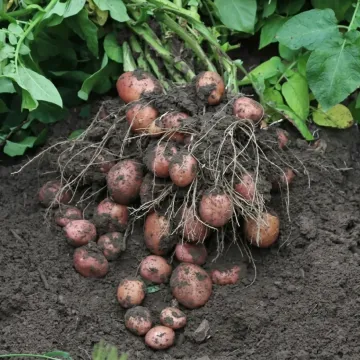
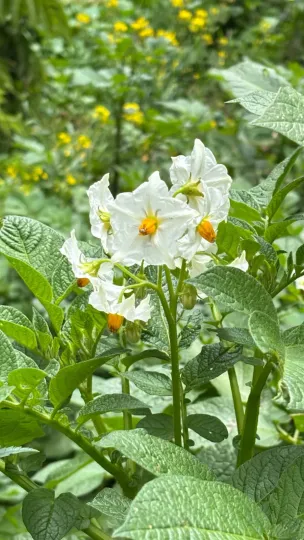
Description
Sowing dates
Potatoes are planted when the soil temperature reaches at least 7°C to 10°C at a depth of 10 cm, typically in mid-to-late spring.
Pre-sprouting (chitting) of seed tubers for several weeks prior to planting significantly accelerates emergence and promotes early crop development.
The standard planting density involves rows spaced about 70 cm apart, with tubers placed 25-30 cm apart to ensure adequate space for hilling.
Planting depth should be adjusted based on soil texture, ranging from 6-8 cm in heavier soils to 12 cm in light, loose sandy soils.
Strategic timing of planting helps the crop bypass late frosts and maximizes the benefit of available soil moisture during the crucial early growth phase.
Growing requirements
Potato (Solanum tuberosum L.) is a member of the Solanaceae family and is widely cultivated as one of the world's most significant food crops.
The crop thrives in well-drained, fertile, and loose soils; it is highly sensitive to waterlogging, which can cause tubers to rot prematurely.
Potatoes require abundant sunlight throughout the growing cycle, as insufficient light negatively affects photosynthesis and tuber bulking.
Regular irrigation is essential during the flowering and tuber formation stages, as water stress during these times directly correlates with reduced yields.
Crop rotation is a fundamental practice to prevent the buildup of soil-borne pathogens and to maintain optimal soil fertility for sustained potato production.
Yield
High-yielding agricultural systems can produce 30-50 tonnes per hectare, depending on the specific variety, soil quality, and management practices employed.
The use of certified, disease-free seed potatoes is the most critical factor in achieving potential maximum yields and maintaining crop vigor.
Proper nutrient management, including balanced NPK applications, is vital to support the plant throughout its intensive growth and starch-accumulation phase.
Regular hilling operations throughout the season prevent tuber greening by ensuring adequate soil coverage, which also helps control weeds.
Effective management of canopy density helps ensure that solar radiation is captured efficiently, leading to larger and more uniform tuber sizes.
Main diseases and pests
Potato crops face significant pressure from pathogens such as early blight (Alternaria), anthracnose, Verticillium wilt, Helminthosporium, and Rhizoctonia.
Viral infections, specifically Potato Virus A, Potato Virus X, and Tomato Mosaic Virus, can severely stunt plant growth and reduce overall harvest volume.
Insects like the greenhouse whitefly, various moth species, and gall midges can cause economic damage by feeding on foliage or transmitting viral diseases.
Other pests occasionally observed near potato fields include cabbage white butterflies, weevils like the Buçarka and Kazarka, pea weevils, and gold-tail moths.
Integrated pest management (IPM) strategies, including seed treatment and timely chemical applications, are necessary to protect the crop from these diverse threats.
Harvesting
Harvesting should occur once the haulms (tops) have withered and dried, signaling that the plant has completed its vegetative cycle and the skins have set.
Mechanical harvesting is often preceded by haulm killing (desiccation) to harden the tuber skin, which is vital for preventing bruising and skinning during storage.
Harvesting during dry weather minimizes soil adhesion and reduces the risk of field-to-storage contamination by pathogens like soft rot bacteria.
After excavation, tubers should be cured in a dark, well-ventilated area to allow small surface cuts to heal, significantly improving long-term storability.
For long-term storage, potatoes must be kept in a climate-controlled environment with high humidity and temperatures between 2°C and 4°C to prevent weight loss.
In brief
49
Crop diseases
60
Crop pests
Content graph
Crop diseases · 49
Alternaria leaf spotAnthracnoseArracacha virus BAster yellowsBlackspot bruiseCercospora leaf spotCharcoal rotCommon scabFusarium dry rotFusarium wiltFusarium wiltGray moldHelminthosporium leaf spotInternal rust spot of potatoLate blightParatrichodorus minorPhoma leaf spotPink eye of potatoPink rotPlant RustPotato deforming rustPotato leaf roll virusPotato leafroll virusPotato leaf spot (Cercospora)Potato smutPotato StolburPotato virus APotato virus XPotato wartPotato wartPowdery mildewPowdery scabPsyllid yellows of potatoPythium root rotRhizoctonia root rotRice stem rotRoot-knot nematodeSeptoriaSkin spot of potatoSowbane mosaicStem-end browningStem nematodeSting nematodeTobacco mosaic virusTomato mosaic virusUlocladium leaf spotVerticillium wiltWild potato mosaic virusWitches' broom
Content graph
Crop pests · 60
Alfalfa seed chalcidAlfalfa weevilAphidApple blossom weevilApple fruit weevilApple fruit weevilAustrian beetleBean aphidBeet flea beetleBeet midgeBeet webwormBeet weevilBrown-tail mothCabbage aphidCabbage mothCereal leaf beetleChloropid fliesCockchaferCodling mothColorado potato beetleCrucifer flea beetleDiamondback mothDiamondback mothEuropean apple sawflyEuropean corn borerEuropean grapevine mothEuropean vine mothFlax flea beetleGall midgesGrape phylloxeraGreen apple aphidGreenbugGreenhouse whiteflyGrey beet weevilGrey beet weevilGround beetle (Zabrus tenebrioides)Large whiteLeaf miner mothLeaf minersMealy plum aphidOnion flyOriental fruit mothPea aphidPea mothPea weevilPollen beetlePollen beetlePotato tuber mothPyralid mothsSand weevilSan Jose scaleSawfliesSucking pestsSucking pests complexSunn pestTurnip mothTurnip sawflyTwo-spotted spider miteWeevilWestern corn rootworm
Content graph
Connections · Potato
Most often together:
Marketplace
Products · 2120
All 2120
Herbicides, Desiccants 686
Fertilizers 497
Insecticides, Acaricides 433
Fungicides 282
Potato 109
Plant Growth Regulator 101
Biological Products 9
Rodenticides 2
Adjuvants 1
Racer
F.A.GAN Chemical Manufacturers Ltd. Israel, member
Herbicides
0
0
·
3K
10 offers
10.02 €per 1 l
Buy


Liquid nitrogen fertilizers brand KAS-32, r.
«ЄвроХім», ВАТ
Fertilizers
0
0
·
2.9K
4 offers
0.61 €per 1 kg
Buy


Shogun 100
F.A.GAN Chemical Manufacturers Ltd. Israel, member
Herbicides
1
0
·
2.9K
5 offers
6.44 €per 1 l
Buy



Pirate
Три Дельта Компані Інтернешнл, Гонконг, Китай.
Herbicides
3
1
·
2.8K
1 offer
37.84 €per 1 l
Buy


Vuksal Suspension, s.
«Аглюкон ГмбХ&Ко.Кг», Німеччина
Fertilizers
3
0
·
2.8K
4 offers
8.92 €per 1 kg
Buy


Komandor
Ф.Меатон Лімітед, Лондон, Великобританія.
Insecticides
0
0
·
2.7K
3 offers
17.41 €per 1 l
Buy


Alfazol
Nanjing No.1 Pesticide Factory of Red Sun Group Co., Ltd.
Insecticides
0
0
·
2.6K
2 offers
10.57 €per 1 l
Buy


Tivitus
ТОВ «Фабрика агрохімікатів», Черкаси, Україна
Herbicides
1
2
·
2.6K
7 offers
98 €per 1 l
Buy


Sharpei
ЗАТ Фірма Август, Росія.,селище Вурнари,
Insecticides
0
0
·
2.5K
2 offers
11.69 €per 1 l
Buy

Bypass
Ф.Суперус Ко ., Лтд., Гонг-Конг, Шанхай, Китай.
Herbicides
2
1
·
2.5K
2 offers
34.4 €per 1 l
Buy


Clear 480 SL
Жейянг Дейо Кемікал Індастріал Ко, Жейянг, Китай.
Herbicides
1
0
·
2.4K
12 offers
1.89 €per 1 l
Buy

Agil 100
F.A.GAN Chemical Manufacturers Ltd. Israel, member
Herbicides
0
0
·
2.3K
8 offers
5.04 €per 1 l
Buy


Quin Star
«Нанджин Ессенс Файн-Кемікал Ко. Лтд» (Китай)
Herbicides
2
0
·
2.3K
23 offers
1.83 €per 1 l
Buy


