

San Jose scale
Comstockaspis perniciosa
Description
How to identify
San Jose scale (Comstockaspis perniciosa, formerly Quadraspidiotus perniciosus) is a destructive pest belonging to the Diaspididae family and Hemiptera order.
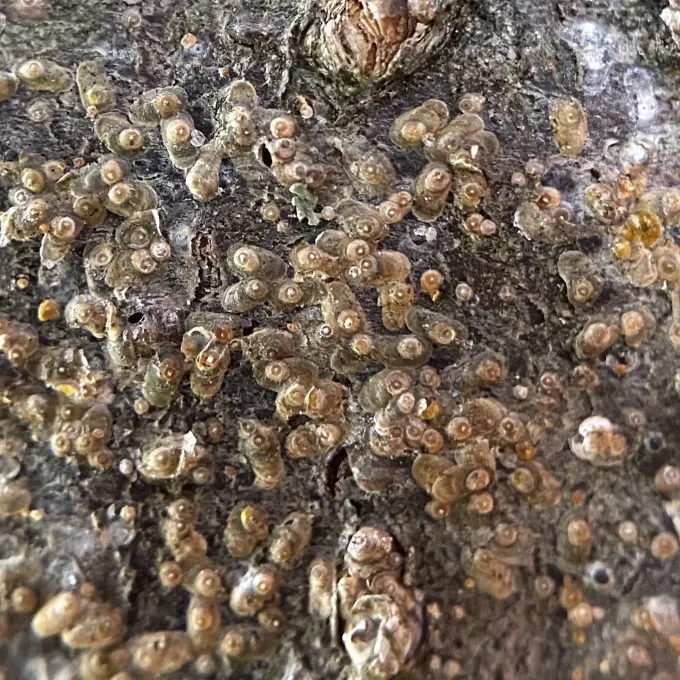
The female is sessile, protected by a circular, gray, shield-like covering about 2 mm in diameter. The male is small, winged, and mobile during the mating phase.
The first-instar nymphs, known as "crawlers," are bright yellow and highly active, allowing them to spread across the plant canopy and to neighboring trees.
This species is notorious for its ability to reproduce rapidly, often completing multiple generations within a single growing season depending on local climate.
It is classified as a significant quarantine pest in many countries due to its potential to devastate commercial fruit production.
What it damages
The pest primarily targets fruit trees, including apple, pear, and plum, where it settles on branches, twigs, and trunks in dense colonies.
While the pest can occur on other plants like tomatoes, cucumbers, eggplants, or winter barley, these are usually hosts of convenience rather than primary targets.
Feeding involves sucking plant sap and injecting saliva containing toxins that cause tissue death and prevent normal plant growth.
Severe infestations lead to branch dieback, leaf yellowing, and if left unchecked, the complete mortality of the infested tree.
Fruit quality is severely impacted as the scale insects cause unsightly red spots and pitting, making the harvest unmarketable.
When it appears
The insect overwinters as a first-instar nymph under the scale covering, remaining dormant until spring temperatures rise above 10°C.
As the growing season begins, the overwintering nymphs complete their development and emerge as adults to reproduce.
The period of "crawler" emergence typically aligns with the bloom stages of fruit trees, representing the most vulnerable window for chemical control.
Throughout the summer, successive generations overlap, creating a persistent pressure that requires ongoing observation and management.
In autumn, as day length and temperatures decrease, the population enters its overwintering phase, preparing for the cold period.
Signs of infestation
The most visible sign of infestation is a crusty, gray, ash-like appearance on the bark caused by the overlapping scales of the colony.
When the bark is scraped, the underlying tissue may show reddish discoloration, indicating the toxic impact of the pest's feeding activity.
Fruit infestation is signaled by distinct purple-red spots with a central lighter point where the scale insect is attached.
Stunted shoot growth and a general lack of vigor in the canopy are classic symptoms of a heavily infested tree struggling for survival.
In severe cases, the bark may crack, and sap may ooze from the feeding sites, further weakening the structural integrity of the branches.
Control measures
Effective management begins with strict quarantine measures, ensuring that only certified, scale-free nursery stock is introduced to the orchard.
Pruning out heavily infested branches and maintaining tree health helps to reduce the refuge sites available for the pest.
Dormant oil applications are highly effective in early spring, as they physically smother the overwintering scales before bud break.
- Application of systemic insecticides targeting the "crawler" stage.
- Promotion of natural enemies such as parasitic wasps and predatory beetles.
- Regular monitoring using pheromone traps to time insecticide applications accurately.
Integrated pest management (IPM) strategies should be employed to alternate chemical treatments and support biological control agents.
In brief
11
Damages crops
Content graph
Damages crops · 11
Reference
Connections · San Jose scale
Most often together:
Marketplace
Products · 35


Commandor, w.r.k., (imidacloprid, 200 g/l)
Chemiline Agro
Insecticides
0
0
1 offer
22.56 €per pack
Buy




Biology
Taxonomy
- Latin name
- Comstockaspis perniciosa
- Order
- Hemiptera (bugs, aphids, leafhoppers)
- Family
- Diaspididae
- EPPO code
- QUADPE
Community
Discussion
No discussions yet — be the first.