

Pest · Hymenoptera · affects Fodder beet, Winter barley, Apple
Especially harmful
Alfalfa seed chalcid
Bruchophagus roddi
Description
How to identify
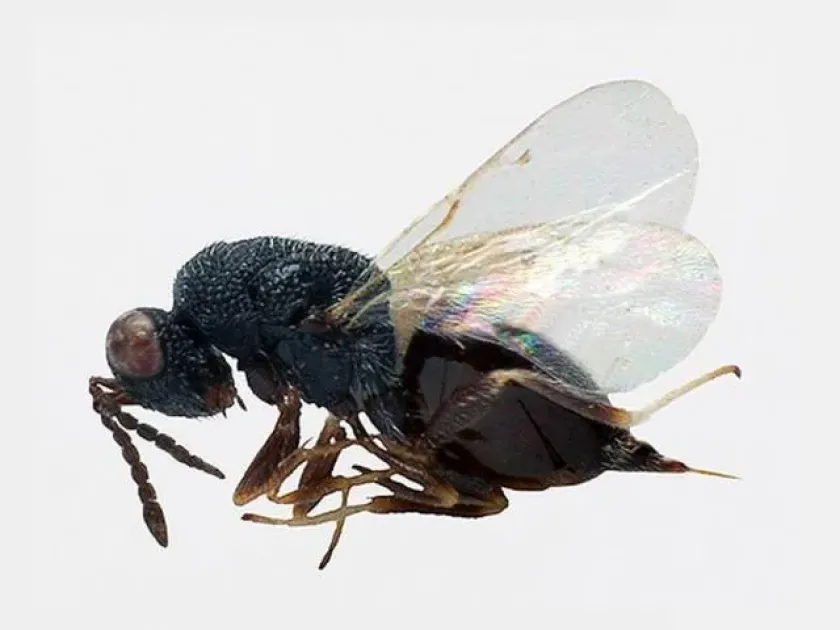
The Alfalfa seed chalcid, known scientifically as Bruchophagus roddi, is a small wasp in the family Eurytomidae within the order Hymenoptera. Adults are minute insects measuring approximately 2–3 mm in length.
The insect possesses a compact, black body with a notably thick abdomen, which is a distinctive morphological feature of this species. Its wings are clear, and the body surface appears finely pitted under magnification.
The larvae are small, legless, white to yellowish grubs. They spend their entire developmental period inside the host seed, where they consume the endosperm and embryo, eventually hollowing out the interior.
Due to their small size and rapid movement during flight, adults are often difficult to detect in a field environment without specific monitoring equipment.
Their life cycle is highly specialized, allowing them to remain hidden within seeds during their dormant phase, which ensures survival across seasons.
What it damages
This pest primarily attacks alfalfa (lucerne). It is considered a major threat to seed production, as the larvae target the plant's reproductive organs exclusively.
The larvae feed inside the developing seeds, effectively destroying the seed's viability. A single larva usually consumes the entire contents of a seed, leaving only a thin outer shell.
While the pest is associated with various legumes, the economic impact is most significant in alfalfa seed crops, where yields can be drastically reduced.
Because the damaged seeds often remain intact externally, they can easily pass through harvesting and cleaning processes, leading to the distribution of infested seeds.
Heavy infestations can lead to a substantial loss in seed weight and quality, making it difficult for growers to meet market standards for germination and purity.
When it appears
The Alfalfa seed chalcid overwinters as a mature larva inside infested seeds that remain in the field after harvest or in storage facilities.
Adults typically emerge in late spring, coinciding with the budding and early flowering stages of the alfalfa crop. This timing is critical for the pest to access the young, susceptible pods.
The flight period of the adults lasts throughout the alfalfa blooming season. During this time, females insert their ovipositors into the developing pods to lay eggs.
Depending on local climatic conditions, the pest can complete two or more generations per year, with activity peaking during warm, dry weather conditions.
Understanding the synchronization between the pest's emergence and the plant's phenology is essential for planning effective monitoring and management strategies.
Signs of infestation
The most visible sign of infestation is the presence of small, perfectly circular exit holes on the surface of the alfalfa seeds, indicating that an adult has emerged.
In the field, infested pods may show signs of premature yellowing or shriveling, which often indicates that the larvae are consuming the seeds inside.
Infested seeds are typically lighter in weight and can be identified by diagnostic methods such as floating tests or laboratory inspection of seed lots.
Yellow sticky traps placed near the upper canopy of the alfalfa can be used to detect the arrival of adult wasps and track their population density.
Regular scouting during the pod-filling stage is highly recommended to assess the potential impact and decide on the necessity of intervention measures.
Control measures
Effective management begins with strict cultural practices, including timely harvest of the seed crop to prevent the pods from shattering and releasing infested seeds into the field.
Deep plowing after harvest is a recommended technique to bury crop residues deep in the soil, preventing the overwintering adults from emerging the following season.
Maintaining spatial isolation between older, infested fields and new seedlings helps reduce the movement of the chalcids into younger crops.
Chemical control, if necessary, should be applied during the budding stage, always ensuring that applications avoid peak times for bee activity to protect pollinators.
Integrated Pest Management (IPM) programs should also emphasize the role of natural enemies and avoid the use of broad-spectrum insecticides that could disrupt natural control agents.
In brief
21
Damages crops
Content graph
Damages crops · 21
Reference
Connections · Alfalfa seed chalcid
Most often together:
Marketplace
Products · 5


Biology
Taxonomy
- Latin name
- Bruchophagus roddi
- Order
- Hymenoptera
- Family
- Eurytomidae
- EPPO code
- BRPHRO
Community
Discussion
No discussions yet — be the first.