

Pest · Coleoptera (beetles) · affects Winter wheat, Winter barley, Fodder beet
Especially harmful
Ground beetle (Zabrus tenebrioides)
Zabrus tenebrioides
Description
How to identify
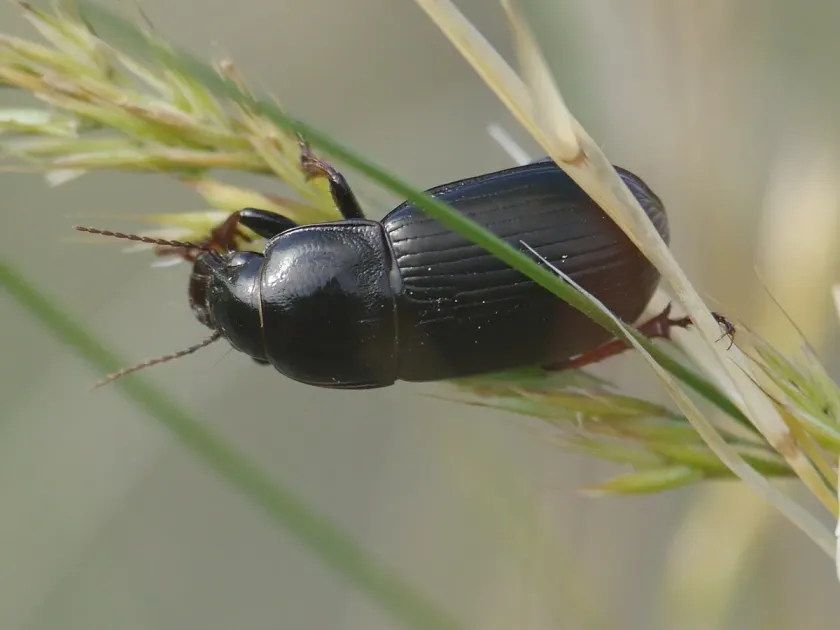
Zabrus tenebrioides, commonly known as the ground beetle or cereal ground beetle, is a significant insect pest belonging to the Carabidae family.
Adult beetles are 12–16 mm long, characterized by a convex, black body with a metallic sheen, and elytra with visible longitudinal grooves.
The larvae are campodeiform, reaching up to 30 mm in length, with a yellowish-brown head and a lighter, elongated body specialized for burrowing.
The life cycle is univoltine, meaning there is only one generation per year, with the larvae being the stage responsible for the most severe damage.
Pupation occurs in the soil during the spring, leading to the emergence of new adults which feed on maturing grain crops in early summer.
What it damages
This pest primarily attacks winter cereal crops, including winter wheat, barley, and rye, which suffer heavily from larval feeding in autumn and spring.
Besides cereals, it can also infest various other crops such as fodder beet, oilseed rape, cabbage, hemp, soybean, and even alfalfa and apple trees.
In autumn, larvae feed on the parenchyma of cereal leaves, turning the leaves into shredded fibers and potentially destroying entire plant stands.
Adult beetles feed on ripening grain in the ear, consuming the endosperm and causing substantial losses in yield quality and quantity.
Severe infestations create characteristic barren patches in fields, significantly reducing the density and overall health of the winter crops.
When it appears
Adult activity peaks during the grain-filling stage in June and July, when beetles congregate in the ears or beneath crop residues.
Following harvest, beetles move into the soil to escape the heat, becoming active again in the autumn to lay eggs coinciding with winter crop sowing.
Larval emergence starts in September and October, immediately targeting the newly sprouted winter cereal seedlings.
Larvae continue their feeding activities throughout the autumn until the onset of hard frosts, when they retreat deeper into the soil for overwintering.
Spring activity resumes once soil temperatures rise, with larvae feeding continuously until the pupation phase begins in late spring.
Signs of infestation
The primary symptom of infestation is the presence of unevenly distributed thinned patches or "bald spots" across the field during the seedling stage.
Damaged plants exhibit shredded leaves, as larvae consume the leaf edges, leaving only the central midribs intact, resulting in a tufted appearance.
Closer examination of the soil near damaged plants often reveals small burrows or tunnels where larvae hide during daylight hours.
In mature crops, damaged ears show partially empty glumes or grain loss where adults have chewed the spikelets during the milk or dough stages.
The accumulation of adults under straw swaths or surface debris is a clear indicator of a potential infestation risk for the upcoming season.
Control measures
Crop rotation is the most effective cultural practice, avoiding the planting of winter cereals immediately after previous cereal or grass crops.
Proper soil tillage, including stubble cultivation and deep plowing, helps disrupt the larvae's habitat and exposes them to natural predators.
Seed treatment with systemic insecticides is a mandatory practice for protecting seedlings from early-stage larval grazing in high-risk areas.
Chemical control using authorized foliar insecticides is recommended when larval population counts exceed the economic damage threshold.
Regular field scouting and monitoring are essential to identify hotspots and implement targeted management actions to prevent the spread of the pest.
In brief
17
Damages crops
Content graph
Damages crops · 17
Reference
Connections · Ground beetle (Zabrus tenebrioides)
Most often together:
Marketplace
Products · 241
All 241
Insecticides, Acaricides 221
Fungicides 6
Herbicides, Desiccants 4
Wheat 4
Sunflower 3
Plant Growth Regulators 1
Rye 1
Barley 1


Pirinex 48 EC, (chlorpyrifos, 480 g/l)
Makhteshim Chemical Works Ltd.
Insecticides
0
0
3 offers
2.29 €per 1 l
Buy


Biology
Taxonomy
- Latin name
- Zabrus tenebrioides
- Order
- Coleoptera (beetles)
- Family
- Carabidae
- EPPO code
- ZABUTE
Community
Discussion
No discussions yet — be the first.