

Pest · Coleoptera (beetles) · affects Fodder beet, Winter wheat, Potato
Especially harmful
Grey beet weevil
Tanymecus palliatus
Description
How to identify
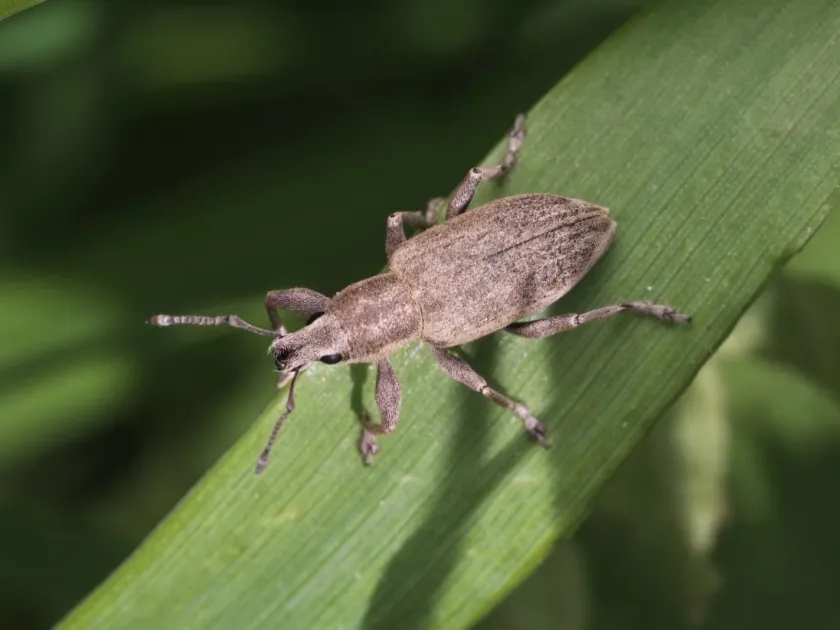
The grey beet weevil (Tanymecus palliatus) is a member of the Curculionidae family, characterized by its oblong body covered in dense grey or brownish scales.
Adults reach a length of 8–12 mm. Their head features a short, wide snout with a distinct longitudinal groove, which is a key diagnostic feature for identification.
The larvae are fleshy, legless, and white, with a brownish head capsule. They spend their entire life cycle in the soil, feeding on roots and organic debris.
These insects are adept at surviving in various soil types and are notably resistant to many environmental fluctuations, ensuring their persistence in farming areas.
Pupation occurs in the soil, usually at depths of 15 to 40 cm, where the pupae develop before emerging as adults in the following spring season.
What it damages
This polyphagous pest is known for causing significant damage to a wide range of economically important crops, often destroying early-stage sprouts.
Affected crops include:
- Fodder beet
- Winter rapeseed
- Garden cabbage
- Pepper
- Sunflower
- Winter barley
- Common hop
- Apple tree
Adult beetles primarily target the seedlings of newly germinated crops, consuming cotyledons and growth points, often leading to total stand loss.
Larvae contribute to the damage by feeding on the root systems, which results in stunted growth, nutrient deficiency, and increased susceptibility to fungal diseases.
The damage is particularly severe in dry weather conditions when seedling growth is slow, providing the pests with an extended window for feeding.
When it appears
Adults emerge from their overwintering sites in the soil when air temperatures consistently reach 10–12 degrees Celsius in early spring.
Peak activity and the most intense feeding period occur in May, coinciding with the germination and emergence of susceptible spring crops.
The flight period for these beetles extends through the early summer months, after which they shift their focus to mating and egg-laying in the soil.
The development cycle is typically biennial, meaning that a significant portion of the population is present as larvae in the soil at any given time.
New adults emerging in late summer often remain underground until the following spring, effectively creating a persistent population reservoir.
Signs of infestation
The most recognizable sign of infestation is irregular, notched edges on leaves, often referred to as "leaf stripping" or "scalloping" by farmers.
Total destruction of seedlings is common, where only the lower stem remains, causing empty patches within the crop rows.
In cases where larvae are present, localized wilting of plants can be observed as the root system fails to support the foliage due to direct damage.
Finding adult weevils in the soil around the base of the plant during early morning inspections is a reliable indicator of active infestation.
Inconsistent emergence and gaps in field rows are classic symptoms of seedling damage caused by the grey beet weevil during the critical establishment phase.
Control measures
Strategic crop rotation is essential, specifically avoiding planting susceptible crops adjacent to perennial grasses or long-term fallow fields.
Deep autumn tillage is highly effective at disrupting the life cycle by bringing soil-dwelling larvae and pupae to the surface, exposing them to predators and cold.
Seed treatment with systemic insecticides is the industry-standard approach for providing early-season protection to seedlings during their most vulnerable phase.
Foliar application of insecticides may be necessary if monitoring reveals pest density levels that exceed established economic injury thresholds.
Maintaining clean field borders by removing weeds reduces the available alternative food sources and shelter, discouraging the migration of beetles into crops.
In brief
16
Damages crops
Content graph
Damages crops · 16
Reference
Connections · Grey beet weevil
Most often together:
Marketplace
Products · 13


Biology
Taxonomy
- Latin name
- Tanymecus palliatus
- Order
- Coleoptera (beetles)
- Family
- Curculionidae
- EPPO code
- TANYPA
Community
Discussion
No discussions yet — be the first.