

Pest · Coleoptera (beetles) · affects Fodder beet, Winter wheat, Apple
Especially harmful
Beet weevil
Asproparthenis punctiventris
Description
How to identify
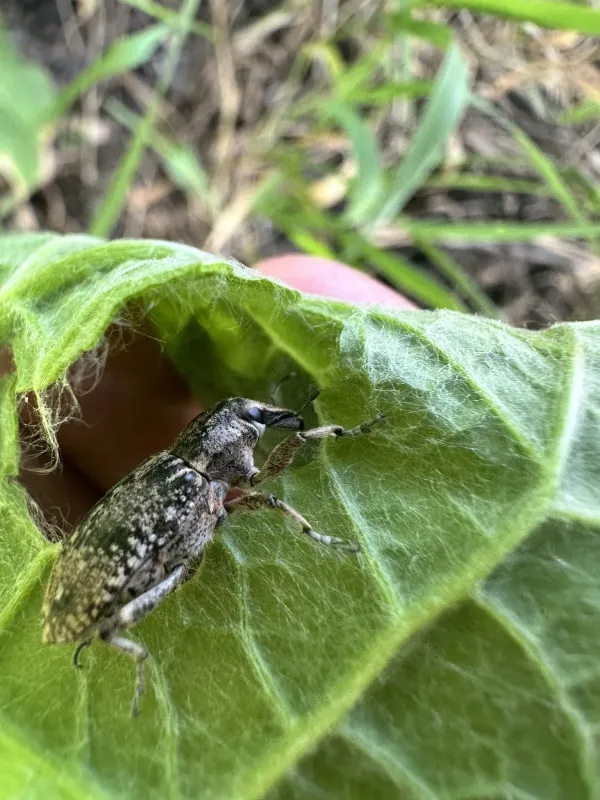
The beet weevil belongs to the Curculionidae family in the Coleoptera order. Adult beetles measure 12–16 mm in length, with bodies covered in dense grey or brown scales.
Key identification features include a short, thick rostrum and distinct dark spots on the elytra. Although they possess wings, they primarily move by crawling across the soil surface during daylight hours.
Larvae have a curved, white body with a yellow-brown head capsule. They develop entirely underground, feeding on the root systems of various host plants.
Pupation occurs within small earthen chambers constructed by the larvae at depths ranging from 10 to 30 cm, depending on soil texture and moisture conditions.
The life cycle typically spans one to two years. Adults overwinter in the soil, emerging in the spring once temperatures have consistently warmed up.
What it damages
The primary hosts include sugar beets, fodder beets, and garden beets. When populations reach high levels, the weevil can readily migrate to other essential agricultural crops.
Crops prone to infestation include winter rapeseed, cabbage, hemp, peppers, soybeans, and sunflowers. Cases of damage to winter barley crops have also been documented.
The most critical damage occurs during the seedling stage, when adults consume the hypocotyl, often causing complete crop failure and requiring costly re-sowing of fields.
Subterranean larvae cause significant damage by feeding on lateral roots and boring into the main taproot, which creates pathways for secondary fungal infections and root rot.
Infected plants exhibit stunted growth, reduced yields, and lower overall quality, making them more susceptible to drought stress and various environmental pathogens.
When it appears
Emergence from overwintering sites begins in early spring as soon as soil temperatures reach approximately 7–10 degrees Celsius. Initially, they feed on weed hosts before moving to emerging crops.
Mass migration to beet fields typically coincides with the seedling emergence phase, which is the most vulnerable period for the crop's establishment.
Mating and oviposition occur throughout May. Females deposit eggs in the surface soil layers near host plants, where moisture levels are favorable for larval survival.
Larval development continues throughout the summer months. They actively move through the soil, continuously feeding on roots until they reach maturity for pupation.
By autumn, the new generation of adults is formed. While some stay underground for the winter, others may emerge briefly for supplemental feeding before entering diapause.
Signs of infestation
Typical damage symptoms include semi-circular notches eaten out from the edges of seedling cotyledons and leaves, a classic indicator of adult beet weevil presence.
Beetles can often be spotted on the soil surface during sunny days. They tend to exhibit "feigning death" behavior, falling still when disturbed, making them difficult to detect at first.
The presence of bare patches in the field and poor seedling density are clear indicators of early-season infestation, especially in fields with historical pressure.
Wilting of seemingly healthy plants during the day often signals that larvae have severely damaged the root system, inhibiting the plant's water uptake capacity.
Yellowing of foliage, particularly in localized spots within the field, often reveals the hidden presence of larvae consuming the root structure beneath the surface.
Control measures
Implementing a robust crop rotation is the primary preventive measure. Avoid planting beets in fields where they were grown the previous year or adjacent to such areas.
Maintaining spatial isolation—planting beets at least 1 kilometer away from previous year's fields—is highly effective in limiting mass infestation by adult weevils.
Seed treatment with systemic insecticides provides essential protection for seedlings during the early, most vulnerable weeks of development, preventing primary adult feeding damage.
During the growing season, if the pest threshold is exceeded, application of contact or systemic insecticides is recommended to manage the adult population before egg-laying occurs.
- Deep autumn plowing to disturb and destroy overwintering sites.
- Control of Chenopodiaceae weeds that act as alternate hosts.
- Use of high-quality seeds to promote vigorous, rapid germination.
- Regular field scouting using pitfall traps to monitor beetle arrival.
In brief
22
Damages crops
Content graph
Damages crops · 22
Reference
Connections · Beet weevil
Most often together:
Marketplace
Products · 18


Biology
Taxonomy
- Latin name
- Asproparthenis punctiventris
- Order
- Coleoptera (beetles)
- Family
- Curculionidae
- EPPO code
- CLEOPU
Community
Discussion
No discussions yet — be the first.