

Pest · Hemiptera (bugs, aphids, leafhoppers) · affects Winter wheat, Sorghum, Fodder beet
Especially harmful
Greenbug
Schizaphis graminum
Description
How to identify
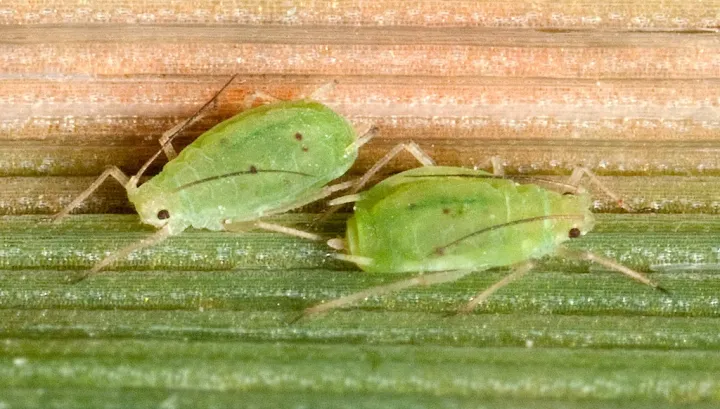
The Greenbug, scientifically known as Schizaphis graminum, is a small aphid belonging to the Aphididae family. It is easily identified by its light green body and a distinct darker green longitudinal stripe along the abdomen.
Both winged and wingless forms exist within the colony. The winged females are responsible for dispersing the infestation to new fields via wind currents.
The life cycle is rapid, especially in warm weather, allowing for multiple generations within a single growing season.
Overwintering occurs as eggs on winter cereals or perennial grasses. In milder climates, the aphid can persist throughout the year as nymphs or adults.
Their ability to reproduce parthenogenetically allows populations to explode in numbers within a very short period of time.
What it damages
This pest primarily attacks cereals like barley, wheat, rye, and oats. However, it can also infest crops such as soybeans, oilseed rape, mustard, peas, and even tomato or apple trees if populations are high.
Greenbugs feed by inserting their stylets into the plant tissue and injecting saliva containing enzymes that are toxic to the plant cells.
This feeding behavior causes the destruction of chlorophyll, leading to yellowing (chlorosis) and necrosis of the leaves.
In addition to direct damage, they serve as significant vectors for plant viruses, particularly the Barley Yellow Dwarf Virus (BYDV).
Severe infestations can lead to total crop failure, especially if the plants are stressed by drought or nutrient deficiencies.
Signs of infestation
The first signs of infestation are small, localized yellow or orange spots on the leaves where the aphids have been feeding.
As the colony grows, the yellowing spreads, causing the entire leaf to eventually curl, turn brown, and wither.
Examining the underside of the leaves or the leaf sheath often reveals dense colonies of small, green-colored insects.
Sticky honeydew secretions on the foliage are a clear indicator of aphid presence, often attracting ants and promoting sooty mold growth.
General plant stunting and reduced tiller development are clear indicators of significant pest pressure in the field.
Control measures
Integrated Pest Management (IPM) is essential for managing Greenbug populations effectively without disrupting the balance of natural predators.
Chemical control should be reserved for when populations exceed economic injury thresholds, utilizing selective insecticides to preserve beneficial insects.
Conservation biological control, such as protecting lady beetles, lacewings, and parasitic wasps, can significantly keep aphid numbers in check.
Cultural practices, including destruction of volunteer grains and proper weed management, reduce the initial inoculum in the field.
- Planting resistant crop varieties to reduce colonization success.
- Using systemic insecticidal seed treatments in high-risk areas.
- Regular field scouting during early growth stages.
- Applying nitrogen fertilizers judiciously to avoid excessive succulent growth that attracts aphids.
In brief
11
Damages crops
Content graph
Damages crops · 11
Reference
Connections · Greenbug
Most often together:
Marketplace
Products · 37






Biology
Taxonomy
- Latin name
- Schizaphis graminum
- Order
- Hemiptera (bugs, aphids, leafhoppers)
- Family
- Aphididae
- EPPO code
- TOXOGR
Community
Discussion
No discussions yet — be the first.