
Colorado potato beetle
Leptinotarsa decemlineata
Description
How to identify
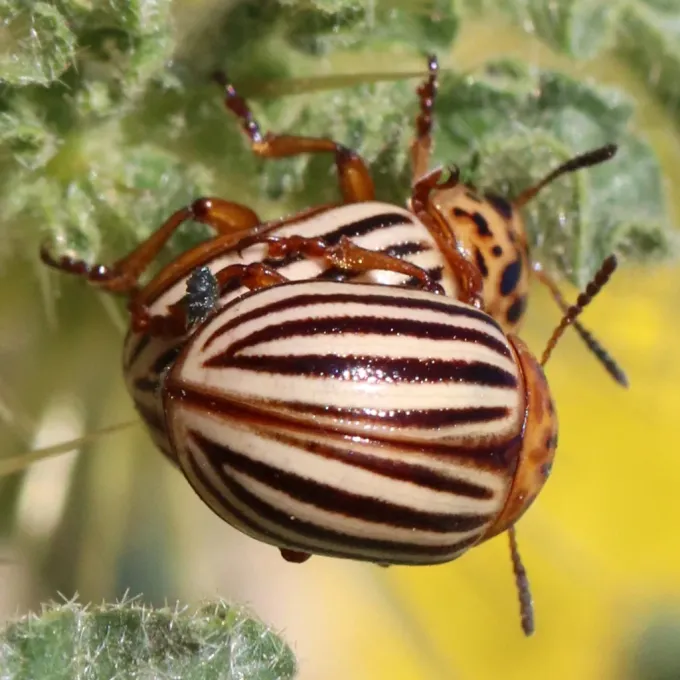
The Colorado potato beetle (Leptinotarsa decemlineata) is a prominent pest belonging to the leaf beetle family. It undergoes four larval stages, with significant changes in size and color throughout its growth.
Larvae are typically hump-backed, starting as dark reddish-brown or gray in early stages and turning a brighter pinkish-orange as they mature, with two distinct rows of black spots along their sides.
Adult beetles have a characteristic oval shape, measuring about 10 mm in length. They are easily recognizable by their yellow-orange color and ten prominent black longitudinal stripes on their wing covers.
The life cycle encompasses egg, larval, pupal, and adult stages. The pupal stage occurs in the soil, which makes it particularly challenging to manage during the dormant period.
Adults overwinter deep in the soil, emerging in late spring as temperatures rise. They are strong flyers and can disperse quickly to colonize new fields and host plants.
What it damages
This beetle primarily affects potatoes, although it is also a major pest for tomatoes, eggplants, and peppers. These solanaceous crops provide optimal conditions for the beetle's development.
The larvae are notoriously gluttonous and can strip entire potato plants of their foliage in a short period. This extensive feeding behavior is the main cause of economic loss.
Feeding typically begins at the leaf margins and progresses until the entire leaf blade is consumed. Severe infestations often leave only the main stems of the plant intact.
The destruction of leaves hinders photosynthesis, directly affecting the plant's ability to produce tubers. This results in stunted growth, smaller potato sizes, and significantly lower yields.
Furthermore, the beetle is known to vector various plant pathogens, increasing the risk of secondary infections and viral diseases within the infested potato field.
When it appears
The emergence of the Colorado potato beetle typically coincides with the sprouting of potatoes in spring. Adults begin feeding and mating as soon as they emerge from the soil.
The peak activity of larvae usually occurs during the early to mid-summer months, often overlapping with the critical flowering stage of the potato plants.
Depending on regional climate conditions, the beetle can complete one to three generations per year, leading to overlapping populations of eggs, larvae, and adults.
High temperatures and adequate moisture levels promote rapid development. In such conditions, the entire life cycle from egg to adult can take as little as 30 to 40 days.
As the season nears its end, adult beetles prepare for hibernation by feeding intensely before digging down into the soil to escape the winter cold.
Signs of infestation
The presence of bright orange or yellow egg clusters on the underside of leaves is the earliest sign of an infestation, indicating the need for immediate action.
Skeletonized leaves, where only the veins remain, are a clear indication that larvae are actively feeding. Often, the presence of dark fecal matter confirms the larvae's recent activity.
Adult beetles are highly visible due to their contrasting stripes. Their presence on the tops of leaves during warm, sunny days is a common indicator of colonization.
Wilting and stunted growth of potato bushes, combined with missing foliage, are symptoms of heavy feeding pressure that has already compromised the plant's health.
Increased presence of other insects or ants on the plants can sometimes correlate with the honeydew-like secretions or tissue damage caused by the beetles.
Control measures
Integrated Pest Management (IPM) is crucial, combining cultural, biological, and chemical strategies to reduce beetle populations effectively and sustainably.
Biological control options include the use of specific microbial insecticides, such as those based on Bacillus thuringiensis, which target larvae without harming beneficial insects.
Chemical control remains a common method, but it is vital to rotate different classes of insecticides to prevent the development of resistance in beetle populations.
- Practice crop rotation to distance potato crops from the previous year's infested sites.
- Hand-picking larvae and egg masses in home gardens to reduce initial pressure.
- Utilizing resistant or early-maturing potato varieties to minimize exposure time.
Post-harvest soil cultivation can help disturb pupae and reduce the number of successful overwintering adults, providing a proactive step for the next planting season.
In brief
1
Damages crops
Content graph
Damages crops · 1
Content graph
Connections · Colorado potato beetle
Most often together:
Marketplace
Products · 368
All 368
Insecticides, Acaricides 301
Potato 15
Plant Growth Regulators 11
Herbicides, Desiccants 9
Fungicides 7
Beans 5
Eggplant 4
Sunflower 3
Sugar Beet 2
Biological Products 2
Zucchini 1
Radish 1


Komandor
Ф.Меатон Лімітед, Лондон, Великобританія.
Insecticides
0
0
·
2.7K
5 offers
200.21 €per 1 l
Buy

Alfazol
Nanjing No.1 Pesticide Factory of Red Sun Group Co., Ltd.
Insecticides
0
0
·
2.6K
1 offer
11.87 €per 1 l
Buy


Nuprid 200
Нуфарм Австралія Лтд. , Австралія (місце виробництва: Чілі
Insecticides
0
0
·
1.9K
6 offers
26.52 €per 1 l
Buy




SuperBison
«Юнісіті Ентерпрайсіс Л.П.», Единбург, Великобританія
Insecticides
0
0
·
1.7K
11 offers
1.6 €per 1 l
Buy


Death To Beetles
«Нанджин Ессенс Файн-Кемікал Ко. Лтд» (Китай)
Insecticides
0
0
·
1.6K
8 offers
23.55 €per 1 l
Buy

Contact Plus
Parijat Industries (India) Pvt. Ltd, Індія.
Insecticides
1
0
·
1.6K
19 offers
1.22 €per 1 l
Buy


Klops
Ф.Суперус Ко ., Лтд., Гонг-Конг, Шанхай, Китай.
Insecticides
0
0
·
1.5K
1 offer
80 €per 1 l
Buy


Proti Kolorada
«Нанджин Ессенс Файн-Кемікал Ко. Лтд» (Китай)
Insecticides
0
0
·
1K
2 offers
2.8 €per 1 l
Buy



ALPHA- AMIPRID R.P.
Ф.Меатон Лімітед, Лондон, Великобританія.
Insecticides
0
0
·
161
2 offers
10.77 €per 1 l
Buy


Mospilan, r.p., (acetamiprid, 200 g/kg)
Nippon Soda Co
Insecticides
0
0
·
121
19 offers
3.2 €per 1 l
Buy


Alpha-Amid
«Юнісіті Ентерпрайсіс Л.П.», Единбург, Великобританія
Insecticides
0
0
·
95
3 offers
10.77 €per 1 l
Buy


Biology
Taxonomy
- Latin name
- Leptinotarsa decemlineata
- Order
- Coleoptera (beetles)
- Family
- Chrysomelidae
- EPPO code
- LPTNDE
Community
Discussion
No discussions yet — be the first.