
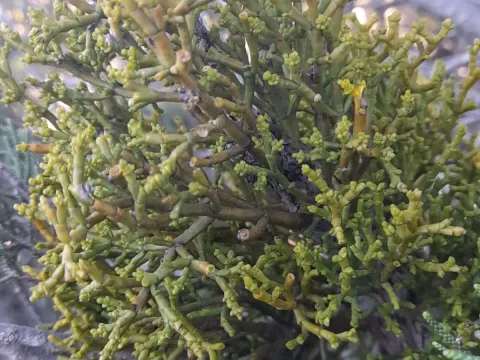
Arceuthobium
Arceuthobium
Arceuthobium, commonly known as dwarf mistletoe, is a genus of obligate parasitic plants within the Santalaceae family. Unlike conventional agricultural crops, these plants are considered significant forestry pests that derive their essential nutrients by attaching to various conifer tree species.
What the section contains
 Apache dwarf mistletoe
Arceuthobium apachecum
Apache dwarf mistletoe
Arceuthobium apachecum
 Arceuthobium blumeri
Arceuthobium blumeri
Arceuthobium blumeri
 Arceuthobium californicum
Arceuthobium californicum
Arceuthobium californicum
 Arceuthobium cyanocarpum
Arceuthobium cyanocarpum
Arceuthobium cyanocarpum
 Arceuthobium gambyi
Arceuthobium gambyi
Arceuthobium gambyi
 Arceuthobium gillii
Arceuthobium gillii
Arceuthobium gillii
 Arceuthobium minutissimum
Arceuthobium minutissimum
Arceuthobium minutissimum
 Arceuthobium vaginatum
Arceuthobium vaginatum
Arceuthobium vaginatum
 Azorean dwarf mistletoe
Arceuthobium azoricum
Azorean dwarf mistletoe
Arceuthobium azoricum
 Douglas fir dwarf mistletoe
Arceuthobium douglasii
Douglas fir dwarf mistletoe
Arceuthobium douglasii
 Dwarf mistletoe
Arceuthobium pusillum
Dwarf mistletoe
Arceuthobium pusillum
 Dwarf mistletoe (Arceuthobium microcarpum)
Arceuthobium microcarpum
Dwarf mistletoe (Arceuthobium microcarpum)
Arceuthobium microcarpum
 Fir Dwarf Mistletoe
Arceuthobium abietinum
Fir Dwarf Mistletoe
Arceuthobium abietinum
 Hemlock dwarf mistletoe
Arceuthobium tsugense
Hemlock dwarf mistletoe
Arceuthobium tsugense
 Juniper mistletoe
Arceuthobium juniperi-procerae
Juniper mistletoe
Arceuthobium oxycedri
Juniper mistletoe
Arceuthobium juniperi-procerae
Juniper mistletoe
Arceuthobium oxycedri
 Larch dwarf mistletoe
Arceuthobium laricis
Larch dwarf mistletoe
Arceuthobium laricis
 Lodgepole pine dwarf mistletoe
Arceuthobium americanum
Lodgepole pine dwarf mistletoe
Arceuthobium americanum
 Lodgepole pine dwarf mistletoe
Arceuthobium pini
Lodgepole pine dwarf mistletoe
Arceuthobium pini
 Piñon dwarf mistletoe
Arceuthobium divaricatum
Sichuan dwarf mistletoe
Arceuthobium sichuanense
Piñon dwarf mistletoe
Arceuthobium divaricatum
Sichuan dwarf mistletoe
Arceuthobium sichuanense
 Western dwarf mistletoe
Arceuthobium campylopodum
Western dwarf mistletoe
Arceuthobium campylopodum
 Western dwarf mistletoe
Arceuthobium occidentale
Western dwarf mistletoe
Arceuthobium occidentale
Arceuthobium
The plant features specialized root-like structures called haustoria, which penetrate the host's bark and phloem. These structures act as a bridge, diverting vital water and minerals from the host tree to support the development and reproduction of the parasitic dwarf mistletoe.
The distribution of Arceuthobium spans the Northern Hemisphere, with high concentrations in North American, European, and Asian coniferous forests. It thrives in humid climates where dense forest stands provide constant host availability and suitable conditions for the rapid spread of its seeds.
Propagation is facilitated by a unique ballistic seed dispersal mechanism. When ripe, the fruit releases seeds under high internal pressure, launching them at high speeds to adhere to the branches of neighboring trees, ensuring the continuity of the parasitic lifecycle.
Environmental requirements for the establishment of Arceuthobium are tied to the host's vigor and the presence of thin-barked young branches. While the parasite can colonize mature trees, it shows a marked preference for hosts that are experiencing stress, allowing for faster penetration of the tissues.
The primary threat posed by Arceuthobium is the systemic deformation of the host tree, characterized by the development of 'witch’s brooms'—dense, disordered masses of branches. This physiological distortion weakens the tree, leading to stunted growth and reduced timber quality.
Secondary infections occur when the parasite creates open lesions, allowing fungal pathogens and wood-rotting diseases to enter the tree trunk. These infections frequently lead to internal decay, rendering the wood unsuitable for lumber and significantly lowering its commercial value.
Insect pests, such as bark beetles and wood-boring insects, are attracted to trees compromised by Arceuthobium. The combination of parasitic nutrient siphoning and insect herbivory often results in premature tree mortality, which can lead to significant forest stand losses.
Forest management strategies primarily rely on sanitation harvesting, where infected trees are selectively removed to stop the spread of the parasite. Regular monitoring and inventory of forested areas are essential for detecting infestations early and preserving the health of the timber stand.
Recent advances in forest protection explore biological control options, including the introduction of fungi that specifically target the Arceuthobium plant without harming the host tree. Integrated pest management remains the most effective strategy for mitigating the economic impact on the timber industry.