
Larch dwarf mistletoe
Arceuthobium laricis
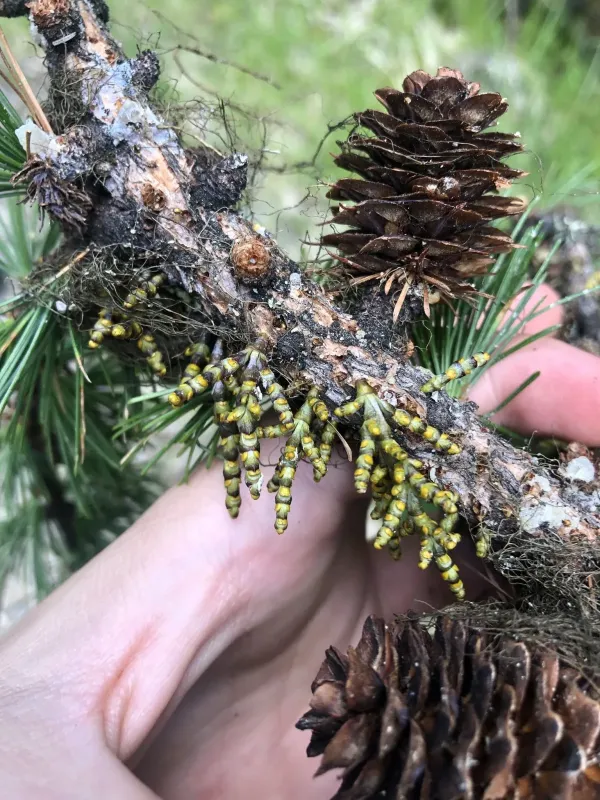
Description
Growing requirements
The Larch dwarf mistletoe (Arceuthobium laricis) is a parasitic plant belonging to the Santalaceae family, specialized in infecting larch trees.
This species is native to Western North America, primarily inhabiting regions where larch forests are prevalent and providing the necessary host environment.
Unlike autotrophic plants, it lacks fully functional leaves and relies entirely on the host tree's xylem to obtain water and essential nutrients for its survival.
Ecological adaptation involves a unique seed dispersal mechanism, where hydrostatic pressure allows the plant to eject seeds at high velocities to colonize new hosts.
Growth conditions are highly dependent on the host tree's health; the parasite thrives by penetrating the host's bark and establishing a systemic endophytic root-like structure.
Main diseases and pests
Infection by Arceuthobium laricis causes significant economic losses in silviculture by reducing timber quality and slowing tree growth rates considerably.
Common symptoms include the development of hypertrophied branches and large witches' brooms, which alter the tree's architecture and photosynthetic capacity.
Major management strategies include clear-cutting severely infested stands or performing selective sanitation cuts to minimize the parasite's seed distribution.
There are no reliable chemical systemic controls available to eliminate the parasite from within the host without harming the tree itself.
Forest management focuses on preventative measures, such as creating buffer zones and monitoring tree stands to stop the spread of this parasitic plant in young forest plantations.