
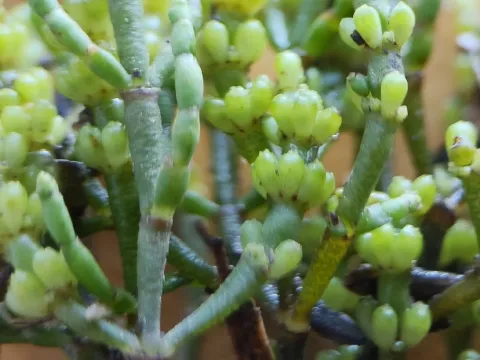
Korthalsella
Korthalsella
Korthalsella is a genus of parasitic plants belonging to the family Santalaceae. These unique organisms are characterized by their epiphytic habit, growing exclusively on the branches of woody host trees where they extract water and essential nutrients through specialized haustorial connections.
What the section contains


Korthalsella
The morphology of Korthalsella is highly reduced compared to terrestrial plants. They consist of photosynthetic, jointed segments that are either flattened or cylindrical. They lack true leaves and a standard root system, having evolved to exist entirely above the ground on their hosts.
The genus is widely distributed across the tropical and subtropical regions of the world. Key habitats include Southeast Asia, the Pacific Islands, Madagascar, parts of Africa, and Australia, where they thrive in warm and humid environments.
These plants require specific environmental conditions to establish themselves. High atmospheric humidity and consistent temperature are essential, as the seeds must adhere to the host branch and germinate successfully before the initial haustorium can penetrate the tree's bark.
While Korthalsella serves as an interesting subject for botanical study, it holds no agricultural value and is instead viewed as a forest parasite that can weaken host trees if infestations become too dense.
Major threats to Korthalsella populations include habitat loss due to deforestation, which removes the necessary host trees required for their survival and reproductive cycle.
Climate change and shifts in local precipitation patterns can also disrupt the delicate balance required for seedling establishment and host tree vitality.
Natural dispersal agents, such as birds that feed on the fruits, are vital for the plant's spread; a decline in bird biodiversity can limit the expansion of Korthalsella colonies.
Fungal infections that affect the bark of the host tree may destroy the infection sites needed by the parasite, serving as a limiting factor in local colonization.
In management contexts, sanitation pruning in commercial or ornamental tree groves is often the primary method used to mitigate the spread of Korthalsella.