
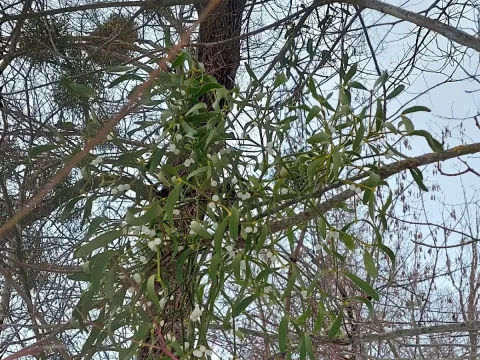
Mistletoe
Viscum
Mistletoe is a genus of evergreen semi-parasitic shrubs belonging to the Santalaceae family. It is recognized for its unique habit of growing on the branches of woody plants while performing its own photosynthesis.
What the section contains
 Crimson-flowered mistletoe
Viscum cruciatum
Crimson-flowered mistletoe
Viscum cruciatum
 European mistletoe
Viscum album
European mistletoe
Viscum album
 Oriental mistletoe
Viscum orientale
Oriental mistletoe
Viscum orientale
 Painted mistletoe
Viscum coloratum
Painted mistletoe
Viscum coloratum
 Three-flowered mistletoe
Viscum triflorum
Three-flowered mistletoe
Viscum triflorum
 Viscum articulatum
Viscum articulatum
Viscum articulatum
 Viscum capitellatum
Viscum capitellatum
Viscum capitellatum
 Viscum continuum
Viscum engleri
Viscum engleri
Viscum fischeri
Viscum fischeri
Viscum loranthi
Viscum loranthi
Viscum continuum
Viscum continuum
Viscum engleri
Viscum engleri
Viscum fischeri
Viscum fischeri
Viscum loranthi
Viscum loranthi
Mistletoe
Native to temperate and subtropical regions of Europe, Asia, and Africa, mistletoe relies on a host tree for water and mineral salts, which it extracts via specialized root-like structures called haustoria.
The plant thrives in well-lit environments, typically settling in the upper canopies of broad-leaved trees like poplars, apples, and lindens. Its survival is closely linked to the health and humidity of its host environment.
There is no traditional agronomy for mistletoe as a crop; instead, it is managed as a pest control issue. Agricultural practices involve pruning infected branches to prevent the parasite from spreading across an entire tree.
Mistletoe is primarily spread by birds that consume the sticky berries and transfer seeds between branches. This natural mechanism makes it difficult to contain and requires ongoing forest maintenance.
The economic value of mistletoe is centered on the pharmaceutical industry. The plant is harvested for its active compounds, including lectins and viscotoxins, which are used in various medical formulations.
Harvesting is usually conducted manually, selecting high-quality leafy branches. The timing of the harvest is critical to ensure the highest concentration of medicinal active substances.
Recent research explores the potential of mistletoe extracts as an adjuvant therapy in oncology, which has increased scientific interest in the cultivation and standard analysis of the plant biomass.
Yield metrics in the industry are based on the dry weight of harvested aerial parts. While not a conventional crop, standardized production requires rigorous ecological monitoring of the harvest sites.
Apart from medicinal uses, mistletoe holds cultural significance in many Western countries, particularly as a decorative element during the winter season, generating seasonal demand.
Mistletoe is considered a significant threat to forest health. By intercepting nutrients, it weakens the host tree, leading to crown dieback and increased vulnerability to secondary infections.
Major issues associated with mistletoe include the reduction of tree growth rates and timber quality. Severe infestations can eventually cause the death of the host tree.
Effective management strategies include:
- frequent monitoring of trees;
- early pruning of infected branches;
- the removal of severely infested trees to serve as inoculum sources.
The plant is highly resilient and adaptive. Once it establishes its haustorial connection deep within the host's wood, removal becomes very difficult without damaging the tree significantly.
Forest protection measures are essential to mitigate the impact of mistletoe, ensuring the longevity of urban and natural tree populations in regions where the plant is invasive.