
Western dwarf mistletoe
Arceuthobium campylopodum
Description
Growing requirements
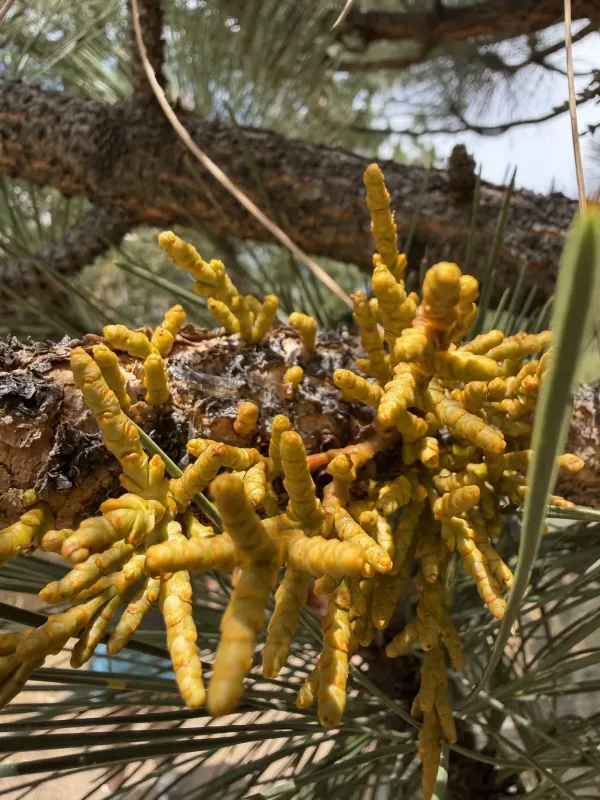
Western dwarf mistletoe (Arceuthobium campylopodum) is a significant parasitic plant species belonging to the Santalaceae family. It is strictly an obligate parasite that lacks the capacity for independent photosynthesis and requires a living host to complete its lifecycle.
The origin of this species is traced to the western forest ecosystems of North America. It is widely distributed across high-altitude coniferous forests, where it has evolved to specialize on specific members of the Pinaceae family, primarily pines and firs.
Botanically, the plant is characterized by small, segmented shoots that emerge from the host bark. It maintains a complex endophytic system that infiltrates the wood of the tree to tap into the vascular bundles, stealing water and nutrients directly from the host's xylem and phloem.
Environmental requirements for this species are tightly linked to the microclimate of host habitats. It thrives in temperate regions where moisture allows for the hydraulic pressure necessary for the explosive discharge of its seeds, which can travel significant distances.
Management in forestry does not involve cultivation but rather suppression. Foresters utilize silvicultural practices, such as sanitation harvesting and buffer zone creation, to mitigate the impact of the parasite on forest stands and maintain timber quality.
Main diseases and pests
The primary threat posed by this parasite is the physical and physiological damage to conifers. Infestation results in growth reduction, structural timber degradation, and the development of dense, clustered branches known as witch's brooms, which drain host energy.
Biological control agents, such as specific fungi (e.g., Wallrothiella arceuthobii), naturally infect the mistletoe reproductive structures. These pathogens serve as a natural check on population density, preventing the total collapse of host stands in some wilderness areas.
Secondary infections often follow mistletoe colonization. The parasite's penetration sites provide entry points for wood-decay fungi and bark beetles, which can further accelerate the decline and death of the host tree.
The dispersal mechanism via explosive seed discharge makes it difficult to eradicate once a forest stand is colonized. The adhesive viscin on the seeds ensures they stick to the foliage of neighboring trees, perpetuating the infection cycle.
Economically, the presence of Arceuthobium campylopodum is detrimental to the timber industry. It reduces the annual increment of growth and necessitates costly sanitation cuttings to salvage timber before the infestation renders the trees worthless.