
Azorean dwarf mistletoe
Arceuthobium azoricum
Description
Growing requirements
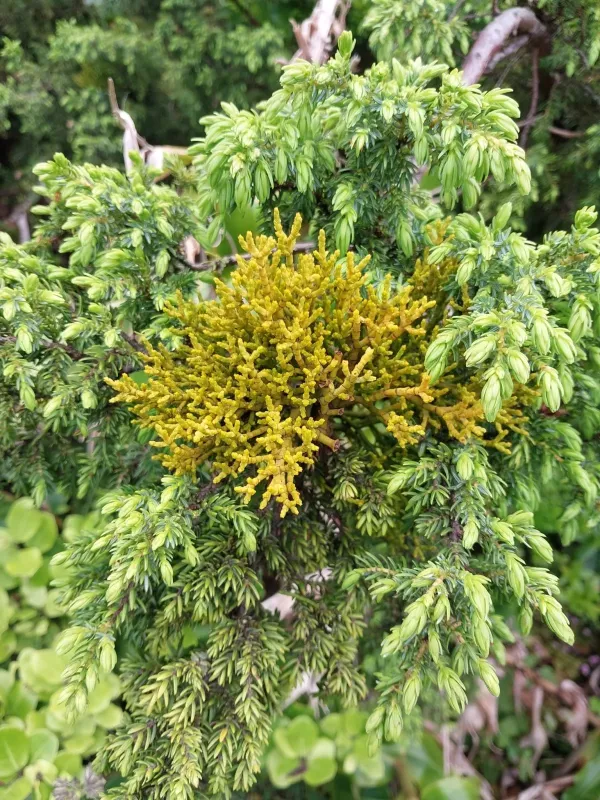
The Azorean dwarf mistletoe (Arceuthobium azoricum) is a rare parasitic plant belonging to the Santalaceae family. Unlike standard agricultural crops, it is a botanical specialist that survives exclusively by parasitizing the branches of specific native trees, playing a complex role in the island's ecosystem.
The species is endemic to the Azores archipelago, which defines its highly localized distribution. It thrives in the specific maritime climate of the islands, characterized by persistent moisture, frequent fog, and moderate temperatures that prevent the desiccation of the plant.
The host tree of choice for this parasite is Juniperus brevifolia, a native juniper species. The mistletoe penetrates the bark of the host with its specialized root-like structures, called haustoria, to absorb water and essential nutrients directly from the juniper's vascular system.
Botanically, it is highly reduced, with scale-like leaves and minimal chlorophyll content, as most of its metabolic needs are satisfied by the host. The plant forms small, localized clusters on the juniper branches, which are often the only visible signs of its presence in the forest canopy.
Reproduction occurs via explosive fruit dispersal, which launches seeds onto nearby branches. This mechanism is highly efficient for spreading within a single host tree canopy but limits the long-distance colonization of new trees, contributing to the species' restricted geographical range.
Main diseases and pests
The primary threat to the survival of the Azorean dwarf mistletoe is the loss and fragmentation of its host's habitat. As the native Juniperus brevifolia forests decrease due to land-use changes, the mistletoe populations inevitably decline in tandem with their hosts.
Invasive species represent a significant threat to the ecological integrity of the Azores. Competitive pressure from introduced plants can alter the forest structure, making it harder for the specialized juniper-mistletoe relationship to persist in its traditional niches.
Climate change poses a long-term risk to this species, as it is highly adapted to the stable, moisture-rich environment of the Azorean high altitudes. Any shift in humidity or temperature patterns could exceed the physiological tolerance of this vulnerable parasitic plant.
Diseases that affect the juniper host represent a major risk, as they compromise the physical integrity of the tree branches where the mistletoe is anchored. Pathogens that induce branch necrosis can physically disconnect the parasite from its nutrient source.
Conservation status for Arceuthobium azoricum is largely tied to habitat protection initiatives. Efforts to restore native juniper forests are essential to ensure that this unique component of the Azorean biodiversity does not face extinction in the coming decades.