
Arceuthobium gambyi
Arceuthobium gambyi
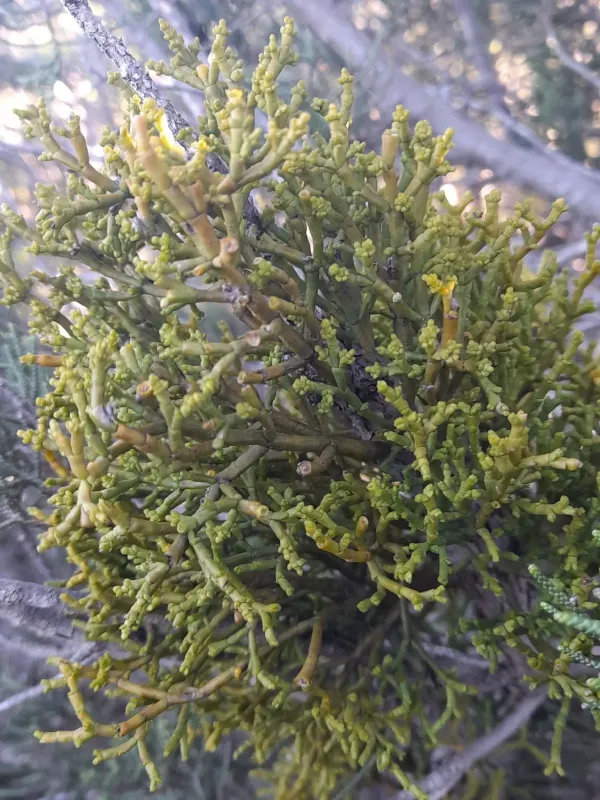
Description
Growing requirements
Arceuthobium gambyi belongs to the Santalaceae family and is a specialized parasitic plant. It is not an agricultural crop but rather a wild forest parasite that depends entirely on host trees for survival.
The plant lacks chlorophyll and traditional roots. Instead, it utilizes specialized structures called haustoria to penetrate the bark and connect to the xylem of the host, extracting essential water and nutrients.
Its natural distribution is dictated by the presence of specific host species. The plant thrives in environments with high humidity and favorable temperatures, which are essential for the germination of its sticky, explosive seeds.
Regarding its botanical structure, the organism remains largely endophytically hidden within the host tree. Only the reproductive shoots emerge periodically on the surface to facilitate seed dispersal and reproduction.
There is no economic cultivation of this plant. It is widely considered a pest in forest management due to its negative impact on the health and development of its host trees, which are often of commercial timber value.
Main diseases and pests
The primary threat posed by Arceuthobium gambyi is the weakening of host trees. Heavy infestations can lead to stunted growth, distorted branches, and in extreme cases, the premature death of the tree.
Management techniques are focused on silvicultural control. This includes the removal of infected trees and branches to prevent the spread of the parasite to unaffected parts of the forest stand.
The explosive dispersal mechanism of the seeds creates a significant challenge for containment. Seeds can be propelled several meters, enabling the rapid colonization of adjacent host trees.
Secondary infections are common at the site of parasitism. The physical penetration of the host's tissues creates entry points for fungal pathogens, which further complicates the health of the timber.
Monitoring efforts remain the most effective strategy. Regular inspections and early detection of parasitic clusters are essential to maintain the productivity and ecological integrity of forested areas.