
Lodgepole pine dwarf mistletoe
Arceuthobium pini
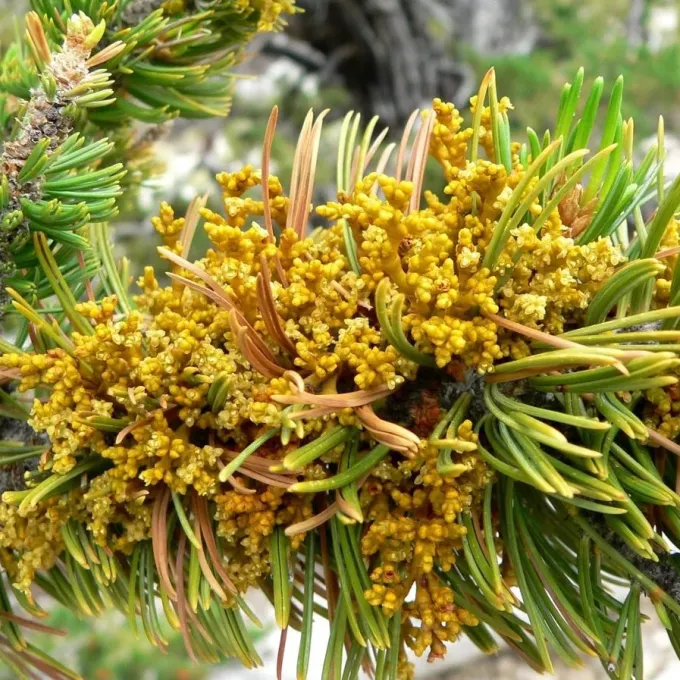
Description
Growing requirements
Lodgepole pine dwarf mistletoe (Arceuthobium pini) is a member of the Santalaceae family. It is a specialized parasitic plant that relies entirely on pine tree hosts for water and nutrients.
Native to North America, this species is well-adapted to the climatic conditions of coniferous forests, thriving where lodgepole pines are dominant.
The plant lacks chlorophyll in significant quantities and has a system of haustoria that penetrates the xylem and phloem of the host, establishing a permanent parasitic connection.
Environmental conditions that favor the host tree usually support the parasite, though it requires specific light conditions to bloom and complete its life cycle.
Unlike standard agricultural crops, it has no commercial value and is managed as a destructive agent within silvicultural management plans.
Main diseases and pests
The primary threat is the physiological decline of the host tree, leading to stunted growth, loss of timber quality, and potential mortality in heavily infested stands.
Deformation of the canopy, known as witches' brooms, occurs due to the parasite's influence on the host's hormonal signaling, disrupting normal growth patterns.
The parasite acts as a pathway for secondary infections by fungi and wood-boring insects, which further weaken the structural integrity of the pine trees.
Management involves silvicultural techniques, such as clear-cutting infested patches and maintaining non-host buffer zones to prevent further spread of seed.
Monitoring remains critical, as the rapid seed dispersal mechanism makes this parasite highly efficient at spreading across younger pine plantations.