
Arceuthobium blumeri
Arceuthobium blumeri
Description
Growing requirements
Arceuthobium blumeri is a parasitic plant belonging to the Santalaceae family. Unlike traditional agricultural crops, this species acts as a significant pathogen within its natural forest ecosystem, requiring management rather than cultivation.
The plant originates from the mountainous regions of the southwestern United States and northern Mexico. Its geographical distribution is restricted to areas where its primary host, Pinus strobiformis (southwestern white pine), is naturally established.
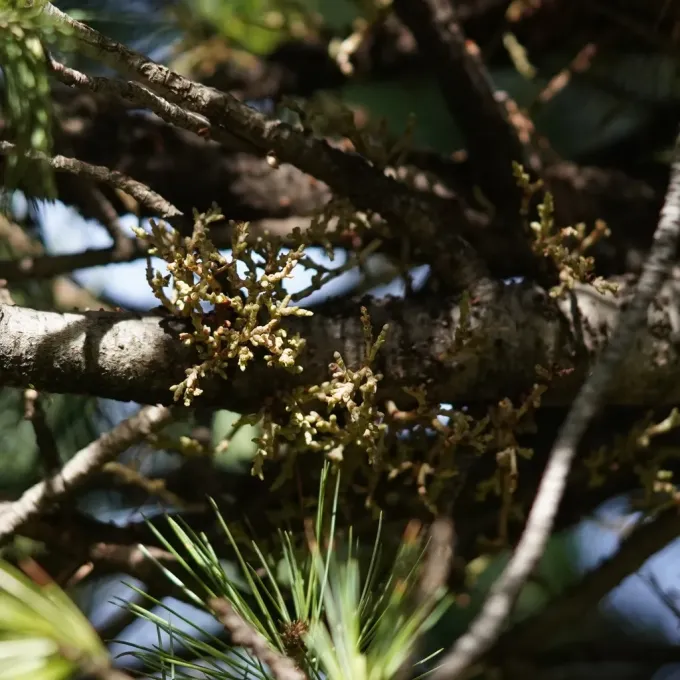
Botanically, it is a dwarf mistletoe characterized by tiny aerial shoots and a complex endophyte system. The plant lacks functional leaves, relying entirely on the host tree's xylem and phloem for water, minerals, and essential photosynthetic products.
Environmental requirements for Arceuthobium blumeri are closely linked to those of its host. It favors high-altitude coniferous forests with specific temperature and humidity profiles that facilitate the germination of seeds on the branches of susceptible trees.
Management techniques are focused on forest health and silviculture. Agricultural efforts regarding this species involve the early detection of infection in forest stands and the removal of heavily infested trees to reduce the inoculum pressure on younger, healthy growth.
Main diseases and pests
The primary threat posed by Arceuthobium blumeri is the physiological decline of the host tree. By intercepting nutrients and water, the parasite impairs the tree's health, leading to growth suppression and increased susceptibility to secondary forest pests.
Infection typically results in the formation of 'witches' brooms'—dense clusters of abnormally shaped branches. These structures act as nutrient sinks, significantly draining the host's vitality and reducing its commercial and ecological value.
The reproduction cycle is particularly aggressive due to the explosive discharge of seeds. This mechanism allows the parasite to spread quickly within a stand, making it a persistent challenge for forest managers and conservationists.
Key impacts and risks associated with this parasite include:
- Structural wood defects caused by tree deformation.
- Increased mortality rates in infected pine stands.
- Enhanced wildfire risks due to the accumulation of dry, dead branch clusters in the canopy.
Controlling the spread requires proactive forest management practices. Because the parasite's root-like system remains embedded within the host tissues, simple pruning of visible aerial parts is often insufficient, necessitating the removal of the entire infected limb or the tree itself.