
Juniper mistletoe
Arceuthobium oxycedri
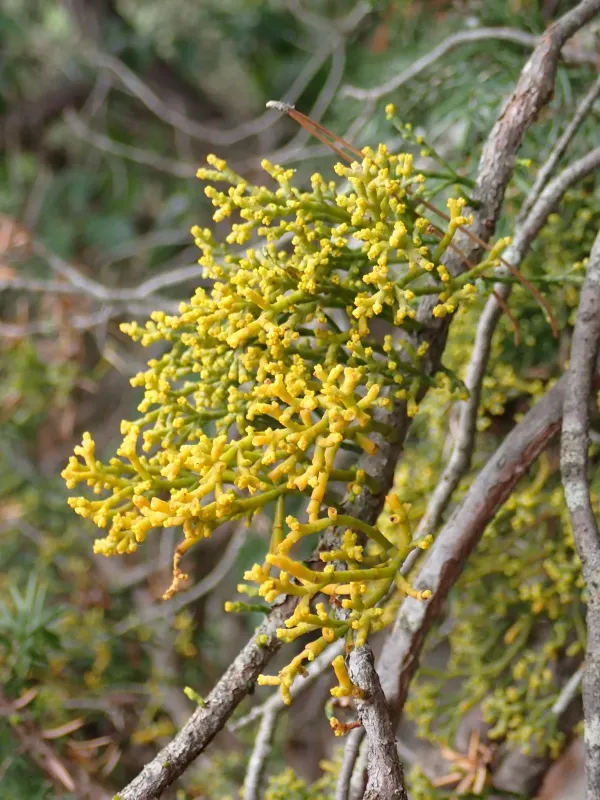
Description
Growing requirements
Juniper mistletoe (Arceuthobium oxycedri) is a perennial semi-parasitic plant belonging to the Santalaceae family. Unlike typical flora, it does not root in the soil but instead functions as an obligate stem parasite, targeting specifically the branches of juniper trees and other related Cupressaceae members.
Its natural range extends across the Mediterranean basin, the Caucasus, and parts of Central Asia. It thrives in xeric environments, such as dry rocky slopes and sparse forests, where high solar radiation and specific temperature ranges facilitate the growth of its specialized root system, known as endophytes.
Botanically, the plant is characterized by small, yellow-green or brownish segmented stems. It lacks significant photosynthetic activity in its adult stage and relies entirely on the host tree's vascular system to acquire water, minerals, and essential nutrients, which it extracts via haustoria embedded deep in the host's xylem.
The environmental requirements of this species are tightly linked to the ecology of the juniper tree. It requires warm, dry climates and prefers high-light exposures that are common in open woodland habitats. The plant is perfectly adapted to the biological cycles of the host, timing its reproductive stages with the host's active growth periods.
In terms of agricultural and forestry management, this plant is considered a serious pest rather than a crop. Management techniques are purely focused on control and eradication. These involve rigorous sanitation practices, including the pruning of infested branches and monitoring, to prevent the irreversible decline of the host juniper population.
Main diseases and pests
The primary threat caused by juniper mistletoe is the development of systemic physiological disturbances in the host tree. This often manifests as dense, distorted twig growth known as witches' brooms, which disrupts the tree's natural hormonal balance and nutrient transport.
Secondary infections pose a significant risk, as the physical damage caused by the parasite's haustoria provides entry points for various pathogenic fungi. These infections often kill the host tree much faster than the parasite would on its own by exhausting the tree's resources.
Dispersal mechanisms are highly efficient; the fruits develop internal pressure, ejecting seeds at high velocities to distances of several meters. This mechanism, combined with the sticky nature of the seeds, ensures that the parasite colonizes neighboring trees rapidly in dense forest stands.
Control strategies prioritize mechanical removal of infested foliage before the seeds mature. In commercial nursery settings, early detection and strict quarantine of incoming plant stock are vital to prevent the introduction of this parasite into healthy, protected juniper collections.
While some natural predators exist, they are rarely sufficient to suppress outbreaks in large areas. Therefore, integrated management programs emphasize maintaining forest health through thinning and promoting vigorous tree growth, which helps the trees resist the debilitating effects of the parasite.