
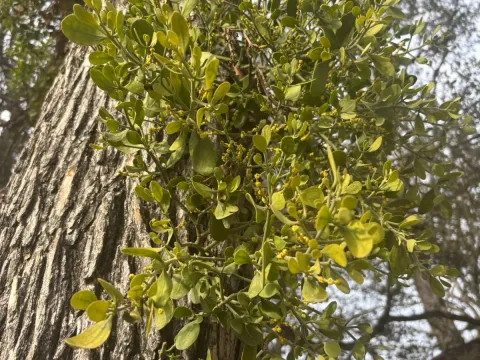
Phoradendron
Phoradendron
Phoradendron is a genus of evergreen hemiparasitic shrubs belonging to the Santalaceae family. Often referred to as American mistletoe, these plants are unique because they perform photosynthesis but rely on their host trees for water and dissolved mineral nutrients.
What the section contains
 American mistletoe
Phoradendron leucarpum
American mistletoe
Phoradendron leucarpum
 Dense mistletoe
Phoradendron macrophyllum
Dense mistletoe
Phoradendron macrophyllum
 Hairy Mistletoe
Phoradendron villosum
Hairy Phoradendron
Phoradendron tomentosum
Hairy Mistletoe
Phoradendron villosum
Hairy Phoradendron
Phoradendron tomentosum
 Juniper mistletoe
Phoradendron juniperum
Juniper mistletoe
Phoradendron juniperum
 Phoradendron bolleanum
Phoradendron bolleanum
Phoradendron bolleanum
 Phoradendron californicum
Phoradendron californicum
Phoradendron californicum
 Phoradendron capitallatum
Phoradendron capitallatum
Phoradendron capitallatum
 Phoradendron piperoides
Phoradendron piperoides
Phoradendron piperoides
 Phoradendron randiae
Phoradendron robustissimum
Phoradendron robustissimum
Phoradendron randiae
Phoradendron randiae
Phoradendron robustissimum
Phoradendron robustissimum
 Phoradendron rubrum
Phoradendron rubrum
Phoradendron rubrum
Phoradendron
The native distribution of this genus spans across the Americas, ranging from tropical regions to more temperate climates. They colonize a variety of host trees, thriving in environments that provide sufficient support and access to vascular tissues for their survival.
Botanically, Phoradendron attaches itself to the host tree through a specialized organ called a haustorium. This structure penetrates the tree's bark and xylem, effectively tapping into the host's resource supply to sustain its own physiological needs throughout the year.
The dispersal of the plant is primarily driven by avian vectors that consume the sticky berries and distribute seeds onto other branches. This mechanism ensures that the parasite can quickly establish itself across various segments of a forest or managed agricultural orchard.
From an agricultural management perspective, Phoradendron is considered a pest rather than a crop. The focus is primarily on population control, involving systematic inspections of tree health and the removal of parasitic clusters to prevent long-term damage to the host plant.
The primary threat posed by Phoradendron is the gradual debilitation of the host tree. By siphoning nutrients and water, the parasite significantly stunts the growth of the host, leading to reduced vitality and diminished crop yields in orchard settings.
Trees heavily infested with American mistletoe are more prone to environmental stress and secondary attacks by wood-boring insects. This creates a cascade effect where the host becomes vulnerable to further pathogens that can destroy its internal structure.
In managed landscapes, the presence of Phoradendron can lead to the death of specific limbs or even the entire tree if the infestation is not addressed promptly. This necessitates regular monitoring of branch architecture and the implementation of sanitation practices.
Managing this pest involves mechanical removal, which can be difficult in mature, tall trees. Agronomists emphasize that early intervention is key to stopping the cycle of berry production and limiting the potential for spreading the seeds to nearby healthy specimens.
The ecological relationship between the parasite and the host is complex, but in agricultural contexts, the focus remains strictly on mitigation. By maintaining tree vigor through proper fertilization and pruning, growers can occasionally reduce the attractiveness of the tree to new parasitic seeds.